Sign
my guestbook. View
my guestbook. ←Previous Next→ Paris Journal 2007 Home
|
.
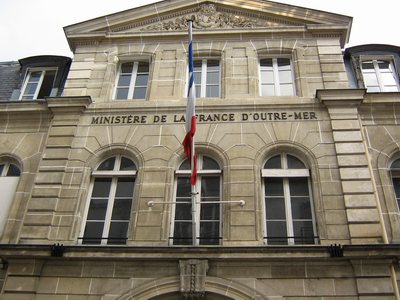
This is where Christian Estrosi,
also known as
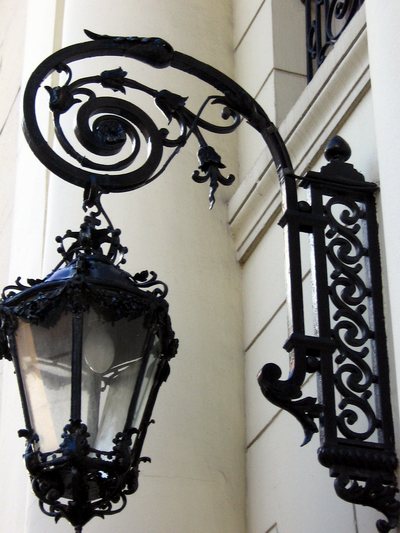
A lamp on the rue de Varenne,
not far from the Hotel François Fillon. Needless to say, there were many
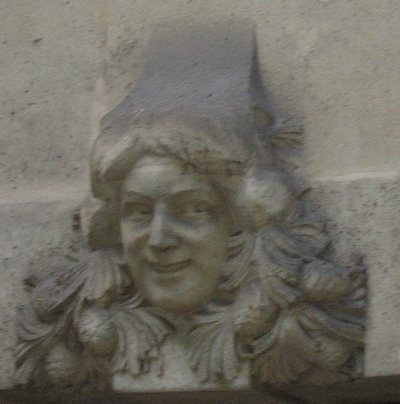
A smiling face on the avenue de
Suffren.
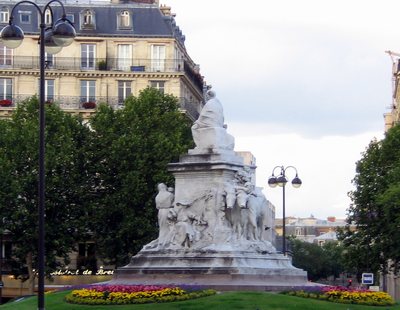
The monument at the Place
Breteuil in the 7th arr.
Miniature
orchids in a shop window on the rue de Varenne. |
Thursday, July 12 I forgot to
mention the rainbow! That day when we
enjoyed the damp solitude in the gardens of Parc André Citroën, when the rain
stopped, we turned, with the sun to our backs, and voila! We saw a rainbow, perfectly displayed
against a backdrop of distant, dark clouds.
The ironic part is that if we had stayed home, we could have seen most
of the rainbow from our balcony. But
with the tall buildings around the park, we just saw a couple sections. It was lovely. We work at the
computers every day, and near the end of the day we watch final minutes of
the day’s stage of the Tour de France.
Then we go out walking. Yesterday
evening’s walk was in the 7th arrondissement, and it included a
couple streets we have never walked on before! These were rue Éblé, and rue Oudinot. Rue Oudinot
was named for Nicolas
Charles Oudinot (1767-1847), the duc de Reggio and maréchal de France,
and rue Éblé was named for Jean-Baptiste
Éblé (1758-1812), a French general. I believe it
was on the rue Éblé that we saw the Ministere de la France D’Outre-Mer. Nicolas Sarkozy recently appointed
Christian Estrosi to head up this ministry.
According to Huw Richards in his June 21st International Herald Tribune
column, “Responsibility for the
overseas territories that are treated as part of France is in the hands of
the Sarkozy confidant Christian Estrosi, whose lack of a college degree and
past as a Grand Prix motorcyclist have earned him the nickname ‘motodidact.’” According to
Outre Mer’s web site, these territories that are treated as part of ·
La
·
La
Guyane ·
La
·
La
Réunion ·
Nouvelle
Calédonie ·
Polynésie
Française ·
·
St-Pierre
et ·
Wallis
et Futuna ·
TAAF
(Terres australes et antarctiques françaises). Speaking of I still think I would love to hear Sarkozy really try to justify his position
for nonrepentence in front of an audience of African and African-American
leaders. More locally,
there is an interesting story in the news about one of the homeless people of
our neighborhood in the 15th arrondissement. I’ve noticed her through the years, as I
would take my morning walk up rue Linois to the Allée aux Cygnes. I never tried to give her any coins because
she did not ask, and because I saw her yell at people who tried to talk to
her. I haven’t seen her yet this year,
and here is part of the reason. Evidently, the
people who work for the city of Her name is
Denise, and she is 65 years old, although she looks older. Her nickname is “Princess.” She had been living in the street on the
rue Linois for 25 years. She has many
suitcases, which she arranged as a sort of hut, with a tarp stretched over
the top during bad weather. It isn’t a
bad location, security-wise, because the neighborhood police station is very
nearby. She did not
beg. She did not accept money or the
offer of a room to sleep in. She would
accept a bottle of wine or cider, but not hot chocolate. If anyone tried to help her, she sent them
on their way. But somehow,
the helpers of the homeless got her to a shelter. There, when she refused to be separated
from her bags, her bags were searched.
In them, the workers found about €40,000! Longtime residents of the 15th
do recall seeing her in a bank, making withdrawals. The money was
put away for safekeeping. She left the
shelter. She reappeared later to claim
her suitcases. Then I guess she
decided to stay, at least until someone will return her baggage. This is a gigantic shelter called Chapsa,
not in the center of She refuses to
have any contact with the other residents of the shelter. She joins them for meals only, but just
looks away from anyone trying to make eye contact. She speaks very little, except to mention a
house that she owns in a village called Beg-Meil, in Her
brother-in-law is going to come from The newspaper
reporters located one of her estranged relatives in Finistère-sud, the part
of The mayor of
the 15th arrondissement, René Galy-Dejean, has known about Denise
for years. He has known that she is
not without means, and that she came from the One thing is
very clear: Now that everyone knows
she has money, she would be in grave danger if she tries to live on the
streets again. I hope her family is
successful in convincing her to return to Beg-Meil and to change her life. |