Paris Journal 2010 – Barbara Joy Cooley Home: barbarajoycooley.com
Photos
and thoughts about Paris
Sign
my guestbook. View
my guestbook. 2009 Paris Journal ← Previous Next → ← Go
back to the beginning
|
Yesterday, after working at the computers then watching the Tour de France, we went out aimlessly looking for dinner in the neighborhood. We wandered from place to place for about an hour, scanning the menus and trying to decide. Tom was very hungry, but decided he wasn’t quite hungry enough to go to Le Blavet yet. One must order all three courses there, and it is difficult for us to eat anywhere near that much these days. But we did wander past the place. Three of the staff were hanging around outside, on the sidewalk. One was a server at La Gauloise once upon a time, and so he recognized us and greeted us warmly. Fortunately, it was not yet dinner time – it was only 7:30 – so we were able to wander on without causing any hurt feelings. We ended up back at our regular “neighborhood pub,” the brasserie called Le Commerce Café at the corner of the rue du Commerce and the leafy Place du Commerce. To satisfy his appetite, Tom ordered the terrine appetizer, and it is indeed filling. Then he had the carpaccio of beef with a green salad and thin slices of Cantal cheese. This also comes with a side order of the excellent fries that this café does so well. At some point, I tasted the carpaccio. I don’t understand the interest that people have in this dish. It is so very bland. I had the veal scaloppini which was prepared very simply: grilled, then drizzled with some of its own juice and a bit of thyme. Add some salt and pepper, and it is perfect. I like it when veal is cooked properly, when it still has some tenderness and juice, and when it isn’t like shoe leather. I also had fries. I would love to know how they cook these fries at Le Commerce. They are obviously cut from the potatoes right there at the restaurant. They have a unique shape I haven’t seen elsewhere. They also seem to be baked, not fried. There seems to be just about no oil or grease involved at all. They always arrive at the table piping hot. At home, I had earlier prepared a tomato, diced and dressed with olive oil, balsamic vinager, and pesto, so I’d already consumed a salad. The major story on the first pages of Le Parisien yesterday was about the oil disaster in the Gulf of Mexico. The tone of the reporting is very sympathetic to the U.S., and somewhat anti-BP and anti-Britain. On the front page, the teaser for the story claims that the “Americans no longer hesitate to speak of the ecological Chernobyl” that this disaster has become. I haven’t seen that term in the American news yet, but perhaps it is being used. I have seen what my friend Linda Young has written on Facebook, about her friend who’s been out there in the area of the spill and speaks of the lack of life, and the smell of death. Included in the coverage is a sidebar that reports that the loss of capital due to the dramatic drop of BP stock amounts to nearly $100 billion. I had not seen that figure before. This affects lots of British pensioners, I understand. The sidebar also reports that the cost of the clean up and claims could be up to $70billion. I remember reading a Wall Street expert’s opinion earlier that stated that BP would not even begin to feel the pain, financially, until these costs reach $30 billion. Well, it looks like they will be feeling the pain. Le Parisien contains an interview with Philippe Cousteau, Jr., the grandson of the famous Jacques Cousteau and son of the famous Philippe Costeau, Sr.. Philippe Junior recently went diving right into the middle of the “marée noire,” or black tide, as they call the area of the spill in French. Philippe says, without doubt, that BP used the dispersants to mask the “marée noire.” “Like one says in the United States,” quips Philippe, “’out of sight, out of mind.’” He thinks that BP did not at all appreciate his diving into the dead zone and filming it so that people could see the enormous disaster beneath the surface. He knew it would be dangerous to dive into the toxic waters, but he says he was specially equipped and outfitted. He felt that he just had to do it, in memory of his father and grandfather. “If they were living,” he says, “they would certainly want to witness the subsurface impact of this catastrophe.” (Philippe has been known to say “It takes more than a birth certificate to be a Cousteau.”) Philippe had a horrible sensation down there. He was surrounded by a sort of toxic cloud, a chemical soup that was red in color, a mix of oil and the dispersants. There were dead fish around him. Being there permitted him to show that the hydrocarbons are not concentrated uniquely on the surface, but they are spread through the depths. The government agencies allowed the use of the dispersants, Philippe claims, to slow the arrival of the oil on the beaches. Philippe believes that in the marshes of Louisiana where the oil has infiltrated, there are thousands of creatures already dead. In the autumn, when lots of migratory birds normally take refuge in the mangroves, what’s going to happen to them, Philippe asks, and what will happen to the sea turtles who are in the process of reproducing? When asked about the economic impact on people in the area, Philippe responds that they are suffering a lot, with 30 percent of the fishing zones forbidden and tourism gravely affected. “One sees plenty of small shops closed up due to lack of customers and some shopkeepers say they can no longer feed their families,” Philippe explains. “The only hotels and restaurants still open receive only journalists.” About the long-term impact, Philippe says, “Even if they could stop the leak tomorrow, this is already one of the worst ‘marées noires’ in history and the consequences will go on for decades. Twenty years after the Exxon Valdez, the fauna still has not entirely come back. There are hundreds of thousands of birds and fish eggs that have not survived the oil.” Philippe hopes that new rules and constraints will be imposed on the oil companies. But above all, the world must take consciousness of the cost of our dependence on petroleum, he says. “When one fills the tank, one doesn’t take measure of how many animals died and how many children become victims of asthma caused by pollutants. We’re in the process of killing ourselves. My only hope is education. I’ve seen plenty of young people ready to fight for saving the planet.” Merci, Philippe. I believe Philippe, who is only 30 years old, is both an American and a French citizen, and his organization, EarthEcho International, which he runs with his sister, is based in Washington, D.C. Note that the EarthEcho web site tells us that “Philippe Cousteau will appear on Spill: The Crisis in the Gulf on the Weather Channel on Friday, June 25; Saturday, June 26; and Sunday June 27 at 9:00pm EST and 1:00am EST.” This may be where his film/video of the subsurface disaster will be shown. Le Parisien also reports that the European Union is considering imposing a moratorium on deepwater drilling, like the one the Obama administration has implemented. On Wednesday, the EU Commission met with representatives of 20 oil companies who responded to a questionnaire on the state of their oil platforms. Sign
my guestbook. View
my guestbook. Note: For addresses & phone numbers of
restaurants in this journal, click
here. |
Saturday, July 17, 2010
The
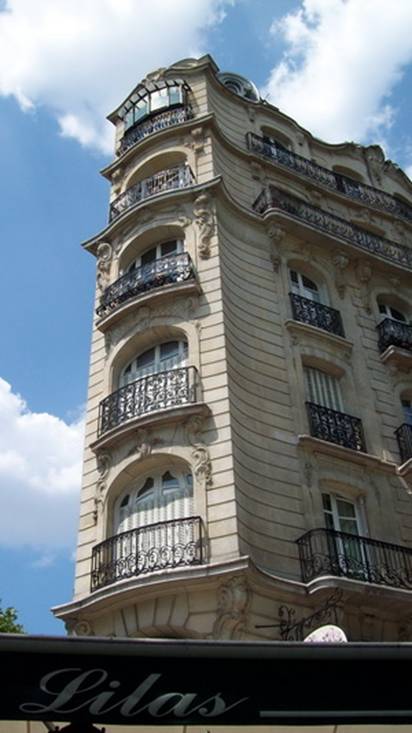
building that houses the historic Closerie
des Lilas, where Hemingway supposedly wrote The Sun
Also Rises.
A
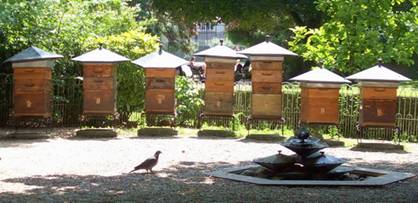
pigeon ramier
inspects the area where bees are kept in the Luxembourg Gardens. Two pigeons ramiers tried to nest in one of
the plants on our balcony. I
successfully dissuaded them by sticking five screwdrivers into the dirt in
the large pot they’d selected.
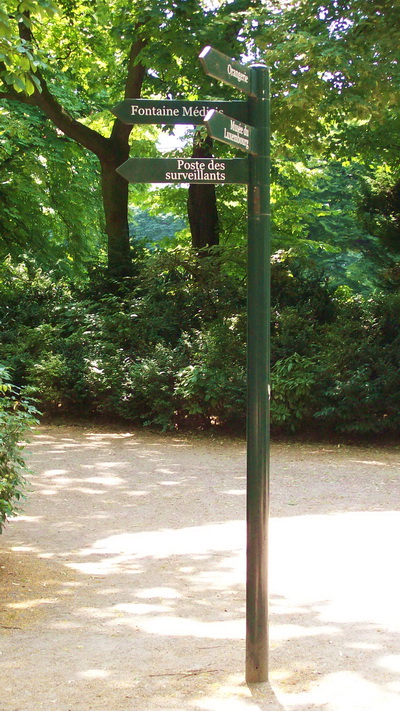
Directional
signs in the Luxembourg Gardens. |