Paris Journal 2011 – Barbara Joy Cooley Home: barbarajoycooley.com
Photos
and thoughts about Paris
Sign
my guestbook. View
my guestbook. 2010 Paris Journal ← Previous Next
→ ← Go
back to the beginning
|
When I first awoke today, Paris was enshrouded by fog. So I went back to bed. Now the fog has lifted a little, and it is raining. Again. Yesterday the temperatures never reached 70 degrees F. The cause, the French newspaper tells us, is an anti-cyclone stalled over the Azores. Back in 2003, during the deadly heat wave, the newspaper said the same thing – the cause of the horrible weather was an anti-cyclone stalled over the Azores. This is confusing, but I will accept it. After reading and writing, I roasted another pot of vegetables yesterday. We consumed them while watching the end of the Tour de France stage once again. Tom loves my roasted vegetables. I’m glad. The hot oven takes a bit of the edge off of the chilliness in the apartment. I cannot bear the thought of turning on the heat in the middle of summer. We walked in the gentle rain up the charming side-streets that parallel each side of the Champ de Mars, connected by the street that runs along at the base of the great Eiffel Tower. The side-streets are good for walking in the rain – the dirt in the Champ is mud on days like this; so the wide, almost unpeopled sidewalks of the side-streets are much more pleasant for walking and staying clean. These two streets, plus the one that connects them under the Tower, change names several times. It must have been impossible to give each of them just one name – there were too many great people to be honored by the developers. So we have avenue Émile Acollas and avenue Charles Floquet on the southwest side, and avenue Élisée Reclus, avenue Émile Deschanel, and avenue Frédéric Le Play on the northeast side. To connect them at the foot of the Eiffel Tower is one street, with three names, from southwest to northeast: avenue Octave Gréard, avenue Gustav Eiffel, and avenue Silvestre de Sacy. Who are all these people? Émile Acollas (1826-1891) was a jurist who was friends with Georges Clemenceau. He taught law to Saionji Kinmochi, a Japanese nobleman sent to Europe from 1870 to 1881 to prepare him for being the Prime Minister of his country. Charles Floquet (1828-1896) was a politician and lawyer who served several times as deputy (what we call congressman), prefect, senator, and president of the council of ministers for the government of France. Élisée Reclus (1830-1905) was a geographer and anarchist whose real name was Jacques Élisée Reclus. If you think his name is odd, consider that his brothers were named Onésime Reclus (also a geographer), and Élie Reclus (journalist). All three were the sons of Jacques Reclus, a Calvinist pastor and professor. No, there weren’t just three kids in this family – there were 17. Élisée’s dad wanted him to be a pastor, but it didn’t take. Élisée did, however, manage to learn several languages, including German, English, and Dutch and well as Latin. For most of his childhood, he was raised by his maternal grandparents and an aunt. After the coup d’etat of December 1851, Élisée and Elie publicly demonstrated their hostility over the course of events. Threatened with arrest, they left for London and then lived a miserly existence as exiles in several places in Britain. Then Élisée went to New Orleans, in 1853. He became a tutor for three kids in a plantation family, and there became aware of the horrors of slavery. His vacations he spent in Mississippi and Chicago. Finally unable to put up with living in a slave-owning family, he went to Columbia to create a coffee plantation, which failed. Returning to France in 1857, he stayed with Elie in Paris and joined the Society for Geography. In the 1870 siege of Paris, Reclus was serving in the National Guard. However, he published a manifesto against the government of Versailles and in support of the Paris Commune, and so was taken prisoner. His sentence was perpetual banishment from France. The rebel Reclus settled in Switzerland and produced several books of geography. Then in 1882, he started the Anti-Marriage Movement and allowed his two daughters to marry without any ceremony, religious or civil. Embarrassment ensued amongst Reclus’ supporters. The French High Court prosecuted the members of the anarchist organization that Reclus belonged to, but he escaped punishment by staying in Switzerland. He was given a chaired professorship in geography at the University of Brussels in 1894, so he was in Belgium when he died. Why did such a rebel have a street named after him in such a prestigious location? His scientific work was greatly admired, and he was a conservationist as well as a vegetarian. Many see him as an early animal rights advocate and social ecologist. Like Acollas and Floquet, Émile Deschanel (1819-1904) was a politician. He was also the father of Paul Deschanel, the 11th president of the French Republic. And he was an author, one of whose works (Catholicism and Socialism, 1850) got him exiled by Napoleon III for about 8 years. Frédéric Le Play (1806-1882) was really named Pierre Guillaume Frédéric Le Play. He was an engineer, economist, and sociologist. Napoleon III liked him well enough to give him responsibility for the Exhibitions of 1855 and 1867. An atheist for most of his life, Le Play converted to Catholicism in 1879. Octave Gréard (1828-1904) was a teacher who was known for establishing schools for girls. We all know who Gustav Eiffel (1832-1923) was. But did you know that he was born in France, in Dijon, with the last name of Bönickhausen? The name was changed to Eiffel from Eifel, a name given to a German ancestor when he emigrated from the German Eifel region to France. I believe that one reason for Eiffel’s success as an engineer is that he was well educated in both the humanities and the sciences. Silvestre de Sacy (1758-1838) was really named Antoine Isaac, Baron Silvestre de Sacy. You’ll note that he lived in an earlier time from all the others described above. Sacy was a linguist and orientalist. His father was Abraham Silvestre, of a Parisian Jewish family. Silvestre adopted the “de Sacy” as a way of adding status to his name, as many of the bourgeoisie tended to do at the time. He became the commissary-general of the cour des monnaies, which regulated coin-making. He also studied Semitic languages, eventually becoming a professor of Arabic and Persian at the École speciale des langues orientales vivantes. He was prolific, with more than 1,000 written works in more than 1,000 publications, written in 16 languages. Wow. (Source: fr.wikipedia.org and en.wikipedia.org) Sign
my guestbook. View
my guestbook. Note: For addresses & phone numbers of
restaurants in this journal, click
here. |
Thursday, July 21, 2011
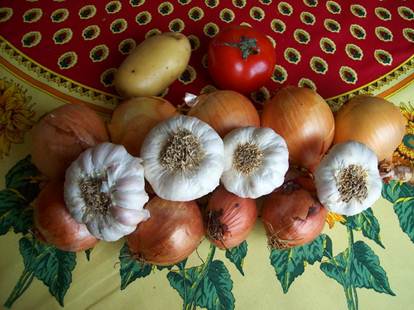
Some of the
ingredients for my roasted vegetables.
I also included some big white mushrooms not shown here.
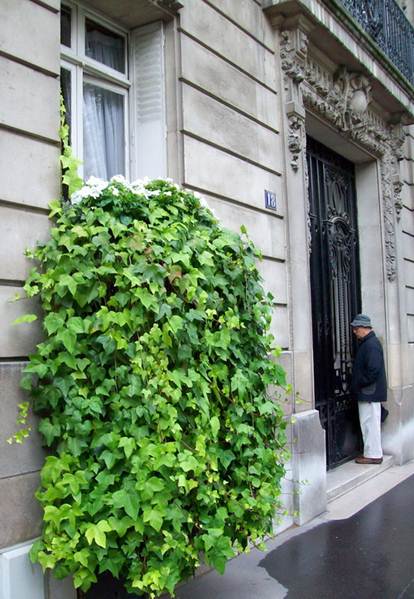
The ivy
grows thickly as Tom peers into a doorway on the avenue Charles Floquet.
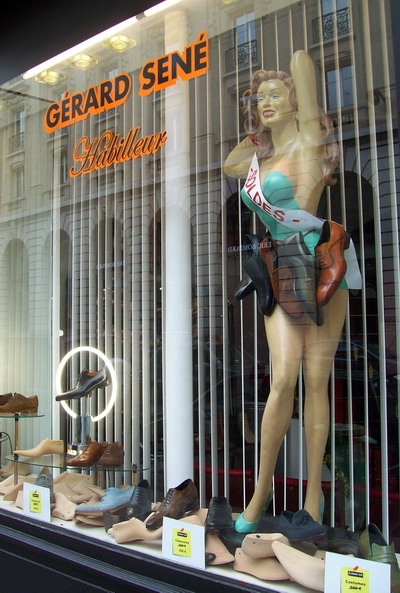
A men’s
shoe store on the rue de l’Universite.
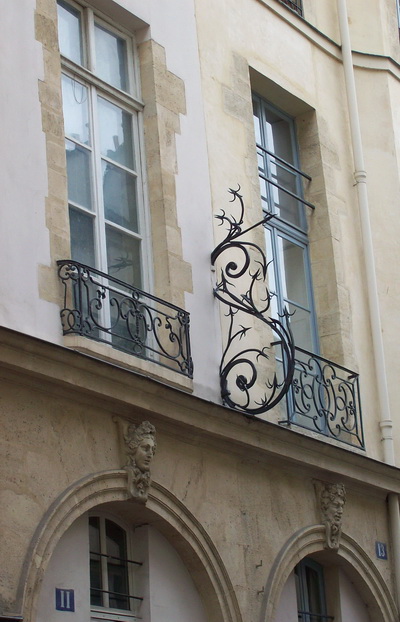
Building
decoration on the rue Jacob.
|