Paris Journal 2008
Sign
my guestbook. View
my guestbook. ←Previous Next
→ Barbara’s
home page
|
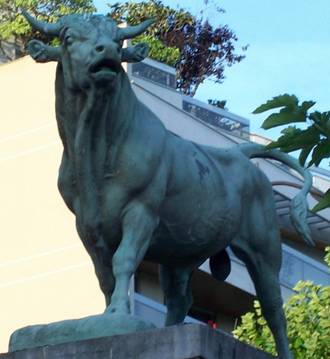
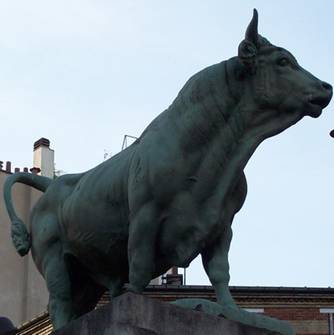
Today’s entry will be late because I’ve been spending many hours putting together the August issue of the newsletter for the Zonta Club of Sanibel-Captiva. The park where we listened to wild, wonderful African rock the other evening is on the site of the former Vaugirard slaughterhouse. So the entrance is graced by two great big cow statues. The cows look rightfully worried. Georges Brassens (1921-81), for whom the park is named, lived very near the slaughterhouse. Generally, slaughterhouses do a good job of lowering real estate values, so I think it is safe to say Georges did not live in the best part of town at that time. Georges was a poet, most famous for his song lyrics. During World War II, the Germans forced Georges to work at a labor camp making BMWs. He got a leave, and decided not to go back to the camp. Instead, he hid out in this slum near the slaughterhouse. The war ended only five months later, but for some reason, Georges stayed in the slum for 22 years. He lived with the building’s owner and her husband, in severe poverty, without water, gas, or electricity. Here’s a web site where you can listen to one of Georges’ songs, “The Wind,” written in 1954. Yesterday was not too exciting; I had to do some cleaning at the other apartment (in the 6th arrondissement), and I walked all the way home in the afternoon heat. Today, it is about 93 degrees F out there. No, there is no air conditioning here. Last night, I finally had the chance to watch “La Carte aux Tresors.” The show this week featured the Drome region, in Provence. In addition to being able to work on my French listening comprehension, I learned about the raising and finding of black truffles; a chateau where a Calvinist minister lived in the 16th century but that is now just a few rocks scattered on the ground and the remnants of the bottom of a big cistern with breathtaking views; a town where the water scarcity problem was solved with the installation of ten public fountains in medieval times; and the raising of aromatic plants for medicinal and cosmetic purposes. The best part is all the spectacular scenery, much of it from the point of view of a helicopter. You see, now that the Tour de France is over, I need to watch other French TV to keep working on improving my listening comprehension of this difficult language. So, the other night, I watched “Batman Begins,” the American movie that came out in 2004, but I watched it in French. I had not seen it in English, so this was very interesting. Now I’m all ready for the new Batman movie. The French word for “bat,” by the way, is “chauve-souris,” which means “bald mouse.” A bald mouse seems even more unlikely for a superhero than a bat. I just learned from the newspaper here that two of the TV stations, M6 and Arte sur Arte, broadcast their shows via the internet, one week after they’ve been aired. I wonder if one can watch these from the U.S.? Or are these only accessible from France? The web sites are www.m6replay.fr and http://plus7.arte.tv . Would anyone care to check this out and let me know if you can watch this French TV from the states? I know it is possible to watch the news shows from France 2 and France 3 on the internet in the U.S., but let’s face it, the news can be pretty boring. And dialogue is much better for improving listening comprehension. Thinking of Batman of course makes me think of Catwoman. Where would she be without those wonderful claws? Early in July, I read a story in the newspaper here about a veterinarian who was in deep trouble with the law for a number of reasons. One of the reasons given is that he was declawing cats. Could it be that declawing cats is illegal here? Today I finally did some investigating on the internet. Evidently, there was a “European Convention for the protection of Companion Animals” made in Strasbourg in 1987 and ratified by 16 European countries by 2003 that states that, “surgical interventions destined for the modification of appearance of a companion animal or other non-curative purposes are forbidden, in particular the cutting of the tail, the cutting of the ears, the resection of the vocal cords, and the removal of claws and teeth.” Bridget Bardot is now trying to get Canada to adopt this rule, too. Not even one state in the U.S. has forbidden the declawing of cats. |
Thursday, July 31, 2008
Cow statues at the entrance to Parc Georges Brassens.
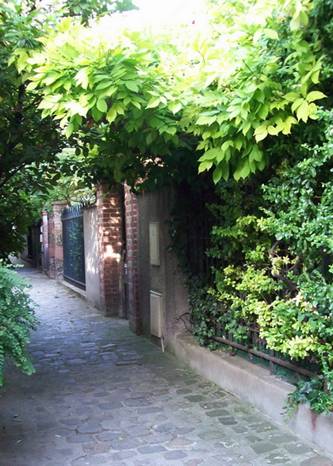
The Hameau d’Alleray, in the 15th
arrondissement, not far from Parc Georges Brassens. This is Paris at its most charming. Who wouldn’t want to live on this verdant
little street? This is no slum.
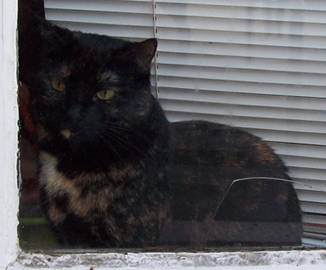
Parisian cat in a window. |