Paris Journal 2008
Sign
my guestbook. View
my guestbook. ←Previous Next
→ Barbara’s
home page
|
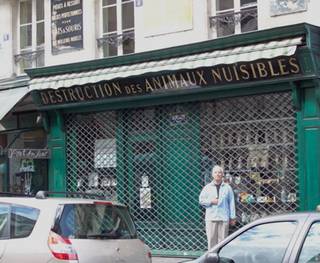
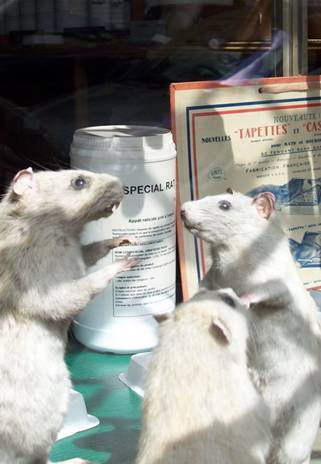
As I planned our walk for last Sunday, I was trying to remember the name of the street where the ‘dératisseur’ shop that inspired the makers of Ratatouille is located. We were passing through the area just south of Les Halles, and I was pretty sure that’s where the shop is supposed to be. I couldn’t remember the name of the street, except for the fact that the name is something simple. We reached the end of the rue St. Honore which led us directly into the rue des Halles, pointing us right at the Tour St. Jacques, our goal. Then I started thinking, how appropriate that a dératisseur would be located near Les Halles. Back when Les Halles was a massive wholesale market for almost every kind of food you can imagine, I’m sure it attracted all the rats you can imagine. Just Google the word and you will see that in France, a dératisseur is considered to be an artisan or craftsman. Protecting food from the rats is an art in France. This makes sense. At about the same moment that I realized that “rue des Halles” is just the kind of simple name that I was trying to remember, I looked up and across the street at an old-fashioned storefront where I saw the words “animaux nuisibles.” Aha! That was it! I found the dératisseur. Since it was Sunday, the security grill obscured the front window, so taking photos was a bit of a challenge, but I did my best. Here you have them, at right. Those who saw Ratatouille know that this is the place where Émile’s father supposedly took him to show him why he should not trust humans. One of the technical guys (sound? light?) on the Ratatouille team at Pixar films grew up in Paris. As a kid, he and his friends liked to go stare in the window of the dératisseur shop near Les Halles. That’s how the shop ended up in the movie. Tom and I decided that rats in Paris really aren’t white like these. These stuffed rats have been in the display window for so long that the pigment in their fur must have bleached out. There were a couple of young French tourists at the shop window just before us. The young man had a little pamphlet that included a blurb about the shop. I believe this pamphlet may be one that the City of Paris has created to promote tourism. The City often makes up walking tours for tourists to take to see the sights featured in popular movies. I know there was one for Ratatouille last year. Speaking of tourism, it is tres important in the Paris economy. In a big city, you’d think that other economic sectors would overshadow tourism. Not so in Paris, according to Saturday’s Le Parisien. Here’s some information from the article. 82 million tourists visited Paris in 2007. Paris has more tourists than any other city in the world. This is Tourism Week in the city. The purpose of Tourism Week? To improve the city’s reputation for welcoming tourists and to inform the public about the great economic importance of tourism. 150,000 people work in tourism in this city, including 85,000 in the restaurant business. The hotel business employs 35,000. The average stay in the city is only two or three nights. Many jobs in transportation or leisure businesses also depend on tourism. According to Jean-Bernard Bros, the adjunct mayor in charge of general revenue for the city, tourism generates €8 billion per year. One in every five jobs in Paris depends on tourism. What about business travel? The Paris officials call that “tourisme d’affaires,” as opposed to regular leisure travel, which is called “tourisme de loisirs.” So, business travel is included in these numbers. French tourists are the most numerous, followed by the Americans, the British, the Spanish, the Italians, and the Japanese. 2007 was considered to be a “year of grace” for tourism in Paris. In the coming years, a veritable tourism revolution is expected. Tourists from countries with emerging economies are expected to come in mass. This includes Brazilians, Russians, Indians, Chinese, and Mexicans. According to www.parisinfo.com, if tourism didn’t exist here: · The Eiffel Tower would have been dismantled, as originally planned · The price of public transport would be much higher · Orsay would nothing more than the name of a station · The great department stores would be 25 to 30% smaller · Café terraces would be half-empty · A pyramid would not have appeared in the middle of the Louvre · The Moulin Rouge would only be the name of a painting
I’m not sure if she counts as a tourist, but Ingrid Betancourt is still in town. On Sunday, she had lunch at the Marco Polo restaurant with her old chum from school days, Dominique de Villepin. Before lunch, they went to the St. Sulpice church to pray. Late in the evening, Ingrid went with her family to a service at Sacre Cœur, on Montmartre. On Bastille Day, she will receive the French Legion of Honor award from President Nicholas Sarkozy. Sometime soon, she will also visit the Pope. But she is saying that she wants to return to Colombia very soon, and she is still speaking of perhaps getting back into politics. Her popularity in Colombia is much, much higher now than it was when she was unsuccessfully campaigning for president when she was kidnapped more than six years ago. But President Uribe’s popularity is even higher now. His popularity at the moment is partially due to the successful rescue of the group of hostages that includes Ingrid. If I were her, I’d be tempted to stay in France. But her husband, Juan Carlos LeCompte, is Colombian. It will be interesting to see what this French-Colombian decides to do.
The Tour St. Jacques |
Tuesday, July 8, 2008
Tom, in front of the dératisseur shop.
The faded
sign above the window explains that Renard Blanc and E. Aurouze started the dératisseur
business here in 1878. The Aurouze
name is still on the shop.
There was
an entire row of these hanging across the top of the display window area.
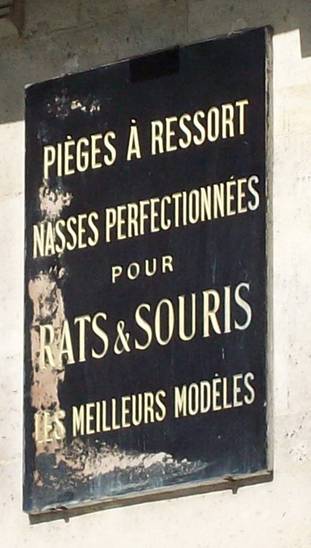
The shop sells only the best models of traps perfected
for catching rats and mice. Sign
my guestbook. View
my guestbook. |