Paris Journal 2011 – Barbara Joy Cooley Home: barbarajoycooley.com
Photos
and thoughts about Paris
Sign
my guestbook. View
my guestbook. 2010 Paris Journal ← Previous Next
→ ← Go
back to the beginning
|
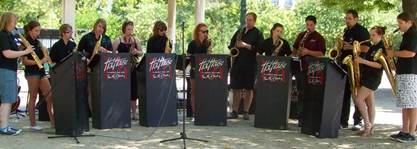
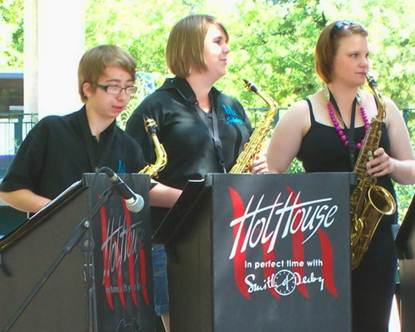
Sunday is Seine Day, and a brilliant Seine Day it was. Paris was a happening place. We began our walk by going through the Champ de Mars. As soon as we arrived there, we could hear saxophones playing Henry Mancini’s “Pink Panther.” Naturally, we gravitated to the sound. It was being made by a group called Hot House, from a British school. Twelve young people and their music teacher entertained us for several minutes, playing jazz and classical tunes. Then it was time for a gospel choir to perform. It was going to take them a while to set up, so we went on toward the left bank of the river. But first, Tom was hungry. We decided to have lunch at the outdoor café of the Quai Branly Museum, remembering some lovely lunches we’ve consumed there in the past. We did have to wait for a table in the shade, one that we
would not have to share. But it was
worth it. African chicken – poulet boucané – was on the menu
again, as I had remembered it well from the past. That’s what we both ordered. And we drank an entire big carafe of water,
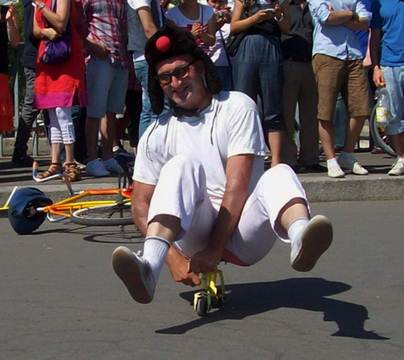
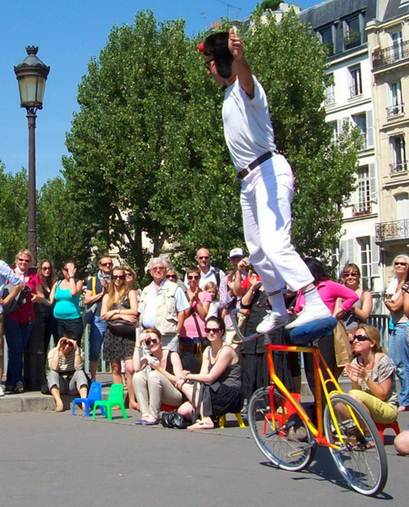
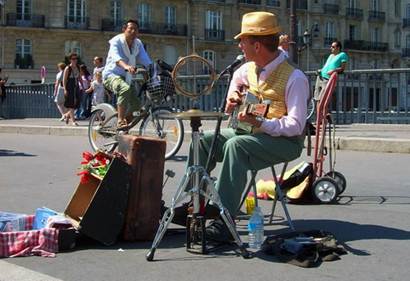
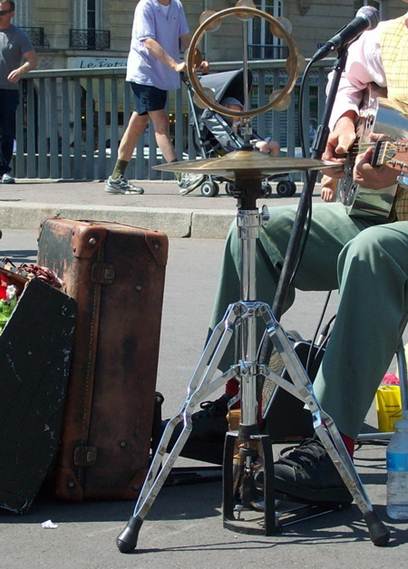
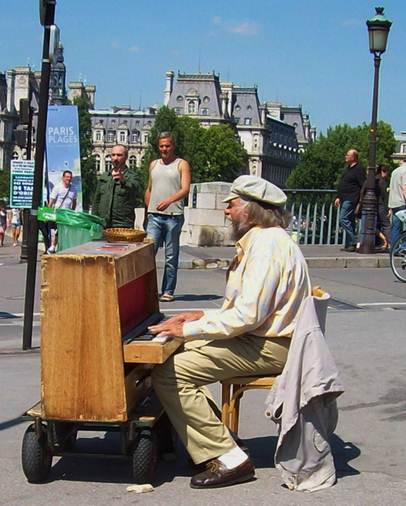
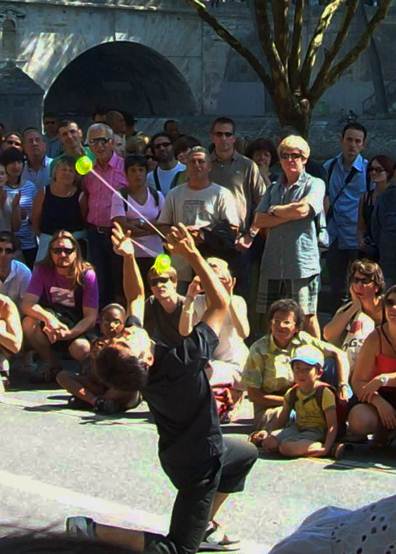
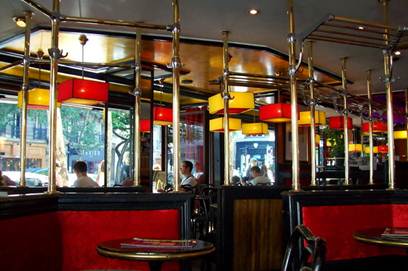
knowing that we needed to hydrate for what was to come. Tom has travelled in north Africa, and he said the dish served to us is authentic. I think it is very much like Basque chicken, from Spain. My only criticism of this café is that it serves a lot of people, but has inadequate restrooms. The entire museum is so well designed overall; I do not understand this deficiency at all. They need to have twice as many toilets, especially for the women. Maybe three times as many. Ah, details, details. But the food and service are good. Visitors are from all around the world, especially at this museum, and so the servers all speak a little English. A German couple in line in front of us was relying on English to communicate; but there was a breakdown. When the hostess told them they’d have to share the table that was available next, they agreed, but they didn’t intend to. They unhappily were seated with a weird couple who had bad table manners. I love the garden at this museum. The plantings remind me of my home in the Florida swamp. It is a beautiful space. Fortified, we continued our walk, taking the usual route along the highway closed to cars on the left bank, until it ended just past the Orsay Museum. There we had to ascend to the street level, but as soon as we could we went back down to the riverbank level to continue our walk, now on the cobblestones. I’ve decided that the only safe and sane footwear for walking on cobblestones is athletic shoes. Forget style. On summer Sundays, Paris becomes its most casual, so it doesn’t really matter. I wanted very much to see the bicycle clown who performs most Sundays on the Pont Saint Louis, the connector between the Île de la Cité and the Île Saint Louis. Before we got to the bridge, we saw an old character playing a keyboard on the sidewalk, across from the park at the rear of Notre Dame. It was just an electronic keyboard, but he had put it in some wood cabinet that he’d built at home, roughly, and he had the keyboard set to sound like a calliope or something similar. He was an accomplished player. We went onto the bridge, and there was a man playing Cajun music. His thick accent was authentic; he was a real American, from Louisiana (or maybe east Texas). He made no attempt to speak or sing in French, although he did perform one song in German: Bei mir bist du schoën. We actually aren’t sure whether he was singing it in the original Yiddish in which it was written (for Yiddish theater), or in German. The tune he used sounded like the original, not the popular later swing version performed by the Andrews Sisters. So I think it may have been Yiddish that he was singing. In Yiddish, the title of the song is בײַ מיר ביסטו שיין, or “Bay mir bistu sheyn.” But mostly he sang country Cajun, a precursor to rhythm and blues. He had a makeshift base drum made from a suitcase (a cajón) and a high-hat with tambourine fixed to the top of the stand. His grandmother did come from New Orleans, but I think his accent was more bayou country or perhaps northern Louisiana (or some parts of east Texas). He was fascinating. The bicycle clown that I wanted to see was waiting patiently on the curb nearby, with his many props. He seemed to be interested the Cajun country boy’s music, but finally it was time, so he got up and walked discreetly near the country boy. Country boy got the message, and so finished his act. Then bicycle clown began to set up the many props for his act, many of which are used to define the space he needs, keeping the passersby at bay. The setting up is done so comically that it becomes part of the act. He has very small, bright-colored plastic chairs that he sets up on each side of the performace space. He seats children and adults alike on these little things. He grabs strollers with toddlers in them, taking them away from their parents and then arranging the strollers, kids, and parents where he wants them on the perimeter of his performing space. If a child cries, he stops and makes them a balloon animal, and they always quit crying. For me, and some others, he brushed dust off of the curb and invited us to sit there. Tom stood right behind me – he doesn’t like to get down that low because it is too hard to get up again. As bicycle clown was clowning around, setting up his props, a few bicyclists went right through his space. He gave each one of them a pat on the butt, pretending to scold them. He was hilarious to watch, and his “show” had not yet even begun. He always selects an “assistant” from the audience. This has to be a young woman who does not speak French. That “requires” him to use his “English,” which he has turned into a comical act of its own. He pretends to speak it very badly, and he does it at a rapid pace. The effect is funny indeed. The show involves amazing acrobatic antics that he performs to circus music coming from a boom box. The antics involve a medium-size bicycle, and a miniature one. He makes me laugh so much. After his act, we walked only a dozen feet farther and then were faced with a young woman in a beret singing classic French songs beautifully. An enchanting chanteuse. We gave her our last coin. We must remember to take a whole pocketful of coins on Sunday walks like this. We give so many away. The Paris Beach event was happening (Paris Plages), and we haven’t visited any of it yet this year. So down we went to the right bank’s Voie Georges Pompidou, which has been taken away from the automobiles and given over to the people and many tons of sand and other beach “amenities.” To Sanibelians, this is a farce of a beach. But this “beach” is meant for people, not wildlife. Thousands and thousands of people were there. From a distance, from the Pont Saint Louis, for example, it did not look crowded. But when we went down into the thick of it, it was a mob. Thankfully, the authorities have banned the riding of bicycles through it – “for the security of all.” Bicyclists must walk their bikes through the crowd, and that is not an easy thing to do either. When a police boat cruised by, announcing that the riding of bicycles is forbidden at this part of Paris Plage, those of us who understood the announcement broke out into applause. There are street performers in this part of Paris Plage, too. The first one we saw was an amazing Yo-Yo artist, working two yo-yo’s and performing seemingly impossible acrobatic stunts at the same time. He was flawless. Tom was mesmerized. We paused briefly again to watch a dancer – a sort of mime performing vaudevillian dance. Cute, and handsome. By the time we reached Pont Neuf, we’d had it. I suggested we walk over to the quiet, calm Place Dauphine on the Île de la Cité and have “tea” at the Bar au Caveau. We’d done that a few Sundays ago, so I had every expectation that this place would be open for business. But it was not. So then I suggested that we go on over to the left bank, not far away, to the Nesle brasserie on rue Dauphine and rue de Nesle, which I also remembered being open on Summer Sundays. But alas, it was not open either. Oh, were we ever getting tired and thirsty! We went on through the slightly crowded 6th, stopping on the rue Gregoire de Tours to buy a newspaper at a news shop that I remembered being open on summer Sundays. Mercifully, it was open and had not yet sold out of Le Parisien. The brasseries near there, near the Carrefour de Buci, are too touristy for us. So we continued to the boulevard Saint Germain, thinking we’d just take the metro home to our calmer neighborhood. But then Tom remembered the Mondrian, one of our favorite brasseries because it is always open, it is colorful and congenial, and Tom can get breakfast there anytime, it seems. It is not too touristy. We sat out on its terrace, on the rue de Seine side, where there are many tables because they’re allowed to use part of the street there, which has been pedestrianized. The weather was gorgeous, so all the customers were outside. Inside, it was just the bartender and servers zipping in and out. Tom had a very nice café gourmand and we both shared a large bottle of cold San Pellegrino. I ordered a glass of cold white burgundy, too. We sat for some time to rest our bones and regain some strength from the refreshments. Finally, we were able to pay up, get up, thank our servers, and go on to the Mabillon station of the metro, where we at last went home to a quiet, calm evening. We’d had enough of the world, so I made a very American dinner using French ingredients and we dined at home (open-faced baked potato topped with a mixture of sautéed mushrooms, garlic, onion, and Merguez sausage meat, and melted blue cheese from the Auvergne). Sign
my guestbook. View
my guestbook. Note: For addresses & phone numbers of
restaurants in this journal, click
here. |
Monday, August 1, 2011
A saxophone
group from Hot
House – Derby, in the United Kingdom.
They performed on the Champ de Mars.
My favorite
bicycle clown.
The Cajun
country boy performing on the Pont Saint Louis. His rhythm section: a cajón, high-hat and
tambourine.
Keyboard
player between Notre Dame and the Pont Saint Louis.
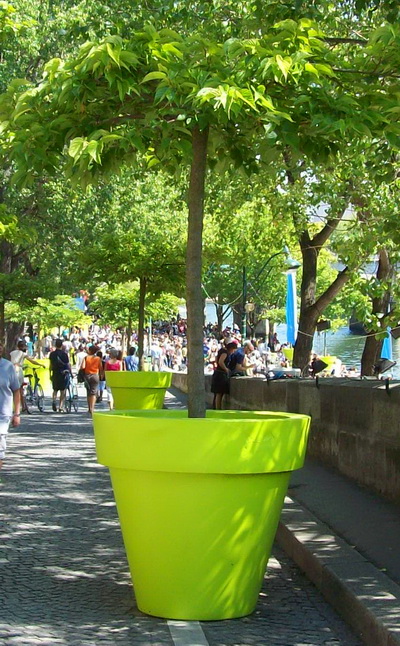
Some of the
many amenities brought in for the Paris Beach event are tropical trees in
huge, colorful pots.
The yo-yo
performing artist at Paris Plages.
The
colorful interior of the Mondrian brasserie. |