Paris Journal 2012 – Barbara Joy Cooley Home: barbarajoycooley.com
Find me on Facebook 2011
Paris Journal ← Previous Next
→ Go back to the beginning
|
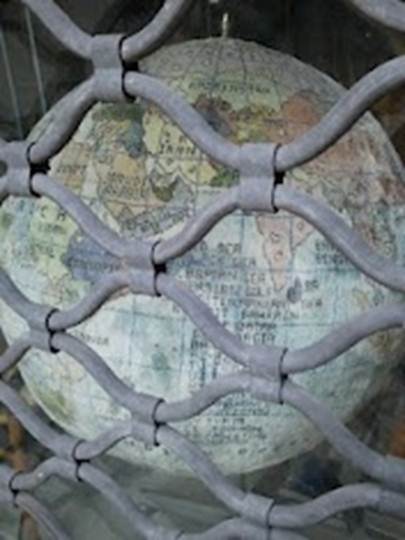
We met Sherry and Neal, another Sanibel couple, at La Gauloise for dinner last night. They’re staying at the Hotel Bonaparte, very near the Saint Sulpice church in the 6th arrondissement on the rue Bonaparte. This hotel is another example of one that has amenities that go beyond the requirements of its star rating. It is a two-star hotel, which means the rates are very reasonable for a fine location in a great city like Paris, yet it has “extras” like air conditioning, wifi, and small refrigerators in the rooms. Sherry and Neal seem to like the Hotel Bonaparte. Sherry asked the manager where the safe was in their room. He responded that the refrigerator is the safe, and he gave them a key for it. Now their passports are very cool. They’d just come into Paris from the south of France, where they’d stayed with other Sanibel friends, Maddy and Jim, on their houseboat/barge (péniche). Their Paris stay will be about a week or so, and so they’re going to see museums and the like. We told them about the Marmottan Museum because they are interested in the Impressionists’ paintings, and that’s the best place to see them. The Marmottan is not included in the popular 4-day Paris Museum Pass, so many people don’t go there. It is a little off the beaten path, over in the chic 16th arrondissement, near the Bois de Boulogne – but well worth the trip. We told them that for such a short stay, there are so many great things to do and see in Paris, that we don’t really recommend trying to fit in a visit to Versailles. That would be better to squeeze into a month-long visit, or perhaps on your third or fourth one-week visit to Paris. By the time you take the train out to Versailles and back, plus visit its extensive grounds as well as the chateau, you’ve killed an entire day. (There are far more interesting chateaux in France, such as those in the Loire Valley.) In a one-week stay, an entire day is a lot, and it is better spent on seeing things in Paris proper. Another museum we recommended to them (which was not on their list already) is the Cluny, also known as the medieval museum, on the boulevard Saint-Germain in the 5th arrondissement. It has the advantage of being not far from their hotel’s neighborhood, plus it is just so darned fascinating. And everyone simply must see the unicorn tapestries at the Cluny. We told them about the churches to see, in addition to Notre Dame, that are in that most historic part of Paris. Namely, in addition to Saint Germain des Pres and Saint Sulpice, we recommended seeing Saint Severin and the very, very old Saint Julien le Pauvre. Because Sherry and Neal are interested in horticulture, we also recommended the Jardin des Plantes, in addition to the exquisite and fascinating Luxembourg Gardens, which are only a very short walk from the Hotel Bonaparte. Of course they will be visiting the Louvre, too. You know, you could spend an entire week just seeing the Louvre – it is that big, and its collections are that extensive. Dinner at La Gauloise was good, but a certain flair seems to be missing there now. I wonder if they lost that great chef who was there? I think my dinner, in particular, was very good: I simply ordered a main course, the supreme de volaille which was served in a cocotte with delicious morel mushrooms and that wonderful jaune sauce. After dinner, we sat and talked for an hour. Then we realized that we could walk up to the Champ de Mars in time to see the Eiffel Tower twinkle, which it does on the hour, every hour after dark, for 5 minutes, up until 3AM or so. And so we did. We arrived at the edge of the Champ just as the twinkling started. It was so beautiful, as always. Earlier, we were a little early arriving in the neighborhood of La Gauloise before dinner, so we crossed the street to admire the oriental rugs in the window of the Ysmailoff shop at the Village Suisse on the avenue de la Motte-Picquet. This is one of the best oriental rug stores we’ve seen in Paris. It is sizeable, and the shop always has a little loom or two set up to show how the rugs are made. This time, we noticed a rug-covered globe, too, right next to one of these looms! I photographed the rug-globe with my smartphone, but the metal grid in front of the window is not beautiful, I know. Still, I thought this was pretty cool, to make and exhibit a hand-knotted oriental rug globe. Alas, we cannot buy any rugs from Iran, because it is again illegal to bring them into the U.S. There was a similar embargo from 1986 to 1999. It resulted in soaring prices of Persian rugs that were already in the U.S. because of that old supply-and-demand rule in economics. When that embargo was lifted, the U.S. market became flooded with Persian rugs that had been gathering dust in warehouses for years. New rugs also poured into the U.S. The prices went down. As part of the current U.S. economic sanctions against Iran, a new rug embargo went into effect on September 29, 2010. Of course, other products from Iran are also affected; pistachios and caviar, for example. The embargo means that American tourists cannot bring Persian rugs home with them, even if they were purchased in France instead of Iran. This cuts into the business of legitimate dealers such as Ysmailoff (who is also a professor at the École des Arts et Techniques). But there are shady dealers who will still sell Persian rugs to unwitting Americans, knowing that these customers cannot bring the rugs home legally. Beware! Ysmailoff is more than a dealer. This shop also specializes in the “artisanal” cleaning of fine rugs, as well as restoration and repair. While I adore Persian rugs, I am also a firm believer in the use of economic sanctions – they are far better than wars. I am sorry for the economic hardships they impose, but wars are so much worse. According to a French-language web site called labelstep.org, there are over 8 million people employed in the Iranian rug industry. The vast numbers of these people are in the most economically disadvantaged classes. Many are in rural areas, where work options are limited. Many are trying to preserve a very traditional way of life. The label STEP web site further points out that hand-made rugs were, historically, among the first kinds of merchandise to be globally commercialized – that they have a historic importance in economic and cultural relations between the East and the West, forming a cultural and symbolic bridge, and that they symbolize peaceful trade. Label STEP (a Swiss organization) also tries to claim that the embargo hurts small businesses selling Persian rugs in the U.S. If the last embargo (from 1986-1999) is indicative, this is not true. Persian rug prices soared in the U.S. during the 1990s. The embargo enables these small American businesses to increase their prices, due to decreased supply unable to meet continuing demand. Plus, there are many oriental rugs that are made elsewhere, not in Iran, to meet some of the demand. Rug makers outside of Iran benefit from the embargo, because the embargo eliminates competition from Iran in selling to the U.S. market. Is the demand great? Label STEP says that in 2009, the U.S. imported handmade rugs from Iran with a total value of $41 million. The U.S. has clearly stated that it is directing the sanctions against the Iranian government, not the Iranian people. Another web site, www.prestigecarpet.ca, informs us that in addition to the earlier U.S. embargo, during the 1990s the Iranian government itself also limited the number of handmade rugs that could leave the country every year. Surely that did not help the rug weavers in rural areas. |
Wednesday, August 1, 2012
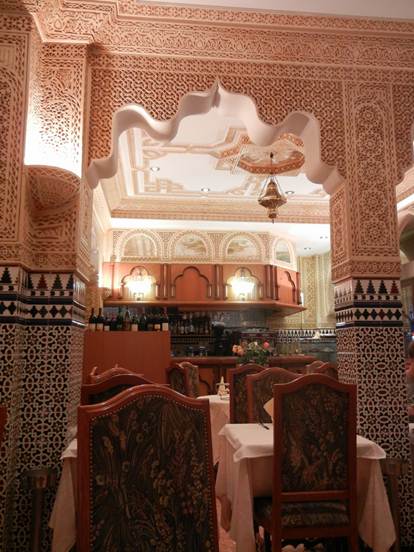
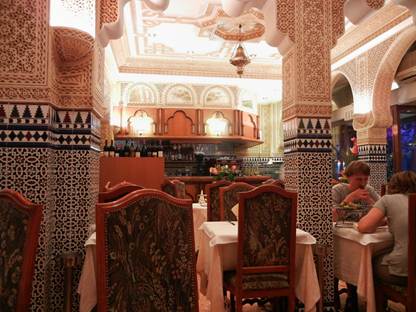
Interior
of Le Tipaza, the North African restaurant on the
avenue Emile Zola.
Globe
covered by a handmade rug, in the Ysmailoff shop
window on the avenue de la Motte-Picquet. |