Paris Journal 2013 – Barbara Joy Cooley Home: barbarajoycooley.com
Find me on Facebook 2012
Paris Journal ← Previous Next
→ Back to the Beginning
|
We stood in a tiny shop in
the Village Suisse with the shopkeeper, a tall, handsome man named Bernard
Lincot. There was barely room enough to
move in the space that was filled with paintings – some framed, and hung on
the wall; some framed, and leaning against each other in groups on the floor;
some unframed, but on stretchers, and some not framed at all, just piled up
in a stack. All of the paintings were
expensive; things in the Village Suisse generally are expensive. The Village, located on the avenue de la
Motte-Picquet, has an assortment of shops, most of which sell beautiful
antiques. Bernard, however, sells
only paintings. As we stood in this space,
which was the size of a small-to-medium size walk-in closet, we listened to
him tell his tale of woe about a pipe breaking, water damage, and the
insurance company not wanting to pay him any money this time. This was the fifth time the water line had
broken! Bernard is thinking that
perhaps it is time to find a new landlord. As frustrated as he was
about the situation, he was still extremely pleasant to talk to. He was fluent in English. He told us he learned his English from a
friend a long time ago, a friend from San Francisco, with whom he’d traveled
about in Europe. Did I say Bernard is
handsome? He has the physique of a
former athlete, probably a swimmer, I thought. We looked at just about
every painting in the place. There is
one that I like, and it is framed beautifully, but it costs 650 euros. I have to think about that. After today, Bernard goes
on vacation, and he’s going to think about what to do about his shop. Did I mention that Bernard
is handsome? So this morning, I
googled “Bernard
Lincot.” He’s an actor. No wonder he looked vaguely familiar. He’s had many, many small
parts in movies, on TV, and in short films.
He played the part of a “bagnard
costaud” (big, tough convict) in
the 1994 movie of Les Miserables. He had the lead role of Martin Luther in a
made-for-TV movie called Frere Martin. And yes, he is a former
swimmer. Bernard is handsome. But not as handsome as my husband Tom. Before visiting with
Bernard, we’d visited an 86-year old woman who was tending not only her own
shop, but also several others whose keepers were on vacation. She answered our questions
about the prices on a few paintings in one of the shops she was tending. Then she told us about herself. Her son lives in Miami, and
she lived for a time in Naples. She
must have lived in Chicago in the past, because she said her son was born
there. She told her son to buy her
a condo in Naples, and she’d stay. But
he said she’d be bored there, and that she should stay in Miami, near
him. But she thought she’d be bored in
Miami. Also, she thought she’d be
bored without a shop to keep. She likes the heat, and she
likes Paris in August, so she is one of the few present among her colleagues
at the Village. She was friendly and
helpful to us, so I think we will seek her out in the future when we go
there. And we will. I think antiquing in Paris is in our
future. Upon exiting the Village on
the avenue de Suffren, we turned toward the Seine. When we arrived at the quai, we squeezed
through the crowd at the corner; people are attracted to that spot by a
Sanisette (public toilet) and a kiosque that sells t-shirts and souveniers. When we were across the street
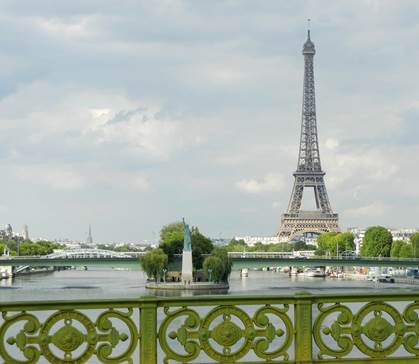
on the elevated walkway, we had space around us again, and that glorious view
of the river and the Eiffel Tower. We
had to squeeze through another crowd around the carroussel and food vendors
to reach the steps down to the riverbank, where we turned to the
southwest. That stretch of riverbank
by the Eiffel Tower is for tourist boats.
The paved area is broad, and so accommodates some inexpensive, outdoor
eating areas. After we walked for a while,
the space narrowed, the crowd was gone, and rough cobblestones were beneath
our feet. When we’d crossed under the
elegant, bi-level Pont de Bir Hakeim with its decorative hanging lamps, we
began to walk alongside peniches
that were tied up three abreast, for just about the entire length of the
space between that bridge and the Pont de Grenelle. We met another nice, long-haired
cat there. She was rolling around on
the cobblestones, waiting for some attention, which we gave her. She no doubt lives on one of the boats. She is well cared for, and she has odd
little ears that curl back at the tips. When we’d crossed under the
RER train bridge that bisects the Allée des Cygnes, I remembered that there
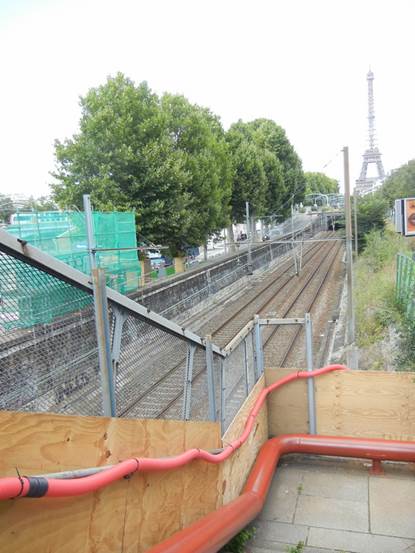
is some way to cross the train tracks there.
By crossing over the tracks, we could reach the Seine end of the rue
du Theatre, and we could avoid the awful Beaugrenelle construction zone. A bright yellow “pietons” (pedestrians) sign marked the
spot, but nobody in their right mind would go where it points unless, like us,
they’d been there before, and they knew that it really was a legitimate place
to cross. The steps there are shabby
with weeds poking through every crack, of which there are many. The rusted but pretty iron railing is
obscured by sections of plywood, hung there to support a tube that is
supplying water or some other liquid to the port area where the boats are
tied up. The effect of the plywood
and weeds is off-putting, but when we closely examined some of the weeds,
especially the bush-sized weeds, we found some pretty interesting things
growing there. My favorite was a type
of passion flower vine that had been plastered with big blooms, which were
now all past their prime. Knowing about and taking
this route over the train tracks that run along this section of the Seine
made us feel like bona fide urban
explorers. On to the next
little-visited site! I complain about the
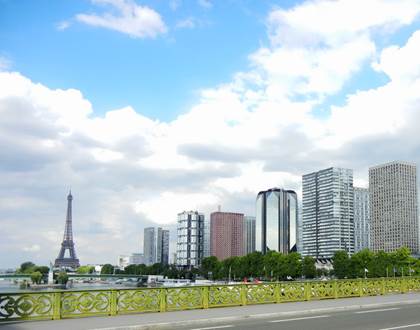
high-rises along the Front de Seine, and while it is true that I don’t think
they belong in Paris, I am now willing to admit that if they’re photographed
in just the right way, they can look good. Also, I know about the
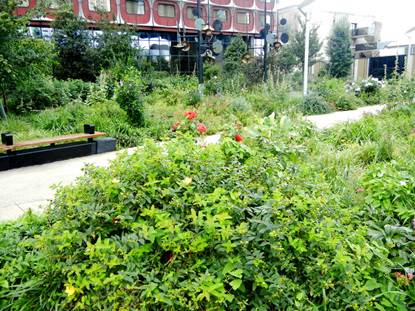
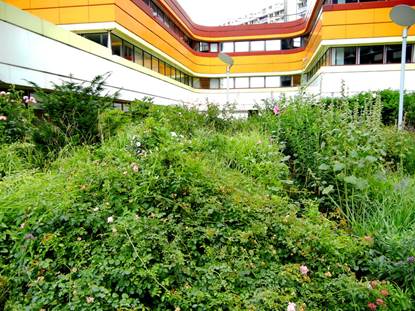
fabulous garden on the terrace that encircles a number of these high-rises,
one level up from the street level. After we’d crossed the
tracks and then crossed the road, we headed for the ramp and steps that are
hard to see, but present, between two entrances to dimly lit, grungy parking
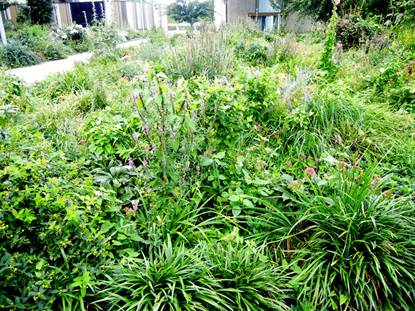
lots that exist under the elevated terrace. Suddenly, we were in that
quiet and beautiful place, surrounded by big flowerbeds bursting with
wildflowers. Where were the
people? Gone on vacation. We only saw a few Asian tots playing there;
a couple of them had cute little skateboards and they wore cute little
helmets. This terrace/garden is a
little confusing to navigate, but we knew there was a pedestrian bridge on
the far side that would take us over a street and into a neighborhood park
named Square Pablo Casals. We made our
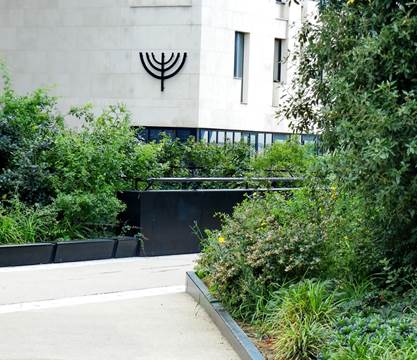
way around, past the software company, the bases of residential towers, a
Hotel Mercure, a synagogue or Jewish study center, a public gymnasium/indoor
swimming pool, tennis courts, and then, voila! There was the pedestrian bridge over the
rue Emeriau. This graceful, sweeping passerelle goes by a few majestically
tall spruces as it descends to the Square.
Pablo Casals, by the way, was a Catalan cellist of world renown. Reportedly, George Carlin
(the comedian) once said that when Casals was asked why he continued to
practice three hours a day at age 93, he responded, “I’m beginning to notice
some improvement.” He lived to age 96. We left the park and were
soon at the calm Place Charles Michels, where just about every business and
café were closed up for vacation. The
Feast of the Assumption on August 15 marks the peak of vacation time; even places
that don’t close for a month anymore, but only for a week, are closed this
week. After resting on a park
bench in the nearly deserted Place, we ambled on down the rue du Theatre
toward home. We passed the corner that
was once home to one of our past favorite restaurants, Le Bayadere, and
another bistro, Les Cigales. Both are
gone. Les Cigales is now a Lebanese
sandwich shop. I didn’t notice what is
now in the space that was La Bayadere.
(La bayadere is a fabric with colorful, horizontal stripes, named for
a type of Hindu dancer – la bayadere
– who used such fabric in her costume.
It is also the name of a ballet originally staged by French
choreographer Marius Petipa [The Temple
Dancer, in English]. The words
“ballet” and “bayadere” have the same etymological origin.) When we were just about
home, Tom suggested we do a little grocery shopping at Dia, the discount
grocery on our block, before going up for our pre-dinner repose at the
apartment. By the time we were home,
we’d been out walking for three hours.
When dinner time rolled around, we still felt that we’d ventured
enough for one day; off to the Chinese
carryout we went, which is not far. I finally tired of reading
nonfiction. The “biography” of Paris
by Professor Jones is one very long tome.
I’m up to World War I now, and decided to take a break last
night. I’m back to reading fiction
again: a novel by Paulita Kincer entitled The
Summer of France. Paulita is from
Columbus, where we lived for 30 years.
Small world. So far, so good, Paulita! |
Sunday, August 11, 2013
The
Front de Seine, as seen from Pont Mirabeau.
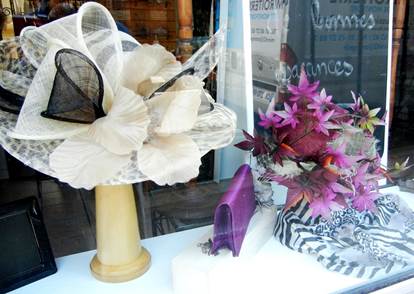
Hats
in a shop window in the 16th arrondissement.
Wildflower
beds in the garden on the elevated terrace of the Front de Seine.
The
not-so-beautiful way to cross the tracks to go from the Front de Seine to the
riverbank near the end of the rue du Theatre.
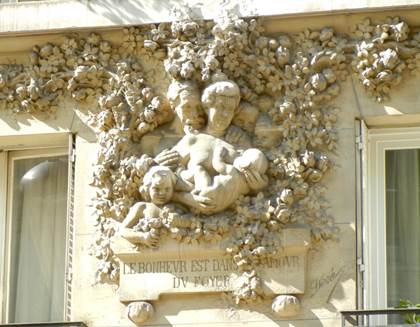
Happiness
is in the love of home. |