Paris Journal 2015 – Barbara Joy Cooley Home: barbarajoycooley.com
Find me on Facebook ←
Previous Next
→ << Back to the beginning
|
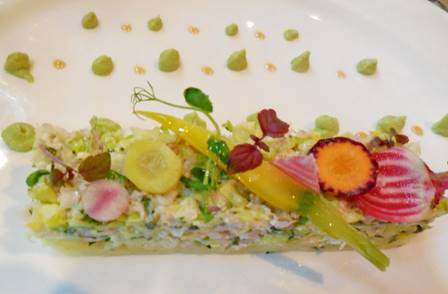
Blessed with another beautiful summer day, we decided to walk along the Petite Ceinture, at least as far as the old Vaugirard train station, and then to find a park that we haven’t seen before: the Jardin de l’Hopital Vaugirard. The Petite Ceinture is a former railway that has been turned into a greenway – a place for pedestrians to stroll, away from the automobile traffic and the hot pavement. The railway encircled the entire city, but is being turned into pedestrian park space piece by piece, neighborhood by neighborhood. “Our” section of the Petite Ceinture in the 15th arrondissement nearly connects the Parc André Citroën on the west and the Parc Georges Brassens on the east. It parallels the 15th arrondissement’s southern border. I’ve written about it in recent year’s Paris Journals, so today I’m just reporting that the Petite Ceinture in the 15th is still there, and it is doing well. As native plants continue to grow, the greenway is looking good, in a wild sort of way. One of the reasons I was particularly interested in walking there yesterday was to satisfy my curiosity about the latest Paris controversy: the Triangle. Have you heard of it? The Triangle is a modern skyscraper planned for this southerly part of the 15th arrondissement. It will be all glass, concrete, and steel, shaped like a tall triangle in wafer form. The Triangle will be oriented in a line that goes due north-south, so that it will minimize the shadow it casts on residential buildings to the north of it. The site is smack in the middle of the large Parc des Expositions convention complex that stretches between the boulevard Victor and the Peripherique, from the rue Desnouettes to the rue Olivier de Serres. Within the Parc des Expositions, the site of the Triangle, as far as I can tell, is basically next to where the avenue du E Martel is now located (at the Porte de Versailles). At nearly 600 feet tall (42 stories), the Triangle will loom over everything around it (click here to see images). But bear in mind, this is not an area with tiny, quaint little French buildings. We walked past lots of buildings built in the early part of the 20th Century that were 8 to 10 stories high. Some built in the mid-20th Century are even taller. Still, I’d have to say that the Triangle will not be in rhythm and harmony with its surroundings. It will be, as they say in architectural circles, a “cathedral building.” It will stand out – enormously. This will be the only enormously tall building constructed in Paris since the Montparnasse Tower in 1973. Parisians are still smarting over that spear plunged into the city’s heart. The Triangle is being designed to be energy efficient, and will supposedly produce four times less CO2 than a regular building of the same size. The architecture firm hired for the job is Herzog & de Meuron, the same Swiss agency that designed the “birds nest” Olympic stadium in Beijing. The Triangle is being constructed mainly for office space – something that Paris has in excess. There are also plans for a swimming pool, gardens, luxury boutiques, and a luxury hotel. But there are no plans for housing, which is something that Paris needs. A city-wide height restriction of 37 meters was imposed in the 70s, in the aftermath of the Tour Montparnasse (210 meters), but exceptions were made for areas like this, on the outer edges of the city. The intention of those exceptions, as I understood it, was to provide for more subsidized housing. (Even on Sanibel Island, we exempt below-market-rate housing from density restrictions.) Tom and I think it will take years to build the Triangle. Construction started in 2014. We turned away from the Petite Ceinture at the old Vaugirard train station, leaving the site of the Triangle behind us. As we began our short trek up the rue de Vaugirard, we detoured a bit on the rue Lacretelle to see the handsome façade of the old Hôpital Vaugirard, which is now the site of the University of Paris II’s Physical Education school. Returning to the rue de Vaugirard, we continued alongside the old hospital wall to the place where it finally stopped – at the gateway to the Jardin de l’Hopital de Vaugirard. The French Wikipedia says that “in the 17th Century, this terrain was occupied by the gardens of country homes along the rue de Vaugirard. The most important of these gardens was that of the lieutenant general of the police, Nicolas de La Reynie, created by André Le Nôtre. The land later belonged to a former college of the Jesuits.” In 1994, the Jardin was established as a nice, shady neighborhood park on a steep slope, leading from the rue de Vaugirard to the rue Vaugelas. We left the Jardin de l’Hopital de Vaugirard to walk over to another fine neighborhood park, the Square Desnouettes Clos Feuquières. This park is on the grounds of the property once owned by the Marquis de Feuquières. The simple walk home up the rue de la Croix Nivert, with a diversion on the rue des Frères Morane, was far shorter than the walk down to and along the Petite Ceinture. We were ready for a rest when we reached the rue du Theatre, but decided to forge on to the discount grocery, because we needed a few things. Finally, the pantry was stocked and we had a little time for rest and reading before dinner at Le Pario. At Le Pario, we know we will never be given too much food. Tom doesn’t need to sneak a ZipLoc bag into and out of that resto. Servings are small, and artfully arranged. We started with a mis en bouche of soothing, cool white bean soup. A small dish of butter arrived when the bread basket came. This, we decided, must be the Brazilian side of Le Pario; Parisian restos usually do not provide butter for the bread (unless you ask for it). Then came a shared starter course of crabmeat and veggies. It was pretty, fresh, and light.
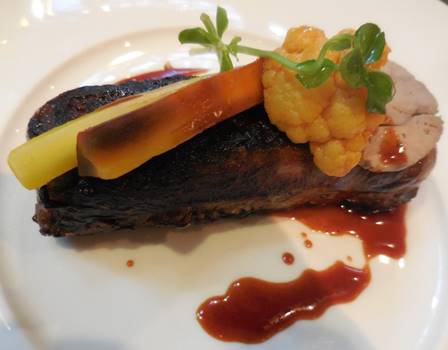
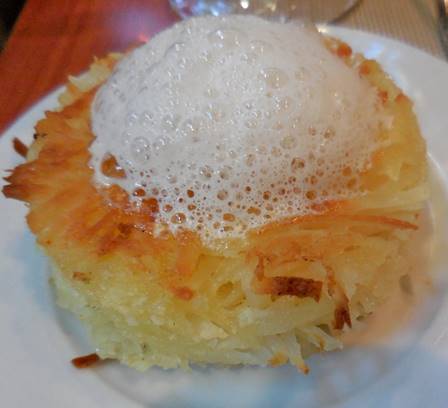
I decided to have the pressé de viande du soleil again (beef brisket with a tiny slice of foie gras and a few veggies). It came with a side of shredded potato-and-coconut cake with a frothy coconut sauce. Yumm.
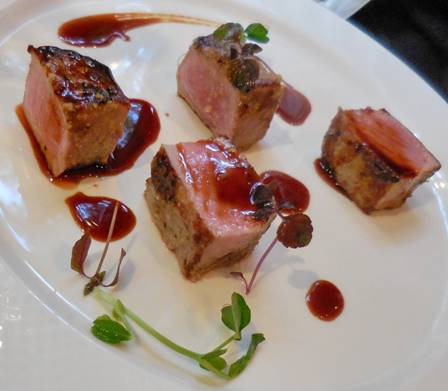
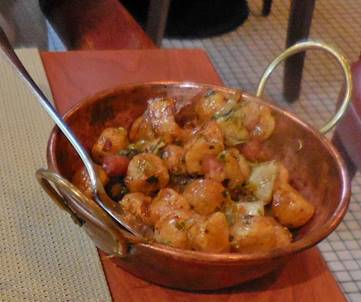
Tom had four chunks of veal chop, and a little dish of tiny round potatoes.
We shared the lovely cherry sablé for dessert. Le Pario’s sound system was playing very appropriate and beautiful music by Brazilian composers like Antonio Carlos Jobim. At home, we turned on the tunes of Miles Davis, and watered the thirsty plants on the balcony. Then the plants and we could sigh, and relax. |
Tuesday, August 11, 2015
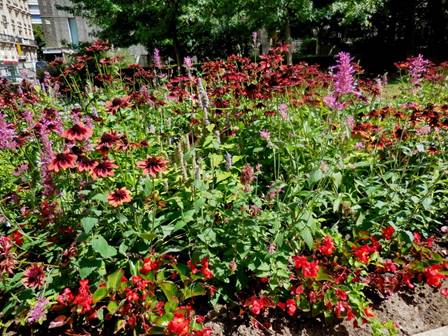
Flowers in the Jardin de l’Hôpital de Vaugirard.
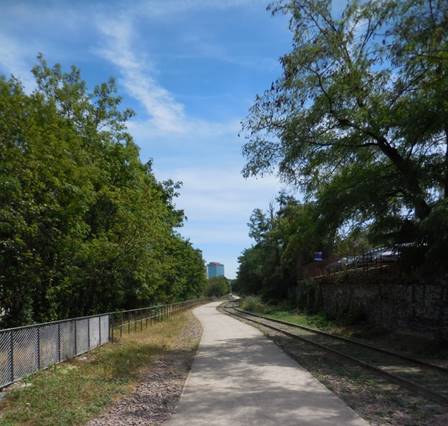
Walking along
the Petite Ceinture in the 15th
arrondissement. Here, the track is elevated atop a mound, a few stories above
the street level.
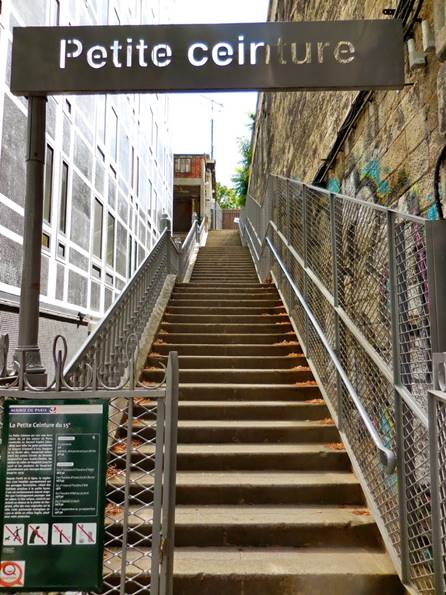
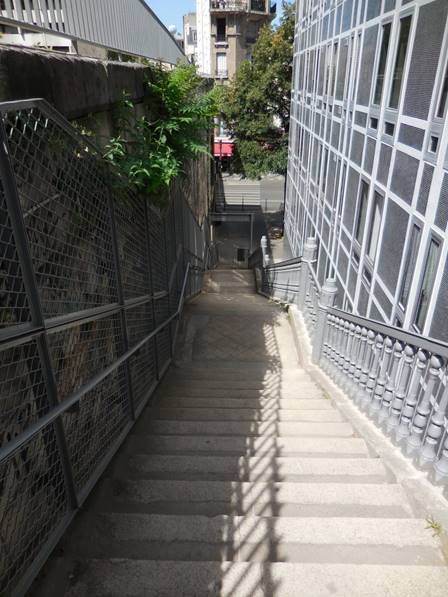
Stairs up to
the Petite Ceinture, by the old Vaurgirard
station.
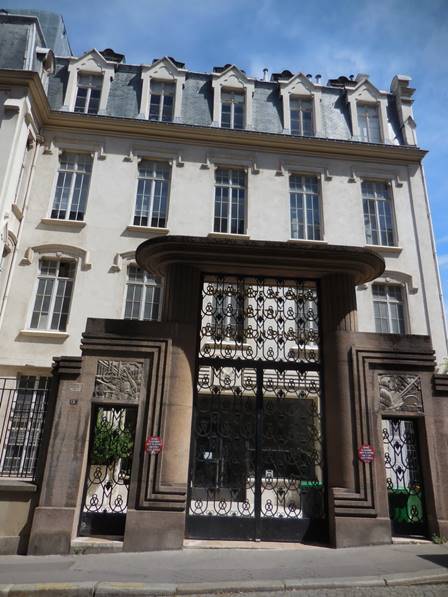
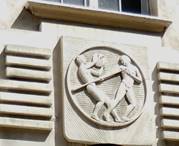
The old Vaugirard hospital, now a physical education
college. Bas relief above the
building’s doorway, below.
Wildflowers
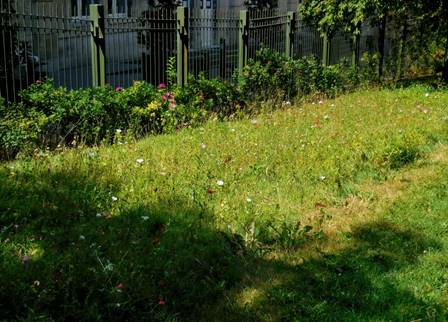
allowed to grow in one section of the Jardin de l’Hôpital de Vaugirard.
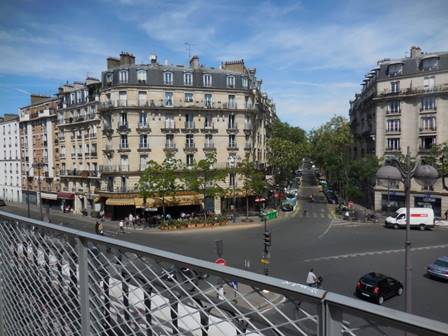
Looking down at
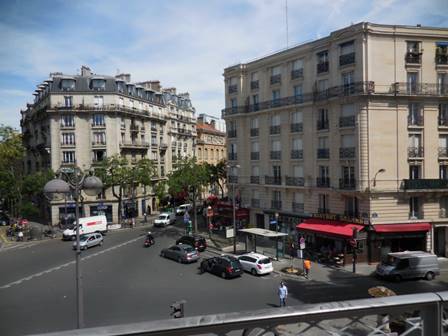
the Balard intersection from the Petite Ceinture.
|