Paris Journal 2010 – Barbara Joy Cooley Home: barbarajoycooley.com
Photos
and thoughts about Paris
Sign
my guestbook. View
my guestbook. 2009 Paris Journal ← Previous Next
→ ← Go
back to the beginning
|
Today is the 6th anniversary of Hurricane Charley, and it is the first time since then that August 13 has fallen on a Friday. Six years ago, as August 13 was approaching, we were here in Paris, watching the advancing Charley via the National Hurricane Center web site and the web site for the Fort Myers affiliate of NBC, which is NBC2. When a hurricane is approaching, NBC2 does live streaming broadcasts, which is very useful to those of us who are away. Even today, the NBC2 web site has a story about Charley. Usually, I have good Fridays the 13th. But not in 2004. Until the last hours, the experts thought Charley would make landfall farther north, near Tampa. As we learned the bad news that day, that Charley was indeed slamming himself right into our island in the Gulf of Mexico instead, we called Delta Airlines and begged them to change our flight home so that we could go back as soon as possible. Delta was able to change the tickets so that we would arrive exactly a week later, on Friday the 20th. I also went to the Thomas Cook travel agency on avenue de la Motte-Picquet to cancel a trip to Germany that we had planned. Our German friends, Arnold and Mareen, were very disappointed. Back then, I struggled more with my French, but I managed to explain the situation to the two young women working at Thomas Cook, and who amazingly spoke no English. (Thomas Cook is a British company.) They were very sympathetic. They wished me “bon courage” when I left. Some say Charley was a category 5 hurricane (the most powerful), but I think the official line now is that it was a strong category 4 with maximum winds of 150 miles per hour. The center of it passed over North Captiva, actually blowing that island apart, splitting it into two sections. The maximum strength winds and storm surge occur around the outer edges of a hurricane, which meant chez nous. Fortunately, Charley was a compact hurricane, and that meant not so much of a storm surge for us. Whew. But the wind did some awesome damage, changing the landscape forever. So our French summer was cut short in 2004, and we went home to deal with all the troubles that followed Charley, including the fact that three more hurricanes criss-crossed Florida in the next month and a half. It was scary and traumatizing. So my heart went out to the people in La Faute-sur-Mer, France, who are still dealing with the aftermath of a storm called Xynthia which hit France at the end of February. Wednesday’s edition of Le Parisien contained an article about how those folks are doing. For many of them, their home in La Faute-sur-Mer was a secondary home, and from what I see in the photos, these were manufactured homes, or mobile homes, in an area protected by a dike. The dike failed during Xynthia, damaging or destroying 1600 of the 2500 homes in the town. Windspeeds reached 100 miles per hour, the level of a category 2 hurricane, and waves reached 25 feet. By some accounts, Xynthia killed at least 51 people in France. The French government is now in the process of buying damaged homes from their owners in La Faute-sur-Mer, which is near the Ȋle de Ré. So far, 667 offers to buy have been issued by the government, and 350 people have accepted those offers. 250,000 euros is the average price for the homes. Many of the people want to leave. But some don’t. For those who refuse to sell, the procedures for “expropriation” could take up to ten years, according to Le Parisien. I guess the government would prefer to return the terrain to swampland rather than to maintain the dike, so they want the homes to go away. The local city hall forbids property owners to repair their homes. A total of 1,534 homes on the mainland are in the “black zone,” the area where the demolitions are mandatory. On the nearby Ȋle de Ré, however, only 22 homes are in the black zone. At the tip of the island, in the community of Les Portes-en-Ré, the water levels went as high at 1.4 meters. But not one home there is in the black zone. Les Portes-en-Ré is a popular vacation spot for celebrities and politicos. The price of a home in Les Portes-en-Ré can be as high as 12 million euros! Most of the 22 homes on the Ȋle de Ré that are in the black zone are in Loix, whose mayor claims that his town was the least affected by the storm on the island. But homes in Loix aren’t quite so pricey. At La Flotte, a community on the Ȋle de Ré where the government has already bought back some of the homes, the purchase prices ranged from 350,000 to 1.5 million euros. Yesterday, residents of La Faute-sur-Mer and tourists formed a human chain of about 1,000 people to draw attention to the east dike, about 6 kilometers long, that was supposed to protect the homes. They want to be sure that Xynthia and the 29 deaths she caused in their town are not forgotten, in spite of the time that has passed. Those who live at the foot of the dike had feared that the rock work done on the dike in 2009 would not be sufficient to protect them. They were right. Yesterday, I took a walk in the afternoon to see which of our favorite restaurants might be open. Most are closed, I learned. I did a little shopping and went back to the apartment, where Tom and I discussed the options. We decided that Stanley and Pat should have a North African restaurant experience as part of their Paris vacation, so in the evening I called the elegant resto, Le Tipaza, to ask for a table. The restaurant staff treated us like we were very important people (Stanley is, anyway), and we had a wonderful time there. Stanley, Tom and I had the tender, juicy Chateaubriand au Poivre, and Pat indulged in a tagine with mixed vegetables and chicken. The restaurant accommodated her desire to have white meat only. Very nice. For dessert, Pat selected an oriental pastry, which she seemed to enjoy. Tom and I shared a crème caramel, which is one of the house specialties. Light, smooth and delicious. Afterwards, we convinced Stanley and Pat that they didn’t really need to take a taxi, since the number 10 métro’s Émile Zola station was right there, in front of Le Tipaza, and it would take them straight back to their neighborhood, at the Mabillon station, in practically no time. Tom gave them two métro tickets, and we walked them right down to the turnstile where we said goodnight. Pat even called us when they got home, to let us know they made it safely without getting lost! I knew they would. For lunches, I’ve been making salads with lamb’s lettuce lately. Yesterday, it was lamb’s lettuce in a balsamic vinaigrette, topped by pieces of pear and Roquefort cheese. I adore lamb’s lettuce (mache, in French), and I wish I could buy it on Sanibel, or even in Fort Myers. Here, it is widely available. I can even buy it at the “hard discount” grocery, Ed, down the street from us. I guess we’ll just have to enjoy it while we can. Sign
my guestbook. View
my guestbook. Note: For addresses & phone numbers of
restaurants in this journal, click
here. |
Friday, August 13, 2010
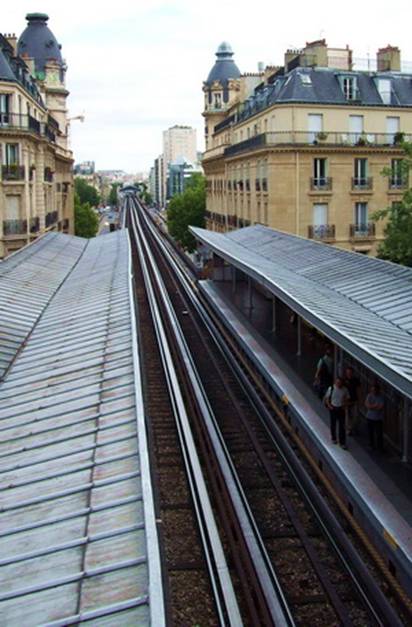
Train
tracks for the elevated line 6 of the metro, looking from the station at
Passy back over the Seine toward the Left Bank.
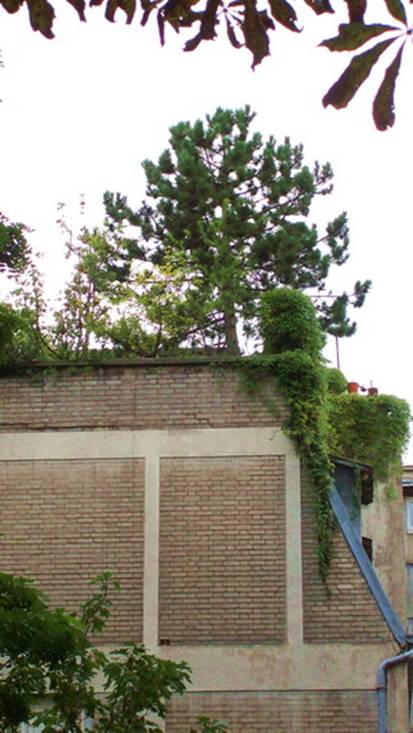
Looking
up at a verdant rooftope terrace in the 16th arrondissement, near
the rue de l’Alboni.
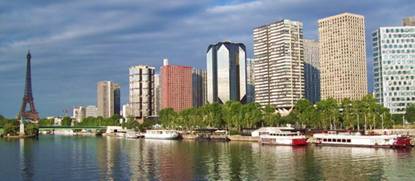
This
edge of the 15th arrondissement, with the unattractive high-rises,
is known as the “Front de Seine.”
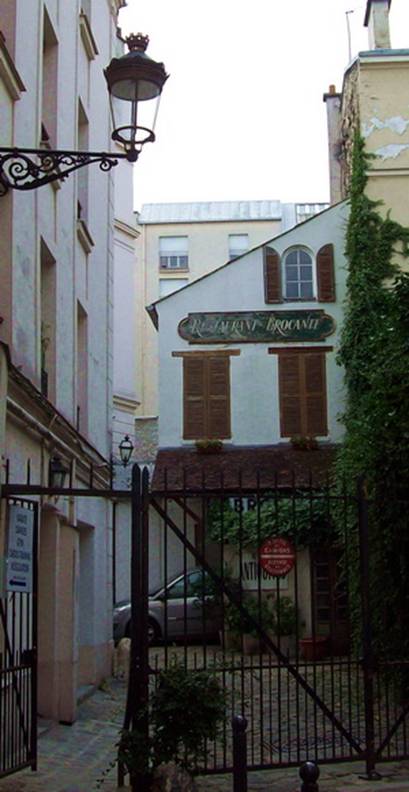
A
step down from an antiques dealer (antiquaire) is a brocante. This one is off of the rue de Passy, in the
chic 16th arrondissement.
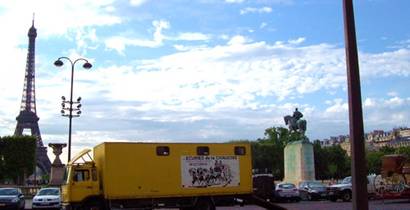
The
truck that brings the horse-drawn buggies from the écuries (stables) to the Champ de Mars. |