Paris Journal 2008
Sign
my guestbook. View
my guestbook. ←Previous Next
→ Barbara’s
home page
|
We arrived safely back in Paris yesterday after spending nearly a week with our friends in Germany. Specifically, we were in the Rheinhessen area of Rheinland-Pfaltz, the leading wine producing region of Germany. At our friends’ suggestion, we stayed in a hotel in their village because their guest room is subjected to loud church bells from two churches all night long. Our friends, Arnold and Mareen, were the most wonderful hosts imaginable. I’ll write about our visit here, even though this was not in Paris, because it is so easy to get there from Paris. All you do is take the fast train from the Gare de l’Est and zoom! In three hours, you are there in Mannheim, and friends can take you from the train station to their village. Arnold and Mareen’s village is Alzey. It is, I confirmed, far more charming than most villages in Germany. One reason is that it wasn’t bombed in WWII. It seems that the bomber pilot thought that a tower on top of a nearby hill was the village church (it must have been nighttime) and he bombed it instead. This was my first trip ever to Germany, and Tom’s second. The last time he was in Germany was over thirty years ago, and he certainly did not then get the insider’s guided tour that we got from Arnold. Arnold had our every day planned out, down to ten minute intervals, it seemed. It was great. We didn’t have to plan or decide anything. We just had to be ready to go in the morning at whatever time Arnold assigned. On Friday, we arrived at around 4PM in Mannheim and Arnold was exactly where he said he would be in the train station, ready to go. We got into his car and we were off – through the countryside, to Alzey (population about 18,000). He gave us just the beginning of a tour of the town, and then, voila, Mareen appeared, walking toward us on the sidewalk. We crossed the street to enter a restaurant, named after a person with a large nose (which I told Mareen is called a “honker” in impolite English). The restaurant offered authentic German fare, and is now expertly run by a friend of Mareen’s, Peggy. The hotel, Am Schloss, was very comfortable and quiet. The next morning, a Saturday, Arnold gave us a complete walking tour of Alzey, and then we met up with Mareen and their neighbors Klaus and Monika, for a lovely lunch outdoors on the attractive town square. For most of the days in our visit, Arnold built in time for repose in the afternoon. That was nice. After Saturday’s repose, Arnold and Mareen picked us up to go to have coffee and cake at Mareen’s mother’s home. Mrs. Stein has a beautiful garden on the edge of Alzey, and a light, bright home that is just right for her. She has a sunny disposition, smiling all the time, and she knows a few words in English. Her coffee and cake were superb. From there, we drove to an extremely small village for the 50th birthday party of Dr. Conny Tovar, Mareen’s assistant (Mareen is a family practice doctor). The other Dr. Tovar, Conny’s husband, has a few little biotech companies. Their place is a horse farm, but with not much acreage, in the ancient little village. The Tovars are in the process of modernizing this in-village farm with its several buildings. They have two horses now, and I think plans for some more. Dr. Tovar the biotech expert also has solar panels on top of his barn. The entire structure of the barn’s roof was rebuilt to hold the weight of both the new roof tiles and the modern solar panels. The solar system is connected to the power grid, and Dr. Tovar has fascinating software that allows him to see what he’s selling to the grid, and what other property owners throughout Germany are selling to the grid from solar panels on their buildings. Both Drs. Tovar speak excellent American English, so we were able to learn a lot here. The birthday dinner (for about 75 people?) was a barbeque, served buffet style. We sat at very long, narrow tables with long wooden benches in an open stable. There was lots of champagne, wine, barbequed pork chops, bratwursts, many side dishes, and desserts. Everybody was nice. Most did not speak any English. The group was diverse – most didn’t know each other because these were people the Tovars had met in the various places they’d lived. Conny insisted that everyone wear name tags with their FIRST name (unusually casual in Germany) and a phrase that explains who they are. Mine said “Barbara Florida, USA.” There were two cats on this farm. One, a young female gray cat, was very special. For a young cat, it was calm, and it sat in my lap while I stroked its face. The cat was mesmerized by me, and I was by her. After dinner, there was a horseriding show. A Spanish rider was brought in for the occasion, and she and the horse put on quite a show. The Tovar’s kids (teenagers) had set up a high-quality soundsystem and lights outside on the special area for riding shows. The new riding surface was made from what looked like chopped up tires – very soft and spongy. The rider was elegant and skillful; the horse danced and pranced perfectly to the music. The show was magical. There were games that were sort of a “roast” of Conny Tovar, in honor of her birthday, after the show. On Sunday, Arnold, Tom and I went on a quick-paced bike ride through the countryside. Hiking and biking paths seem to be everywhere. We saw two great blue herons, one goose, lots of fields of sugar beets, wheat, and some asparagus, and a place that makes huge stainless steel casks for wine. We stopped at an Indian pub in a village for coffee, nan, and garlic/herb yogurt. Mareen is recovering from back problems, so she didn’t join us for the bike ride. But she did make us a lovely lunch – green beans and pasta with bacon in a feta cheese sauce. Lovely. We ate out on the terrace of their apartment. Arnold and Mareen gave us a tour of their extremely elegant living quarters (we had seen the garden on Saturday when we met with the neighbors). The house is a great old Victorian, built of sandstone (red and beige), with fabulous dark woodwork and heavy carved doors. It had been a bank a long time ago, with the living quarters upstairs. Mareen’s father, a doctor, had his offices in the lower level, where the bank had been, and which is now rented to a herbal medicine practitioner. After the afternoon repose, we returned to Arnold and Mareen’s home for a delicious sausage barbeque dinner (with a fabulous red-fruit compote dessert) with friends of theirs, a couple who speak excellent English. She, Ingid, is from New Jersey, and went to Germany many years ago with a group from Middlebury College. She met her husband, a doctor, there (I could only pick up his nickname, which sounded like “Cheddy.”) He works often now in Suffolk, in England. His English is perfect; he sounds Irish or Scottish. We liked this couple very much. He is one of those people, you can just tell, who are very sincerely and thoroughly nice. I asked Ingrid if she is still an American citizen, and if she will vote in November. She answered emphatically yes to both questions, and went on to say that she recently realized that although she has voted in US presidential elections, her vote has not counted in the past since there is no elector in the electoral college for Americans living abroad. So she changed her voter registration by getting a drivers license in Washington state, where her family now lives, and she votes absentee. Although Ingrid could have dual citizenship, she doesn’t believe in it. She is a legal resident of Germany, and she can work there with no problem. But she is not a German citizen, by choice. This couple was leaving for vacation in Washington state and New Jersey the next morning, so they left right after dinner. We stayed and talked with Arnold and Mareen some more. Arnold told us a lot about his children, especially his son who is a Buddist holy man (higher level than a monk) and who is now working in Haiti, helping the poor. All three of his children speak French, German, and English. One of his daughters is a stunningly beautiful chef in France. On Monday, we started with a tour of the attic and basement levels of Arnold and Mareen’s house. Since we are old house people, we were fascinated by this. The house, while it is old, is very well built. It is one of the finest, if not the finest, house in Alzey. Unfortunately, a large school construction project is going on just across from the front of their house. After the tour, Arnold took us to his favorite hole-in-the-wall Chinese takeout, where we all had hot and sour soup, one of my favorite dishes. This was especially good hot and sour soup, made with very freshly chopped vegetables. Arnold then took us on a long, lovely driving tour involving much beautiful countryside with hills of grapevines and too many charming villages to remember. He showed us the company where he had worked for years as an engineer. This is Fritz-Werner in Geisenheim, the company who made printing presses and machinery for making ammunition. We saw a castle/domaine on the hill near the village where Fritz Werner is located. It is/was the home of Furst von Metternich, and they make very good wine there. Arnold showed us a building that is a fake castle, a place that Fritz Werner bought for a training facility and executive retreat. It has vineyards, but is not allowed to sell the wine. It all must be consumed on the premises. When the socialist government forced Fritz Werner to stop making machinery for making ammunition, the company downsized and the retreat had to be sold. I think this happened after Arnold’s time there. Anyway, when Arnold was with the company, he was responsible for this facility, and many other things. His main job was overseeing the construction of factories in Algeria. The retreat is now the home of the prestigious European Business School, the first private school of its kind in Germany. Arnold says that all graduates of this school receive several fine job offers. Arnold took us to a park in the Rhine – a place with fabulous views – and the home of the huge Germania monument near Rudesheim. The monument was placed here, overlooking the Rhine and looking toward France, as a warning to the French to stay back. It dates to 1877-1883. Its real name is Neiderwalddenkmal. We had dinner with Arnold at a restaurant in a little yellow house tucked away in a little village. We’d never have found this place on our own. Tuesday was a more urban day. We went to see the imposing, dark red sandstone cathedral in Mainz. Instead of lunch, we had cake in a tea room in the city. After the afternoon repose, we went on to Worms to see the ancient cathedral there. The crypt of this church, where the Kaisers of Saliers were entombed a thousand years ago, is intact – undisturbed in all this time. Dinner was at the Kallstadter Hof hotel in Kallstadt, in a restaurant run by Katrina von Imhof, a first cousin of Mareen’s, who is a countess. She is very pretty, and was nice and friendly with us. Wednesday was our big day in Weisbaden, the prosperous and lovely capital of the Rheinhessen. Weisbaden was not bombed in WWII because the US Army wanted to put a base there after the war. And indeed, there is a US Army Air Field in Weisbaden, and a complex where soldiers live with their families. Weisbaden has many beautiful Victorian era houses and other buildings. It was developed as a resort town, because it has many hot springs. Before we entered the town proper, we had a little tour and lunch at a domaine where kids from troubled families are trained to be servers, bakers, butchers, cooks, livestock producers, horse trainers, and more. Arnold ordered for us, and the food was good authentic German fare, but it was copious. Weisbaden was lively. I think it probably always is, but this week they have a wine festival going on, so the big town square is full of booths and tables and glasses of wine with people drinking them. After lunch, we met with friends of Arnold’s, the Misselhorns, for cake and coffee at their house. They have a beautiful garden and a light, bright home that is very tastefully furnished. There were many watercolors there by an artist named Bettina. The subjects are all landscapes near a town in Algeria, the name of which sounds like Tisi Ajou, but I have no idea how it is spelled. I think this is the town near our friend Karima’s family’s home near the mountains of Algeria. Quite a coincidence. We took the Mount Nero train up the hill next to the city. The train is interesting because it runs on water power – no electricity or fuel is involved. The view from the top of Weisbaden was spectacular. We walked partway down the hill to look at a Russian orthodox church built by one of the Csars for his daughter to be married in. She later died in childbirth, and both she and her baby are buried here in this church. After taking the little train back down Mount Nero, we met Mareen and her mother. We all had dinner at the restaurant called Beau Site. It is run by a French woman, and her husband is the cook. He’s German, so the food is German. I had a superb dish, a boiled beef with a horseradish and herb cream sauce, creamed spinach, and sautéed potatoes. It was fabulous food. I just wish our lunch had not been so large! Everything about Beau Site was wonderful – the comfort, the ambiance, and the food. After dinner, we decided to tour the Kaiser’s Casino – not just the building, but the casino itself. Fortunately, Tom and I had our passports with us, which helped with the admission process. The casino charged us a nominal fee – perhaps €2.50 – to enter. What we found inside was beautiful. The casino was quiet, but full of well-dressed people. A hush of calm enshrouded the room. Nobody spoke in a loud voice. The walls and ceiling were made from carved and smoothly finished wood. There were elegant chandeliers above. Everything in the room was elegant. There is no Las-Vegas-style bling-bling in this casino. None of us gambled. We were just there to have a look. We walked around slowly, looking at everything. Mareen had a beer, standing at the bar. Shortly before we left, we studied a roulette wheel that had been used by Dostoyevsky. This casino must figure into his novel, The Gambler. On that elegant note, we ended our trip to Germany. Arnold drove us to the train station in Mannheim on Thursday morning. We caught the 9:41 train to Paris, arriving in time for lunch at the Gare de l’Est, but we were not hungry. It was easy to take the metro home, except of course the part of the journey from the station to the metro stop at Odeon was suffocatingly crowded. But from Odeon to Emile Zola, we had plenty of room to breath and relax. The 15th of August is probably the calmest day of the year in Paris. All is quiet. Streets are practically deserted in vast parts of the city. This is the Feast of the Assumption, an important Catholic and national holiday. We met Carol, Ron and Emma at the apartment in the 6th, then had a long, lovely walk through the Luxembourg Gardens. This is where all the people in Paris had gone! They were all in the garden! I’d never seen so many people there. Carol, Ron, Tom and I walked over to the Six Huit for drinks and gazing at Notre Dame. The weather was perfect. Then Carol, Ron, Emma, Tom and I had a wonderful dinner at Le Seraphin -- probably the best meal we’ve ever had there. More about the holiday weekend in Paris later . . . . |
Friday, August 15, 2008
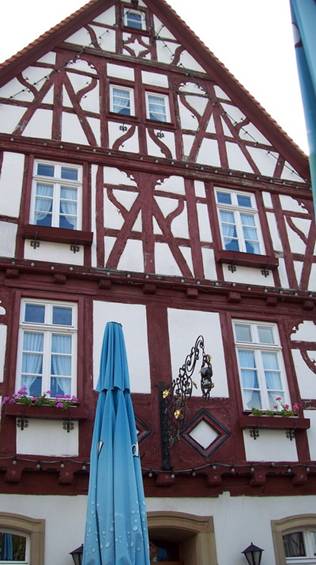
Building near the town square of Alzey, Rheinhessen,
Germany.
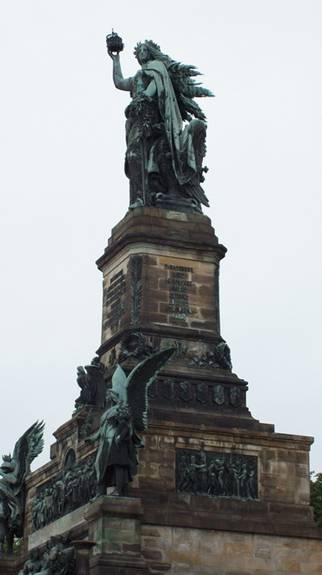
The Neiderwalddenkmal monument,
also known as “Germania.”
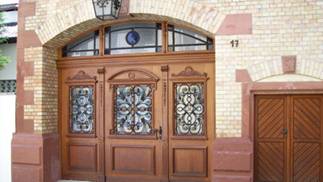
A lovely door in Alzey.
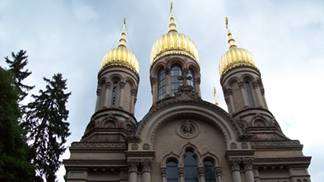
The Russian Orthodox Church on Mount Nero, near
Weisbaden.
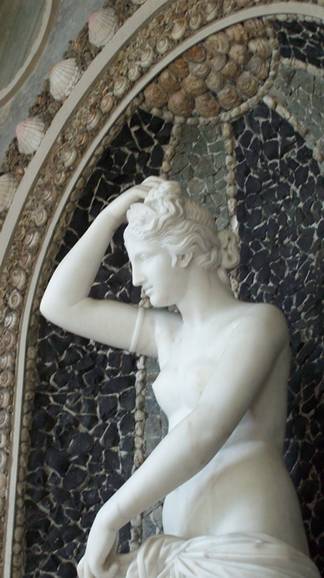
Statue in the Kaiser’s Casino building in Alzey. Arnold & Mareen have a reproduction of
this woman’s head in their living room.
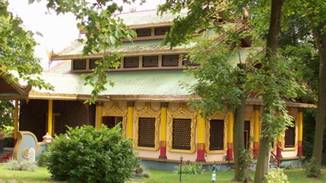
A Burmese temple by the European Business School is now
the French Cultural Center in this part of Germany.
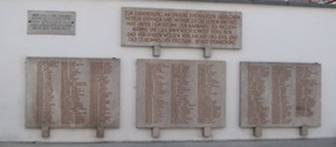
Plaques listing Alzey’s Jews who “lost their lives” in
Germany. Euphemisms, and not an
apology nor any admission of guilt.
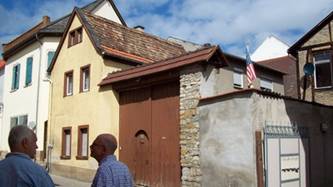
Tom and Arnold discuss construction techniques used on
old houses in Alzey. I did not realize
until long after I took this photo that there is an American flag on display
in the courtyard beyond the wall.
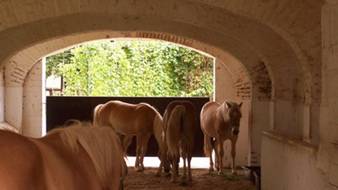
Horses at the domaine near Weisbaden, where young
people learn useful trades. They go
here after 8th grade. I
asked Arnold if they also continue their academic studies beyond 8th
grade, and he answered that it is only required through the 8th
grade. So I guess they do not.
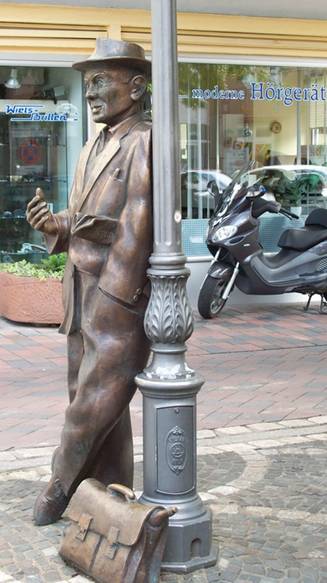
Statue of man with bottle in briefcase, cigar in
pocket, newspaper under arm. Such a
man used to wander the streets of Alzey every day. Today, a similar, but slightly less elegant
man from a nearby village walks into town every day and assumes this role.
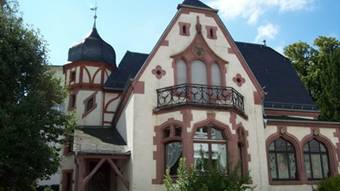
Nice house in Alzey.
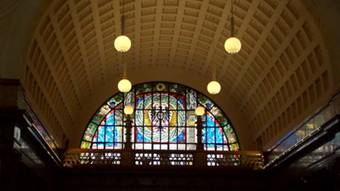
Window in the Kaiser’s Casino building.
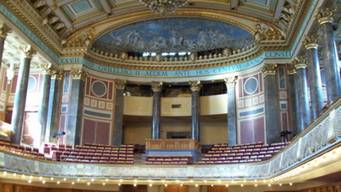
Theatre in the Kaiser’s Casino building.
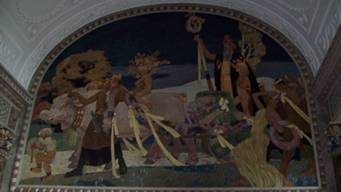
Mural in the Kaiser’s Casino building in Weisbaden.
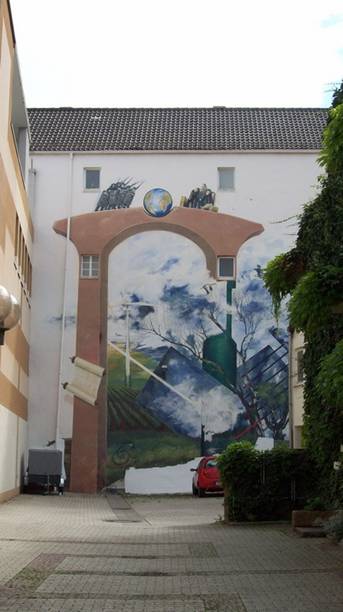
Strange mural in Alzey. |