Paris Journal 2011 – Barbara Joy Cooley Home: barbarajoycooley.com
Photos
and thoughts about Paris
Sign
my guestbook. View
my guestbook. 2010 Paris Journal ← Previous Next
→ ← Go
back to the beginning
|
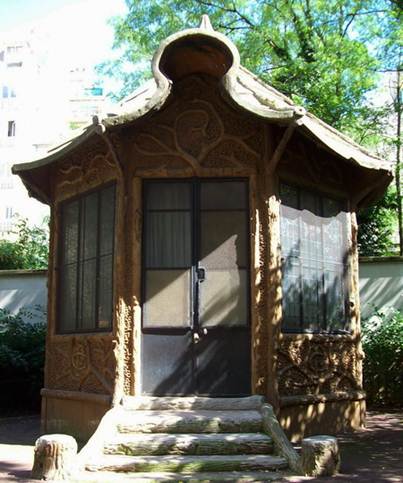
The Feast of the Assumption must be the quietest day of the year in Paris. The streets were so calm and peaceful, we could almost imagine that we were walking through a village yesterday. We were “park-hopping,” walking from one little park to the next, through the streets of the 15th, until we finally ended up at the big park, André Citroën, where we finally found lots of people – as well as beautiful gardens. But first, we solved the mysteries of the places of worship on the rue Fondary. After not being able to find the synagogue that the map indicated was supposed to be on that street, I looked on the internet. The official web site for the town hall of the 15th arrondissement does have the synagogue listed as a currently registered place of worship there on rue Fondary, at number 13. I wrote it down. Also listed were the Assembly of God protestant church at number 25, which we had been able to find (in an apartment building), and the Notre Dame de Grace chapel at number 6, which is also sometimes called the Saint Vincent de Paul chapel. It seems that a priest from the Saint Vincent de Paul order had something to do with starting an order of the Sisters of the Sacred Heart there. The current priest is also of the Saint Vincent de Paul order, which is devoted to tackling poverty. Appropriately, a few poor people are stationed in front of that chapel, begging for coins even though the chapel is closed until September 1. Problem is, there are almost no passers-by to beg from. One the beggers, trying to be helpful, explained to us that the chapel is temporarily closed. He thought we wanted to attend mass for the holiday. I puzzled out the colorful and chaotic flyer posted on the chapel, and ascertained that the chapel will open again on September 1. Membership in the Sacred Heart Society (established in France in 1800) is open to women only, and the group focuses traditionally on girls’ education. So it is not surprising that the historic Lycée Roger Verlomme, also on that block of the rue Fondary, began as a girls’ school, specializing in what we now call home economics, as well as couture. It was the first professional municipal school for girls when it was established in 1881. Now it is a co-ed high school that is undergoing a three-year transformation into a school for “management sciences.” From the outside, it almost looks like a prison camp because it has a guard tower in the corner and walls all around. But the photos provided on the school’s web site make it seem more appealing and historic. The photos also show how darned big the school is! We located the building at number 13, the home of the synagogue. The building has two front doors. One is a typical front door of an apartment building circa 1900. The other is right at the sidewalk level, is metal, with very thick glass that is a mirror if you are on the outside, as we were. It is totally unmarked, and has its own security digicode pad. This door certainly must be to the synagogue, and it probably leads directly to stairs going to the basement level. The synagogue is, for security reasons I suppose, completely incognito. However, the synagogue did host a lecture there last October, and it was advertised on the internet and open to the public. Mystery solved. It would be the closest synagogue to the location of the Vélodrome d’Hiver, the site of the horrible roundup of July 1942 – an atrocity committed by the French police during the Nazi occupation. Never forget. Of course, the girl’s school on rue Fondary was one of many schools from which Jewish children were taken by the French police during the roundup. A plaque on the school’s outside wall reminds everyone of this awful fact. Such plaques exist on many of the schools in Paris. Never forget. From the rue Fondary, we made our way through the Place Saint Charles and then the pleasant family park called the Square Pablo Casals. The park was created in 1979 and named for this Spanish violin-cellist and orchestra director who helped to establish the foundation for the music school in Paris. It features lots of places for kids to play, as well as chestnut trees, ornamental apples, and lilacs from the Indies. Next on our itinerary was a little park called the Square Paul Gilot, established in 1926, and known for its pretty kiosque shaped like a pagoda and graced with stained glass windows (which unfortunately have to be obscured by a protective grill). The plaque for the park, in French, tells us that “this square transports the visitor in an imaginary voyage where the heather of the moors mixes with the chestnut trees, lime trees, and maples.” Ah. So nice. The square honors the memory of Paul Gilot (1888-1938), an engineer for the Company for Special Glass of France (Compagnie des Glaces et Verres spéciaux de France) -- hence the stained glass windows in the pagoda, I suppose. We went on to take a look at the Square des Cévennes on the rue Cauchy. The Cévennes are a mountain range in southern France, and some of the trees in this park are from that area. Mostly, this park is another place for kids to play, surrounded by administrative office buildings. At last we reached the grand André Citroën park. As I’ve written of this park in the past, its design is hugely successful. It is a well-used and well-loved park, and that’s where the people were yesterday, enjoying their holiday. We walked in and out, up and down, enjoying the different layers of the different gardens along the northeastern side of the park. This park is a huge improvement over the munitions factory that it originally was during World War I. After WWI, of course, it was converted to the Citroën automobile factory. The beautiful public park was born in the early 1990s. We rested briefly back at the apartment, and then went out for another walk up to the far edge of the Champ de Mars, the Place de l’École Militaire, where we were going to try to by a copy of Le Parisien, but of course there were no more copies left to buy. It doesn’t matter. We often read it online now. This was just an excuse to walk a bit more. In the holiday spirit, we decided to have a feast at La Gauloise. We were greeted as if we were important, and given a nice table. Immediately, a dish of garlic-drenched pitted olives was deposited on our table. We nibbled on them as we studied the menu, which we know pretty well. I knew what I wanted – the blanc de volaille aux morilles en cocotte. The dish is a bit pricey, but hey, this was a holiday. Tom ordered the fixed-price menu at 24 euros, including the summery, chilled vegetable-and-beef terrine as a starter for us to share, and grilled salmon in beurre blanc sauce with rice. My main course was a “frenched” chicken breast roasted with a few small potatoes and wonderful morel mushrooms in a rich, golden sauce, served in its copper casserole dish. The sauce was exquisite – made with cream and a wine from the Jura (France-Compte region) I believe. The chicken was excellent, and the pricey morel mushrooms were divine as usual. I gave Tom one of the potatoes and much sauce, which he seemed to greatly appreciate along with his delicious salmon. Tom ordered a decaf espresso, which came with a couple chocolates and a couple madeleines, which we shared. No room for dessert. That was it – back to the apartment for another evening of reading and listening to jazz. As my grandmother used to say, “It’s a great life if you don’t weaken.” Sign
my guestbook. View
my guestbook. Note: For addresses & phone numbers of
restaurants in this journal, click
here. |
Tuesday, August 16, 2011
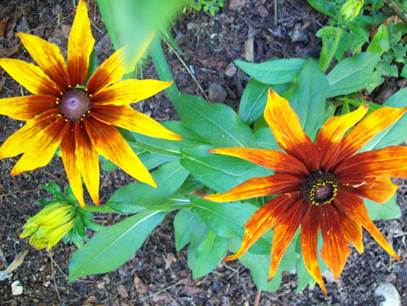
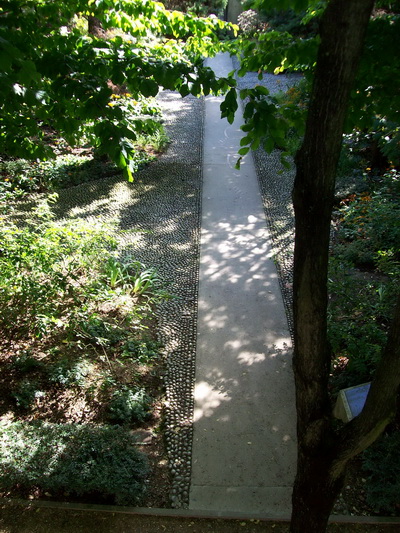
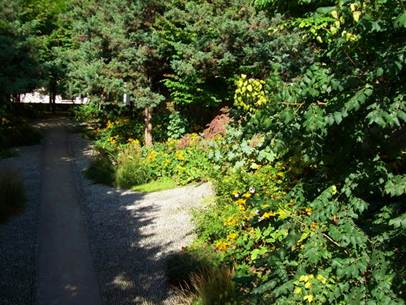
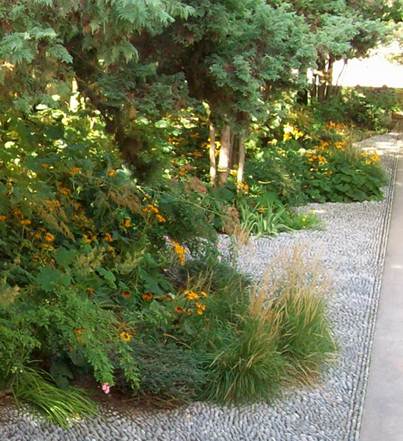
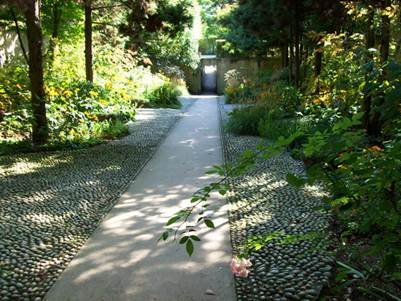
Scenes from
the gardens of the Parc André Citroën.
Above, the
pagoda/kiosque in the Square Paul Gilot, on the rue de la Convention, across from the
official French printing works.
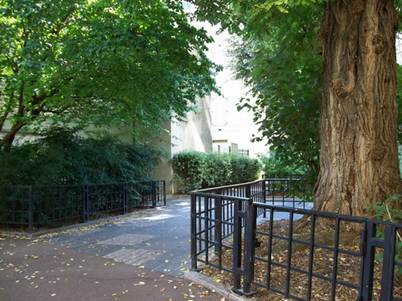
Below, this square looks like a country lane.
|