Paris Journal 2015 – Barbara Joy Cooley Home: barbarajoycooley.com
Find me on Facebook ←
Previous Next
→ << Back to the beginning
|
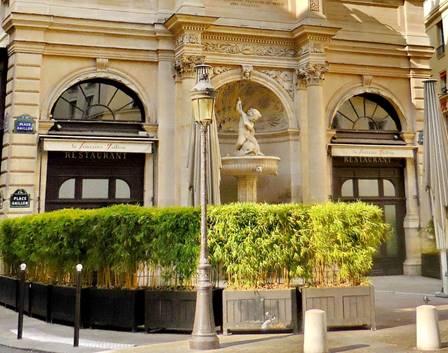
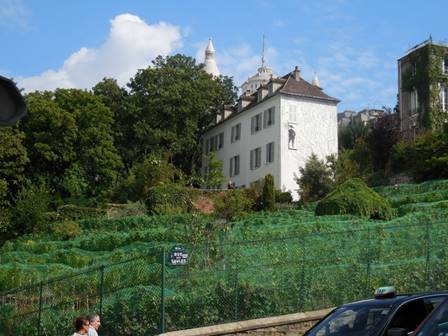
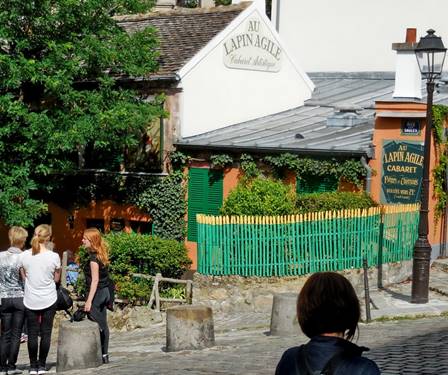
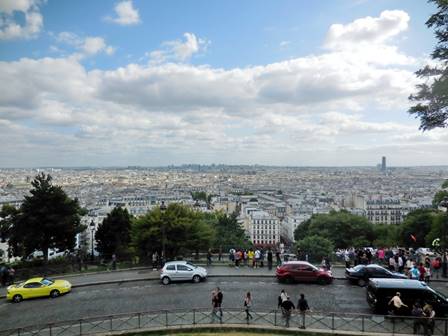
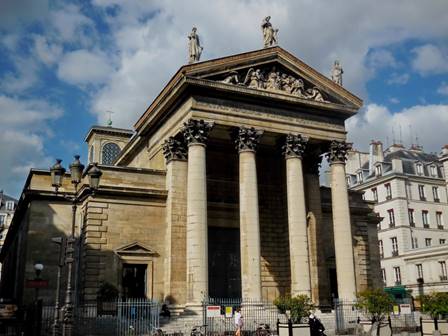
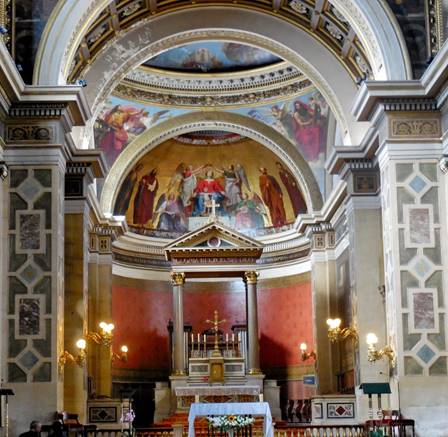
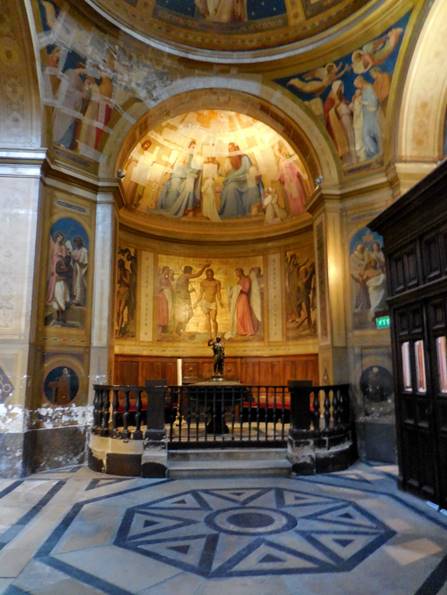
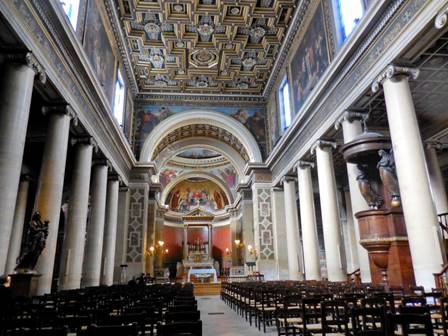
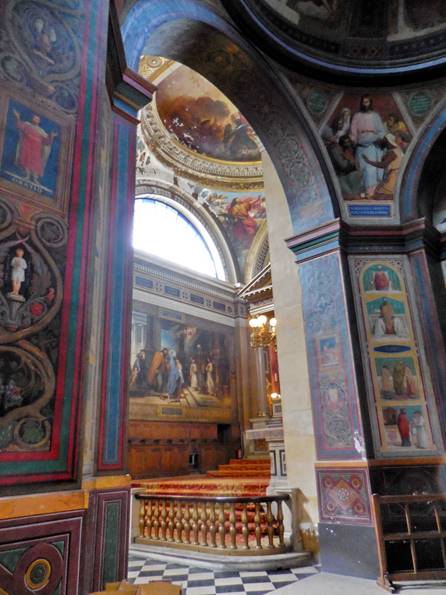
“You know where I want to go?” Tom asked, enthusiastically. “Montmartre,” I said. I guessed right the first time. Tom remembers our earlier visits to Montmartre, 12 to 18 years ago. I tend to remember the more recent ones. We were itching for a good, very long walk, so even if we didn’t stay long on Montmartre, we could walk home from there, we reasoned. We bought another set of metro tickets at the Avenue Emile Zola station and then we were on our way: the line 10 to Invalides, then the line 12 to Lamarck-Caulincourt. Long ago, we learned not to exit at Abbesses, where tout le monde goes when taking the metro to Montmartre. The exit at Lamarck-Caulincourt provides a quieter, leafier, more romantic approach to the peak. The climb is just as steep, either way (Abbesses or Lamarck). Some people take the funiculaire (cable car) after exiting the Abbesses metro station, but we like the climb and we like to avoid crowds. We climbed the stairways of the shady Place Constantin Pecqueur and turned onto the rue Saint Vincent. So far, so good. This was the Montmartre of the good old days. We turned onto the rue des Saules, and while the vineyard and the Lapin Agile cabaret were still there, looking quaint, we began to sense change. Two very long tourist trolleys made up to look like choo-choo trains came tooting down the rue des Saules. Is this an amusement park, we wondered? Has Disney transformed Montmartre? As we climbed up the cobblestoned rue des Saules, away from the Lapin Agile and the vineyard, we saw mobs of people coming towards us. Did a couple of large tourist buses just unload, we wondered? As we reached the rue Saint-Rustique and turned to our left, we realized the awful truth: Montmartre was more crowded than ever – much more crowded than we’ve ever seen it – and we’ve seen some big mobs of tourists there. We could hardly move on the rue Saint-Rustique, and the Place du Tertre had to be even worse. Fortunately, we didn’t want to see the Place du Tertre; we really just wanted to see the sweeping view of Paris from the top of the hill, in front of the Sacre Cœur church. We worked our way through the crowd, somehow found a place along the fence, and took in that view. On the edge of the crowd on the steps below, we saw an amazing acrobat entertaining the masses by performing impossible-looking, gravity-defying moves on one of the tall street lamps. As soon as we could, we exited the Parvis du Sacre Cœur by taking the steps down the hill, leading to the rue Maurice Utrillo. At the intersection with rue Paul Albert, there are some sweet cafés on a cobblestoned place. We saw a fine cat dining with a middle-aged couple at a table on one of the café terraces. The cat was sitting up straight in his chair, waiting politely for morsels to be doled out. After that, we were ready to leave Montmartre. I navigated us around the mobs of people by taking the rue de Seveste past the marketplace and down to the Boulevard de Rochouart, then down through the streets that slice through the middle of the 9th arrondissement (rue Rodier, rue Milton). Then we saw the back of a church. We knew we wanted to go inside, as long as there was no service taking place. It was the Feast of the Assumption, after all. When we walked around to the front door, we realized this was Notre Dame de Lorette, and it was open but quiet. We entered. What an incredibly beautiful church! We’d seen it many years ago, and it had faded from my memory somewhat. What a blessing to see it again, and to be reminded of its quiet splendor. Notre Dame de Lorette is a neo-classical church, constructed in the early 19th century to replace a chapel that was destroyed in the Revolution. Well-known people were baptized there, including the musician Georges Bizet in 1840, and the artist Claude Monet in 1841. Notre Dame de Lorette’s architect was Louis-Hippolyte Lebas (1782-1867). When Lebas was an assistant to Pierre Francois Leonard Fontaine, he oversaw the construction of the Chapelle Expiatoire – another one of my favorite spots in Paris (built on a site that was a mass grave for guillotine victims, including Louis XVI and Marie Antoinette, until their remains were moved to the Basilica of Saint Denis). After a lovely, soothing visit, we continued downhill, down the rue Lafitte and into the 2nd arrondissement. I asked Tom if he wanted to see Place Vendome again, and he eagerly said “YES!” So we turned on the rue Saint Augustin. At the Place Gaillon, we happened upon a sight we’d completely forgotten: the Fontaine Gaillon, with its oversize and elegant fountain and semi-formal restaurant terrace (below). The restaurant was closed.
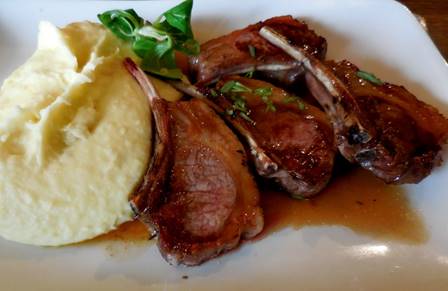
At the rue Casanova, we turned right. We were ready to see the Place Vendome, but we were thirsty and hungry. Just at the right moment, we saw one of the bigger Eric Kayser bakeries. This one had a deli counter, tables and chairs. So we bought a slice of country terrine, a baguette monge (Kayser’s version of the baguette de tradition), and two bottles of Saint Pellegrino sparkling water. It was the perfect snack because we could eat just a few bites to stave off the hunger pangs, and not spoil our appetite for dinner. The rest we could take home, and we did. We’d skipped lunch, as we often do. After a couple hours of walking, we were quite hungry. Refreshed, we continued on around the corner, onto the Place Vendome. The tall column in the middle was completely covered by scaffolding and canvas; it is being restored. At the rue de Rivoli, we had to make our way through another mob that was thick enough to extend into the Tuileries for some distance. After we crossed the Seine on the passerelle leading to rue Solferino, the crowds weren’t so bad. We walked up the Berges de Seine, which were busy but not mobbed, until we realized that we might be late for dinner. At the Pont Alexandre III, we climbed back up to the street level to make our way over toward the Invalides metro station. We were footsore, and pressed for time. As we wound around the Air France building, we noticed a sleek, shiny black taxicab with its green light shining on top. It was waiting at the curb, right next to a bus stop. Tom said, “You know, we could take a taxi.” What a novel idea! And so we did. The fare was only 6.90, and the metro tickets for two cost over 3 anyway, so it was only an additional 3 or 4 euros, with rapid, to-the-door service. Often, the taxi would be too slow because of traffic. But we knew these streets, and particularly on weekends, we knew there’d be little traffic. We’ll do this more often. Taxicabs in Paris are good. So we did have a half hour to relax and dress up before dinner, which was at Le Pere Claude, on the avenue de la Motte Picquet, near the École Militaire. I wanted a really good, traditional French bistrot for our holiday dinner, and Pere Claude fit the bill. We skipped the starter courses. Tom ordered the tender, juicy, grilled lamb chops, which came with a generous serving of heavenly puréed potatoes.
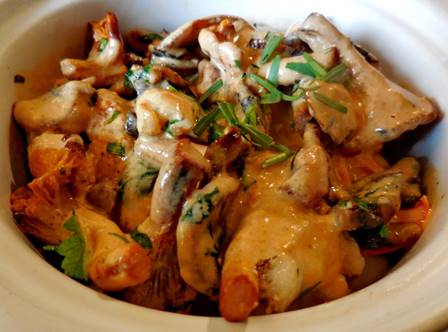
My main course was a cassoulette of lobster, fish, and girolle mushrooms in a lobster bisque/sauce – absolutely delicious.
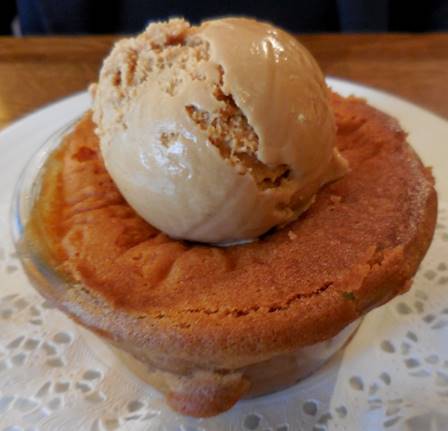
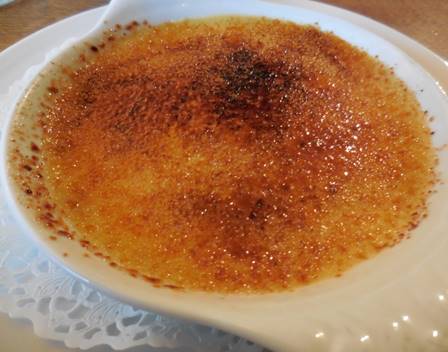
Tom’s dessert was the apple clafoutis, and mine was a classic crème brûlée -- the first one I’ve had this summer. Both were excellent.
The servers were as charming as could be. Thanks to Pere Claude, our Feast of the Assumption was fine. We’re grateful. |
Sunday, August 16, 2015
The vineyard on Montmartre, above, and the Lapin Agile
cabaret, below.
Part of the view of Paris from the parvis
in front of Sacre Cœur. The crowd is behind us and to the right of
us. We escaped to the left, and
downhill.
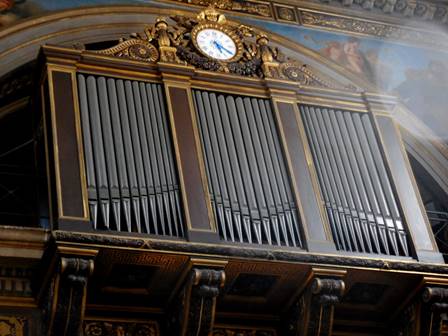
Notre Dame de Lorette, in the
9th arrondissement (above and below).
|