Paris Journal 2009 – Barbara Joy Cooley Home: barbarajoycooley.com
Sign
my guestbook. View
my guestbook. ← Previous Next
→ Back to the beginning
|
We finished working by 2PM or
so yesterday and were thus able to take one of those long, lovely walks along
the Seine on a gorgeous summer Sunday afternoon. Instead of walking through the
Champ de Mars, we went up the quiet residential street paralleling it, to the
northeast of it. The street changes
names three times. First, it is avenue
Frédéric le Play, named in 1926 for Pierre Guillaume Frédéric Le Play
(1806-1882), an economist and inspector general of mines. Then the name changes to avenue
Émile Deschanel, named in 1912 for Émile Augustin Etienne Martin Deschanel
(1819-1904), a deputy representing the Seine district, literary critic, and
professor at the Collège de France. Next, the street becomes avenue
Elisée Reclus, named in 1907 for Jean Jacques Elisée Reclus (1830-1905), a
geographer and theoretician of anarchy.
Finally, up closer to the
Eiffel Tower, the street is no longer a street, but a mere wide, dirt passage
through the park called the Allée Paul Deschanel, named in 1926 for Paul
Eugène Louis Deschanel (1855-1922), a politician and president of France. Isn’t it interesting that so
many streets in Paris are named for scientists, mathematicians, economists,
and other intellectuals? We don’t seem
to do that in Florida very much. And of these four street names
for the road paralleling the Champ de Mars, the three names for the sections
that are graced by dignified and attractive buildings are named for the
intellectuals, and the dirt passageway is given to the politician. So interesting! Paul Deschanel, by the
way, was the son of Émile Deschanel, and was only president of France from
February through September of 1920. He
had some mental health problems, and his presidency came to an end some
months after he was found wandering in his nightshirt at a train station. Before the death penalty was
abolished in France in 1981, Paul Deschanel was the only president during
whose term in office nobody was executed.
He was also a strong proponent of the separation of church and state. We passed through the
subtropical garden at the Musée du Quai Branly and began strolling along the
Seine. When we reached the Passerelle
Solferino where a statue of Thomas Jefferson stands overlooking the French
Legion of Honor building on the left bank, I peered over at the right bank to
see if the talented one-man-band, Bernard Constant, was in his usual
performance spot under the right bank end of the bridge. He wasn’t there the last couple
times we made this Sunday walk. I was
beginning to worry that we wouldn’t hear him perform again. There was a surprising sense of loss in my
heart. Then I saw a glimmer of brass
trumpet in the space under the right bank end of the passarelle, in the
passage that leads to the Tuileries. We climbed over a railing that
separated us from the pedestrian bridge and made our way across it to the
other side of the river. Alas, there
was Bernard, sitting at his drumset, embracing his accordian, with his
trumpets on stands next to him and microphone in front of his mouth. He did not look well. Obviously, he has had some kind of serious
health problem. He wasn’t playing at that
moment, but neither was anyone standing, waiting to listen. We positioned ourselves on the steps,
smiled at him, and waited. He began to play. He played and sang beautifully, if not with
quite the same energy as before. We
listened to several lovely French songs.
Then an American woman who’d been looking through his CDs began to ask
him about them. Tom had planned on buying one of
Bernard’s CDs, so he took the opportunity to go over and look at them
himself. The annoying American woman was
trying to bargain Bernard down to 18 euros for two CDs. He only charges 10 euros per CD, for
heavens sake. Lots of street musicians
charge 15, or even 20. This is how
they can afford to eat. Bernard’s English isn’t too
great, so he didn’t understand what she was asking for, or he pretended not
to. Tom did not offer to help her
communicate her request. We were embarrassed
by her. If I’d gone over to them a bit
sooner, before the woman left, I probably would have whispered to her that
she should pay the full price because the man had been ill. But thank goodness she
left. Tom and I had a long, pleasant
chat with Bernard. He asked about Florida;
he said he’d love to go play in a restaurant there, and spend some time in
the warmth of the subtropics. Tom and
Bernard talked about the drums. He was so humble and
sweet. I told him that I’d visited his web site, and he positively
glowed at that. We bought two CDs from
him, and parted by shaking hands, with me telling him that it was an honor to
meet him. I just love this old talented
very French musician. I want him to be
well and strong again. We went on, energized by the
music and friendship, strolling in the shade of the left bank until we
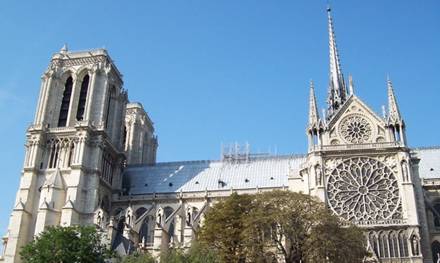
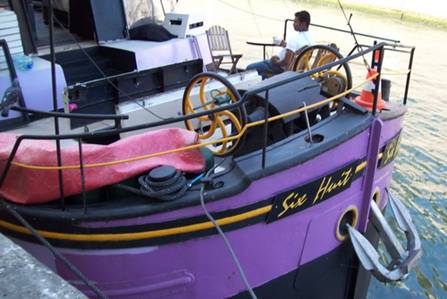
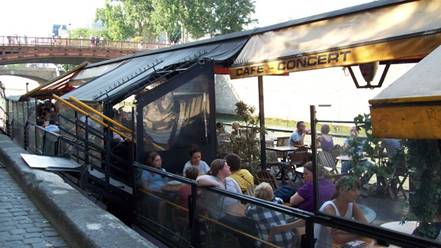
reached the café boat called the Six Huit, with its magnificent view of Notre
Dame. We settled in at a table, gazed
at the cathedral, and eventually one of the friendly servers found us and
took our order. While we waited, we
wondered aloud what had happened to the Korean family that operated the café
boat last summer, and perhaps the summer before. You see, we’ve been visiting
this café boat for about ten summers now.
We’ve seen café operators come and go. Our food and drinks arrived,
and the couple at the table next to ours was preparing to depart. But first they asked the server (in French,
of course) about the Korean family from last year. The server explained that they had to leave
because at least one of them was not legal; he was in France on a carte de visite, not a carte de sejour. We took our time, because this
had to be one of the finest places to sit in Paris on a perfect summer
day. Finally, we paid up and departed,
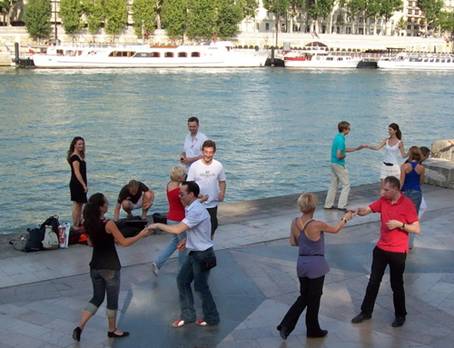
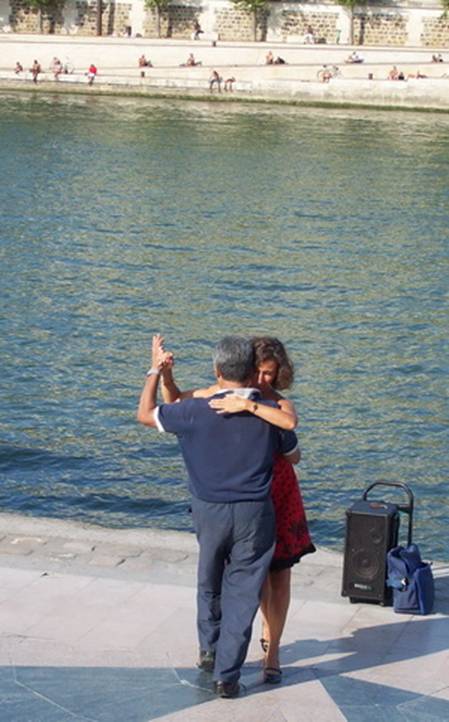
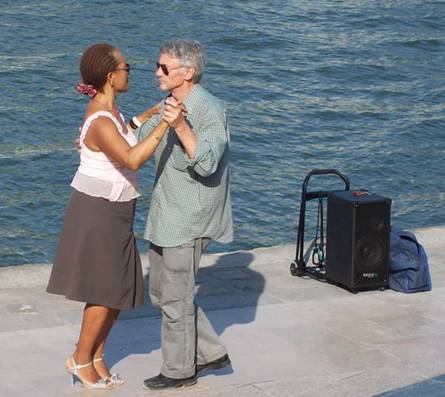
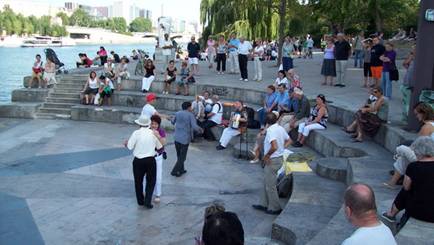
deciding to go on yet farther along the left bank. We soon came to the Square Tino
Rossi, which has three circular areas for dancing next to the Seine. On weekends, ballroom dancing lessons and
demonstrations are given there. After admiring the dancers for
a little while, we went on to the steps leading up to the Quai Saint Bernard
and the Jardin des Plantes. Finally,
that was enough walking for us. We
descended into the number 10 metro station at the Gare d’Austerlitz and went
home to the Emile Zola station. This was the Sunday of the Big
Quiet Holiday Weekend, so not very many restaurants were open. We freshened up, and I put on a dress. We called La Gauloise to reserve a table. When we arrived at the
restaurant after strolling up the chic rue du Commerce, we were greeted
warmly and given a very nice, roomy table for two. I had my heart set on the
special of the day, leg of lamb. So I
was a little disappointed when our server said there was no more leg of
lamb. However I know that this is not
unusual. On Sundays, many people eat
out at mid day, and because the emphasis is always on fresh food at good
French restaurants, this means that the special of the day is often gone by evening. The server explained that instead
of the leg of lamb, they were offering a steak for the same price, 15
euros. I meditated on that for a bit. When the server returned, I
asked about the cut of the steak. He
claimed it was a filet, so I went ahead and ordered it, asking for it to be
accompanied by the pommes de terre
dauphinois that were prepared to accompany the leg of lamb. No problem.
Tom ordered the steak, too, but with fries. The steaks arrived. They were thick, juicy, tender and
delicious, topped with a thin layer of fine pepper sauce. Finding a good steak like this in France is
difficult. After dinner, I told the
server that the steak was superb, just like those in the United States. He said that these steaks did come from the
United States. We were completely
surprised, because we thought France outlawed the import of American
beef. But I guess things change,
sometimes for the better. With the bill, we were given a
little plate full of round chocolates.
How nice. |
Monday, August 17, 2009
Dancing by the Seine in the Square Tino Rossi.
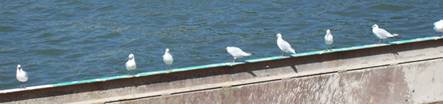
The Seine has seagulls, and now salmon have returned.
View of Notre Dame from the café boat called the Six
Huit.
The chef of the Six Huit takes a coffee break on the
bow.
The Six Huit on the Seine. |