Paris Journal 2015 – Barbara Joy Cooley Home: barbarajoycooley.com
Find me on Facebook ←
Previous Next
→ << Back to the beginning
|
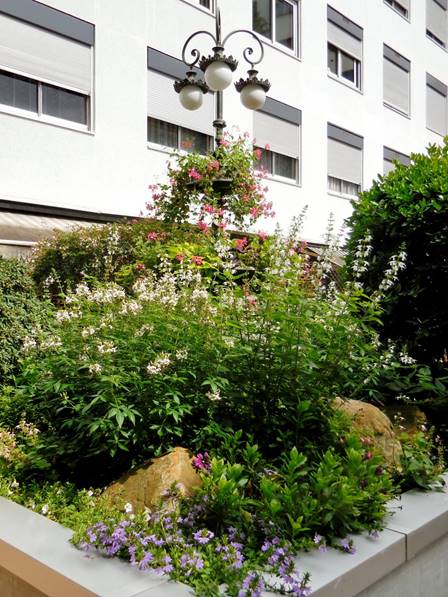
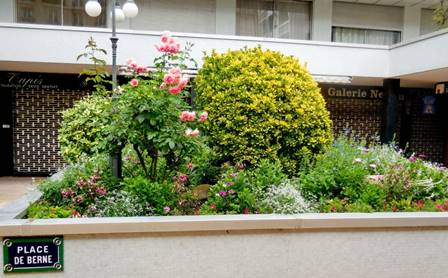
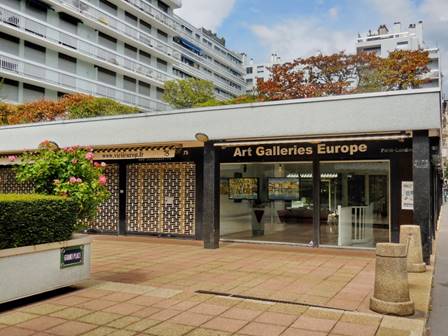
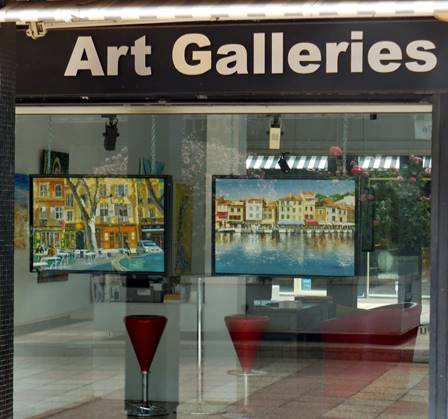
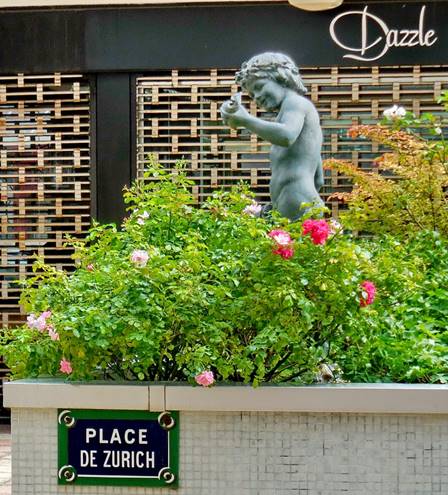
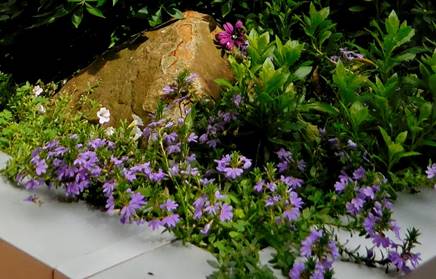
We frequently take a “shortcut” through the Village Suisse on our walks to and from the Champ de Mars. The route isn’t really shorter, but it is quieter; it allows us to skip the busy intersection of the avenues de La Motte-Picquet and Suffren. Usually, the shops of the Village Suisse are closed when we walk through there. Still, we enjoy the beautiful flowerbeds and the window shopping. And it is always nice to get away from automobile traffic. The architecture of the Village Suisse is an anomaly in this upper reach of the 15th arrondissement. It is a modern housing block designed and built in the 1970s, but it has a nice network of courtyards, one opening onto the next. The courtyards are graced with large planters filled with flowerbeds and some statues.
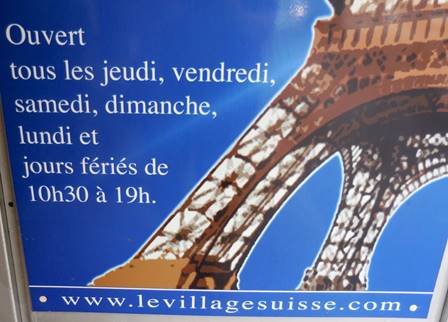
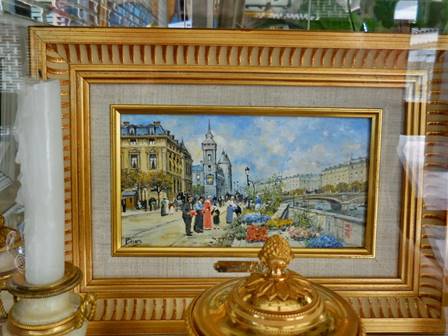
The land was available for development in the 1970s because of its historic use in the Paris Universal Exposition of 1900. At the earlier Swiss national exposition in 1896, the “Suisse village” exhibition had been a hit. So it was decided to bring that “village” to Paris for the even bigger fair of 1900. While most of the Paris 1900 exposition was in the 7th arrondissement – particularly the Champ de Mars – the Village Suisse and the Grand Roue (huge ferris wheel) were placed in the adjacent 15th arrondissement, just across the avenue de Suffren, and very close to the École Militaire. (Click here for some charming images and film clips showing the Village Suisse exhibition at Paris 1900.) All expositions like this are temporary, so the Grand Roue and Swiss village were gradually dismantled after the show ended. Then rag pickers (chiffoniers) used some of the passenger gondolas from the Ferris wheel as vendors’ stalls to sell their “wares.” Eventually, the chiffoniers were replaced by brocanteurs (bric-a-brac and used furniture vendors). Other passenger gondolas from the old Ferris wheel were used as homes for French families following the devastation of World War I. When the area was redeveloped as modern housing in the 1970s, the little businesses were reinstalled as shops in the ground floor of the new complex. The developer retained the name “Village Suisse” and named the interior courtyards after well-known places in Switzerland. But of course, the complex does not look at all like a Swiss village. The current shops are many notches above those of chiffoniers or brocanteurs. These are now fine art and antique galleries, jewelers, clockmakers, and oriental carpet vendors – over a hundred of them. The installation of the art and antique galleries across from the Louvre on the rue de Rivoli only increased interest in the Village Suisse. Those shoppers who cannot find what they want at the grands antiquaires of the Louvre move on to the Village Suisse in their continuing quest. We wandered through the Village Suisse yesterday, even though the shops are generally closed on Tuesdays and Wednesdays. August is the month when many of the shopkeepers close for vacation. So the place was quiet yesterday. Only a couple shopkeepers were hanging around, and one of them sat cross-legged on the floor as he tediously repaired an oriental carpet.
Our second outing of the day was a walk down the avenue Felix Faure, rue de la Convention, and rue Saint Charles to dinner at Le Tipaza. This time we enjoyed grillades instead of tagines. The assorted grilled meats were a nice summery dinner, especially when consumed with ratatouille as the side dish. For dessert, Tom tried the assorted pastries, and I had the tarte berbere again (jazzed up apple pie with raisins and spices). We were pleased to see that the restaurant was almost half full by the time we left. At home in the evening, we listened to more jazz piano CDs and I continued reading Baudelaire’s Revenge. |
Thursday, August 20, 2015
|