Paris Journal 2011 – Barbara Joy Cooley Home: barbarajoycooley.com
Photos
and thoughts about Paris
Sign
my guestbook. View
my guestbook. 2010 Paris Journal ← Previous Next
→ ← Go
back to the beginning
|
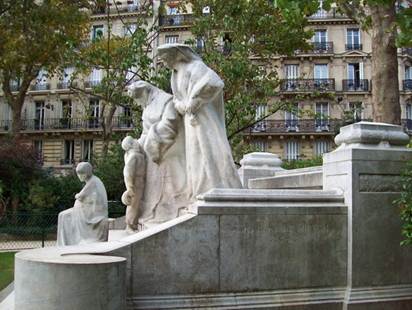
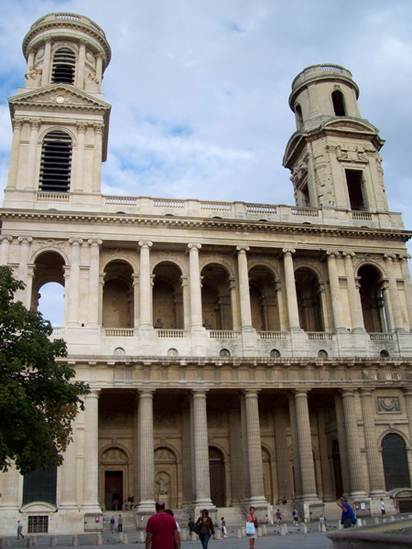
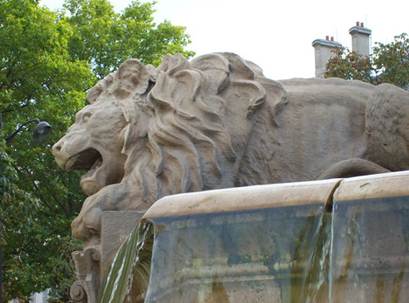
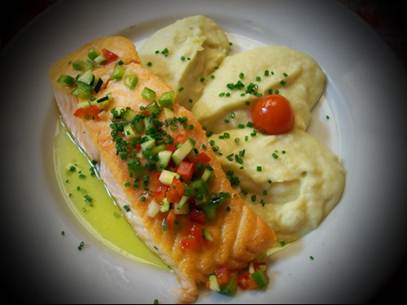
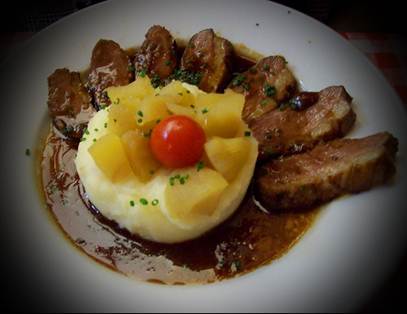
As Geoffroy Roux de Bézieux, the president and major stockholder in Virgin Mobile, is quoted as saying, “being rich gives responsibilities. The first is to contribute to the nation’s solidarity above all in this period of crisis.” Some rich people in French history have done particularly well with their obligation, their noblesse oblige, which is what Geoffroy is talking about. It is also what Warren Buffet is talking about these days. We passed through the Square Boucicaut yesterday evening, and saw a few of the homeless women and kids who are probably among the ones camping out there, encouraged by the rights organization, DAL (Droit au logement). I noticed that there is a Banque de France facing this Square. The other place in Paris where such a camp-in is occurring is on the rue de la Banque, near the Banque de France’s headquarters. So I think the camp-in locations have been chosen because of the Banque’s presence; it has nothing to do with the presence of Bon Marché, the department store that faces the Square from another side. For one thing, Bon Marché has roots in generosity to the poor and working classes. In the Square Boucicaut is a beautiful sculpture, a monument to the charity of two women of the 19th Century, Marguerite Boucicaut (née Guérin) (1816-1887) et Baronne Clara de Hirsch (née Bischoffsheim, from Antwerp) (1833-1899). This work of art was created by Paul Moreau-Vauthier in 1914. Marguerite Guérin wasn't just the wife of Aristide Boucicaut, who founded Bon Marché. She started the Caisse de prévoyance des employés (Employee Provident Fund), funded entirely by the employers’ profits. When her husband died in 1877, she became director of Bon Marché. Once in charge, she created the Société du Bon Marché (1880) and then a pension fund for employees (1886). When she died, she left the bulk of her estate to the welfare and public health organization known as Assistance Publique in France, and she made bequests to numerous philanthropic and scientific organizations such as the Pasteur Institute, the Legion of Honor, and of course, the money for the construction of a hospital that came to be called Hôpital Boucicaut, which I wrote about earlier this summer. Her friend Clara Bischoffsheim was born in Belgium, and married Baron Maurice de Hirsch in 1855 (the same year that de Hirsch became associated with the banking house of Bischoffsheim & Goldschmidt – hmmmm). Maurice was a German Jewish banker born into a Bavarian land-owning family. The de Hirsch couple lived first in Munich, then Brussels, and then Paris. Clara worked with her husband in the founding of colonies in Argentina and Canada, as “outlets” for persecuted Jews in Russia and the Far East. One such “outlet” was an English organization called the Jewish Colonization Association, which sponsored large-scale Jewish immigration to Argentina. After Maurice’s death, Clara continued this work. Their main home was on the Champs Élysées. Maurice had made a lot of money on railways in Austria, Turkey and the Balkans, and in sugar and copper speculation. In the end, the charitable contributions of the de Hirsch couple totaled more than 18 million pounds – in the 19th Century! Tom says that is the equivalent of five times that much in today’s currency. When Louis Pasteur discovered the vaccine for rabies, it was by subscription that the Pasteur Institute was created. The Czar of Russia, the Bey (prefect representing the Ottoman Empire) of Tunisia, the Emperor of Brazil, and Marguerite Boucicaut were among the first donors. At the beginning of the 20th Century, money from Baronne Clara de Hirsch’s estate and from others financed the enlargement of the Pasteur Institute’s laboratories, the construction of the Pasteur hospital, and the purchase of additional land for the Institute. These gifts and ones that followed assured the independence of the Pasteur Foundation, giving it the ability to rapidly respond to public health crises. That’s what I call smart giving. We continued our walk to the beautiful square in front of the great Saint Sulpice church. My sister will be pleased to know that the taxpayer-funded exterior renovation work on this church is now complete, and all the scaffolding has been removed. The ugly construction fencing has also been removed from that part of the square, and pedestrians can finally again cross the rue Saint Sulpice in a crosswalk at the corner of the rue de Canettes, no longer having to go out of their way to either rue Bonaparte or to the rue Garancière, behind the church that is only 20 meters or so shorter in horizontal length than Notre Dame. One of the reasons I love this church is for its history as a church of the people. Unlike Saint Germain des Pres, it was not for the exclusive use of monks, priests, and nuns. It was for the people, built on the site of an earlier Romanesque church. It is named for Saint Sulpicius, a bishop from the 7th century who was known for his resistance to the tyranny of the Merovingian kings. No, I do not believe that garbage about the Merovingian kings being descended from Jesus Christ. Rather, I believe all European “royalty” are descended from early Continental warlords -- the bullies who were the most successful at bullying. To be sure our friends Carol and Ron would have hot water in their shower when they arrive from England to check into the apartment on the rue du Canivet (where we stay in September), we stopped there to flip on the switch for the secondary water heater. Carol and Ron arrive this evening, and this hot water heater heats only at night. Then we walked down to rue Vaugirard to the restaurant Aux 2 Oliviers to make sure it is now open and will serve a la carte, and to make a reservation for the four of us for this evening. That all went well until the server asked me for our phone number, and I blanked out on it for a moment or two, breaking down into giggles. Tom is no help – he never knows the phone number we use here. He depends on me for knowing numbers. The server thought the problem was that I didn’t know my numbers in French, so he said I could say it in English. Language wasn’t the problem; the problem was just having a “senior moment.” But I pulled through and the number bubbled to the surface of my consciousness. From there, we walked up the rue de Tournon to the rue Lobineau, which runs along the south side of our beloved Marche Saint Germain. Tom wanted to dine at le P’tit Fernand. That was an excellent idea. We were greeted warmly at 7:30, and shown to a table deep inside the long, narrow, air-conditioned dining room. Last year or so, I puzzled out the question of whether these Paris restaurants with “Fernand” in the name are all related. They really aren’t, but then they are. Three of them were started by different guys who are friends, and they may pool together to do some things like group purchases. All three have red-and-white checkered tablecloths. One is up on the rue Christine, then there’s this little one on the rue Lobineau, which is our favorite of the three, and there is one down on the boulevard Montparnasse. We weren’t terribly hungry, so we each ordered just a main course, no appetizers. But the friendly server brought us a mis en bouche anyway – some nice little saucisson sec slices, and some of those oblong radishes that I adore. I ordered the salmon, which came with a purée of artichokes that tasted much like purée of potatoes, but a bit more flavorful. The size of the salmon steak was very generous – more than I could finish. Tom had the slices of duck breast, which came in a pool of lovely, dark, rich honey-based sauce, and an artfully arranged serving of puréed potatoes topped by little chunks of slightly cooked apples. Tom then ordered the dark chocolate flourless cake with chocolate sauce and slivers of almonds. It was good and rich, but maybe the chocolate sauce had a little too much sugar. We thought we’d walk all the way home, as we’d walked all the way over to the 6th. But once on our feet, we could tell the old foot bones had had enough. Down to the Mabillon station of the metro we went, to catch the number 10 toward home. Sign
my guestbook. View
my guestbook. Note: For addresses & phone numbers of
restaurants in this journal, click
here. |
Wednesday, August 24, 2011
Monument to
the generosity of Marguerite Boucicaut and Clara de
Hirsch, in the Square Boucicaut.
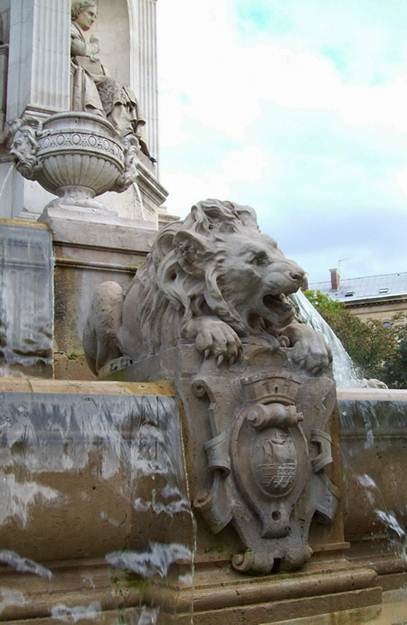
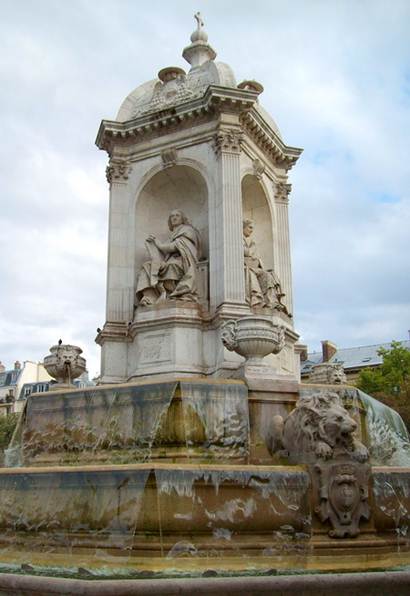
The Saint Sulpice church above, and the fountain in its square,
below. Nice, big cats.
Poached
salmon with puréed artichokes above, and sliced duck breast with puréed
potatoes, apples, and a honey-based sauce, below. Created by le P’tit
Fernand bistro.
|