Paris Journal 2015 – Barbara Joy Cooley Home: barbarajoycooley.com
Find me on Facebook ←
Previous Next
→ << Back to the beginning
|
Paris in the wintertime would be bleak, I think. The days would be so short, and the temperatures, while perhaps not too extreme, would be cold enough that when combined with the damp (think of slush), could chill one to the bone. I’m glad we’re living and working here in the summertime. Work? Tom and I have returned to the project of publishing a volume or two of the letters of Sophia Hawthorne, the wife of Nathaniel Hawthorne. I know that famous couple and their children visited Paris in early January 1858. They didn’t stay long; it was just an interval between their times in England and Italy. I looked into what their visit must have been like at that time. Phase I of Haussmann’s transformation of Paris was underway: the grand croisée de Paris. The east-west part of the grand croisée had been completed, including the new rue de Rivoli and rue Saint Antoine. The north-south axis was under construction at the boulevards Strasbourg, Sebastapol, and Saint Michel. While the construction of the north-south axis was undoubtedly an annoyance during the Hawthornes’ Paris visit, they benefited from the completion of the east-west axis. That part of the project included the construction of the Grand Hotel du Louvre, Paris’ first big luxury hotel. It had been finished in time for the Paris Exposition of 1855. The Hawthornes had a suite on the third floor of the Hotel du Louvre for about a week. Ada Shepherd, who was travelling with the Hawthornes as a companion to their three children, described the hotel accommodations as “neat and tasteful,” thoroughly approving of all the red and green velvet, mahogany, and bronze. She thought this hotel could compare favorably with those she’d seen in New York. Sophia insisted that Nathaniel and she visit the art galleries and the Louvre, but Nathaniel confessed that he would have been happier with simple people-watching. He thought Paris was a lively city, even on a somber day. He liked the architecture of the Louvre better than the paintings. After the experience of dining in a French restaurant at the hotel, Nathaniel made this amusing comparison of English and French cuisine: “All the
dishes were very delicate, and a vast change from the dimple English system,
with its joints, shoulders, beef-steaks and chops; but I doubt whether
English cookery, for the very reason that it is so gross, is not better for
man’s moral and spiritual nature, than French. In the former case, you know that you are
gratifying your coarsest animal needs and propensities, and are duly ashamed
of it; but in dealing with these French delicacies, you delude yourself into
the idea that you are cultivating your taste while filling your belly.” Paris was not what Nathaniel expected. He didn’t know it would be more impressive than London, architecturally. But he wasn’t in France long enough to gain any real understanding of the people or the culture. He did not like the barren and muddy nature of the Parisian parks in the wintertime; he thought England was greener. While they were in Paris, an astronomer named Maria Mitchell joined their group. She, too, planned to go on to Rome. Their party left Paris by train, en route to Marseilles. The family didn’t like Marseilles at all. Sophia, in particular, found it to be nasty and dirty. In her notebook, she wrote, “There is dirt in the hotel and everywhere else, and it evidently troubles nobody, -- no more than if all the people were pigs in a pigsty.” The steamer they took from Marseilles to Italy was, however, “clean and comfortable.” I think of the complaining we do about the discomfort and time it takes to travel from Miami to Paris and back each summer; but it is nothing compared to what these intrepid travelers did in the 19th century. The travel was hard on them. Nathaniel caught a cold and fever, and was really sick for perhaps the first time in his life. I’m not sure he ever fully recovered. I’m thankful for all the comforts and conveniences that we enjoy, and I certainly appreciate them all the more now that I contemplate what my friends Nathaniel and Sophia went through. (Sources: Nathaniel Hawthorne: The English Experience, 1853-1864, by Raymona Hull, and Wikipedia.com’s article on Haussmann’s renovation of Paris.)
|
Monday, August 24, 2015
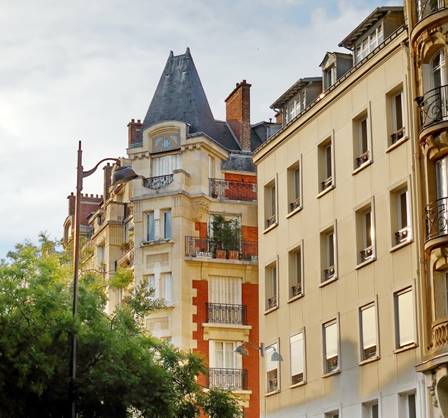
The top of
this apartment building at the rue du Theatre and rue Violet reminds me of
the pointy haired boss in the Dilbert cartoons.
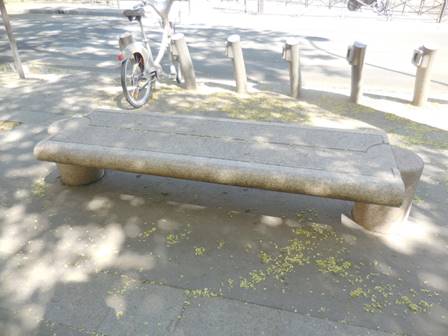
The rue Balard has especially nice granite benches – a notch or
two better than the wooden benches we see on most streets.
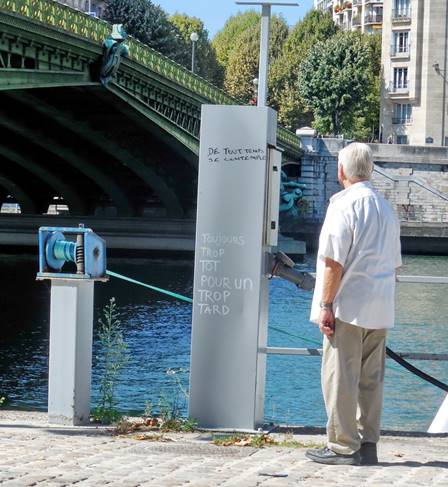
Tom, a
self-proclaimed existentialist, contemplates the meaning of this riverfront
graffiti. Translation: I contemplate all times. Always too early for one too late.
|