Paris Journal 2011 – Barbara Joy Cooley Home: barbarajoycooley.com
Photos
and thoughts about Paris
Sign
my guestbook. View
my guestbook. 2010 Paris Journal ← Previous Next
→ ← Go
back to the beginning
|
Over dinner at Axuria the other night, Carol asked us what we thought about the Dominique Strauss-Kahn situation. We answered her, but what really matters is what the French people think. The French, by the way, call him “DSK,” and they pronounce his last name as “strohs-can,” with a solid emphasis on the final “n.” And the last part is pronounced just like “can” as in “tin can.” There is no accent on one syllable over the other. The very popular newspaper, Le Parisien, reports that according to the polls, the French do NOT want DSK to return to politics. Members of his party, the Socialists, are embarrassed by his return, according to interviews with party leaders. The feminists in all parties say it is unthinkable for him to be anywhere near the frontline in the 2012 presidential elections. One prominent Socialist party leader says “DSK is no longer a subject.” François Hollande seems to be rising to the top of the list of contenders from the Socialist Party for the Presidential election. Nicholas Sarkozy of the UMP (conservative moderates) is unpopular as a president, and too many voters are afraid of the far right wingers like Le Pen. At this point in time, it seems quite possible that the Socialist candidate will win next year. In fact, now the polls say that 57 percent of the French voters favor the Socialist candidate, whoever it might be (as long as it isn’t DSK, and it won’t be). Only 37 percent favor President Sarkozy. The polling company, BVA, isn’t mincing words. “The verdict of the French concerning the political future of Dominique Strauss-Kahn today is extremely severe. It is without appeal,” says Gael Sliman, adjunct director of BVA. “Today in all cases, the French do not want to hear talk” of DSK even supporting a Socialist candidate. So the womanizer and possibly violent rapist finally is seeing the consequences of his long track record of bad behavior. This was the final straw for the French. It’s over, DSK. And it’s a wonder this didn’t happen a long time ago, they seem to be saying. DSK lost his IMF job, lost his political future, and nobody wants his endorsement or support. The French are saying, “Good riddance.” Another thing the French would like to get rid of is the green algae on the beaches of Brittany, as I’ve written about earlier this year and in prior summers. Now, Normandy is also being hit by the slimy, stinky stuff. Right during this week when the liberation of Paris was being celebrated, the famous Utah and Omaha beaches of Normandy were being invaded – by green algae. Thousands of tons of rotting green algae have been removed this year from Normandy’s beaches. The situation is affecting many areas. In the Calvados, for example, the surface area covered by green algae was 76 hectares in 2010 (167 in 2009). In the Côtes d’Armor of Brittany, it was 675 hectares in 2009; 27 in the Loire-Atlantique, and 71 in the Vendée. This talk in the press every year at this time about the Normandy invasion in 1944, the Liberation of Paris, and the advance of General Patton’s army toward Germany makes me think of the death of my uncle George Albert White, Jr., whom I never knew. He was in General Patton’s army, and I’ve been told that he was shot by a German sniper on October 12, 1944. He died, in France, for France. My dad said he died during the attack on Fort Driant, the toughest of several German/Vichy forts around Metz, near Nancy. In 2005, I found some interesting information about that attack on Fort Driant. But on Friday, I tried again. My search came up with this stunning account, on the web site at http://www.jcs-group.com/military/war1941army/194409driant.html By
October 9, Patton's attitude about the attack on Fort Driant
had changed completely. He said, "The show is going sour. We will have
to pull out." It had quickly become a no-win situation for the Americans
because both daylight and nocturnal assaults had failed. Daytime attacks were
vulnerable to the deadly fire that rained down on Fort Driant
from the adjacent forts. At night, assaults were quickly broken up and driven
into confusion when the German squads emerged from their underground tunnels.
German
resistance stiffened even more on October 11, when the defenders began
converting knocked-out tanks into makeshift pillboxes. German self-propelled
assault guns appeared to lay down harassing fire on the Americans. On the
night of October 12-13, the remaining American forces were withdrawn from
Fort Driant. The casualties in the operation had
been inordinately high and can be blamed on the Americans' complete lack of training for such operations.
The Third Army suffered 64 men killed,
547 wounded, and 187 missing, assumed captured. The attack on Fort Driant was the only battle ever lost by General George
Patton. Questions linger as to why the fort was attacked when the Third Army
had little or no gasoline and could have been spending the time resting,
regrouping, and preparing for the coming invasion of Germany. The XX Corps had failed to take Fort Driant, but Patton's XII Corps enjoyed some success south
of Metz in its line-correcting operations along the Seille
River. Attacking
the fort may have appeared to be a costly blunder, but Patton could not
resist the temptation to try out the defenses. If he had done otherwise, he
would have surrendered the valuable momentum his army had gained in its drive
across France. The cost of the operation must be measured against the gains
of keeping the army at a high level of combat readiness and giving the
soldiers valuable on-the-job training against fixed fortifications. The cost
to the Germans was far higher, with Balck suffering
the loss of 43,200 men during the October fighting. Furthermore, the Germans
lost valuable tanks and other equipment that could not be easily replaced. By
the end of November, all the forts had capitulated except Fort Driant. It eventually fell on December 8 after the Third
Army had completely enveloped Metz. Although the attack on Fort Driant was a tactical loss for Patton, the overall
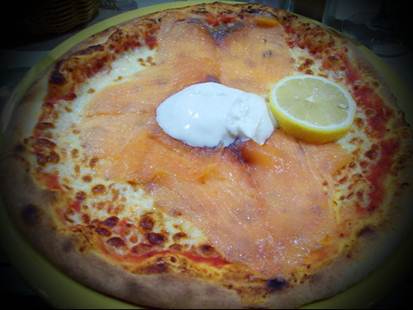
strategic picture favored Third Army. Wow. So my uncle, my dad’s oldest brother, was killed in the only battle ever lost by General George Patton. My grandmother, Edith Violet Egelhoff White, had her oldest son’s body sent home from France for burial. He rests now in the Riverview Cemetery in Wilmington, Delaware: George A. White, Jr., b. June 24, 1914, d. October 12, 1944. Sharing a tombstone with him in that cemetery are my grandfather, George A. White, Sr., and my grandmother Edith. (BTW, my dad said I look just like his mom, Edith.) Another grand coincidence: my husband’s birthday is also June 24. My husband’s middle name, Winfield, is the same as my dad’s first name. And my husband’s father, also a Thomas Winfield, was killed on my father’s 50th birthday. War is hell. So is all other violence and mayhem. Preferring peace and serenity, we were pleased to see during yesterday evening’s walk that the Champ de Mars is still serene, and free of the illegal vendors, scammers, and pickpockets. Even the illegal fruit vendor on the street corner is still gone. When we reached the base of the Eiffel Tower, we finally saw some of the security police, with a couple paddy wagons ready to fill, if need be. But there was no need. We walked back to our neighborhood along the rue Violet. We needed a break from the bustling rue du Commerce. Now that the frenzied Parisians have returned, they are out shopping energetically, snapping up the latest fashions from all the trendy shops that now live on the aptly named rue du Commerce. But rue Violet is still the way the neighborhood used to be. It ends near what was once the town hall for the village of Grenelle, situated at the end of the Place du Commerce. We turned there, and walked the length of the park as the sun began to set. We dined simply at the Commerce Café, at the other end of the Place. Our server was the gentle lady who now remembers us, and knows what beverages we like to drink. Tom had his usual carpaccio of beef with salad and fries, and I ordered a pizza. Pizza in France is not the heavy affair that it is in the U.S. It also isn’t quite as satisfying, but I’m sure it is far healthier. I ordered the one called the Commerce, which is topped with very small amounts of tomato sauce and mozzarella cheese, and a moderate amount of thinly sliced smoked salmon, with a dollop of crème fraiche in the middle. The thin crust is homemade, right out in full view at the pizza man’s station. He tosses the dough around and around, until it is a disk of the right size. It was a satisfying and simple way to end a satisfying and simple day of working, walking, and soaking in this city of life. Sign
my guestbook. View
my guestbook. Note: For addresses & phone numbers of
restaurants in this journal, click
here. |
Saturday, August 27, 2011
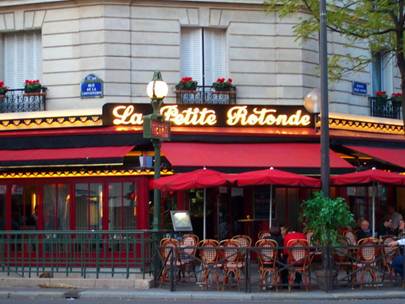
Picturesque
brasserie at the corner of the rue de la Convention and the avenue Felix
Faure.
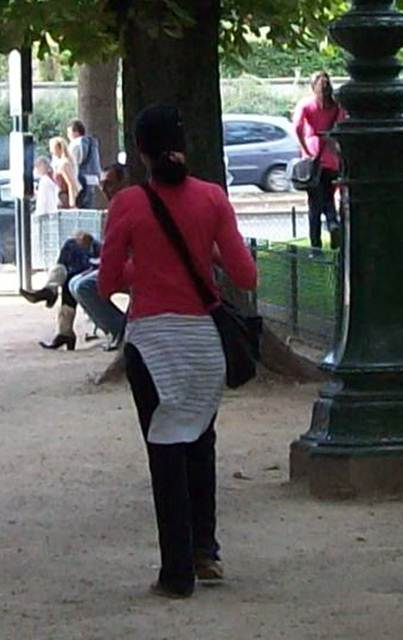
These two
gals in the pink sweaters are Gypsies on their way to get their scam
instructions for the day from the boss Gypsy.
These folks are now gone, no longer working their dubious trade on the
Champ de Mars.
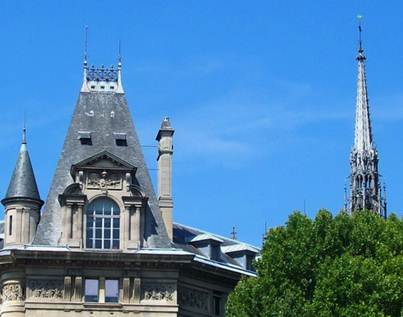
Towers of
the Palais de Justice and Sainte Chapelle on the Île de la Cité.
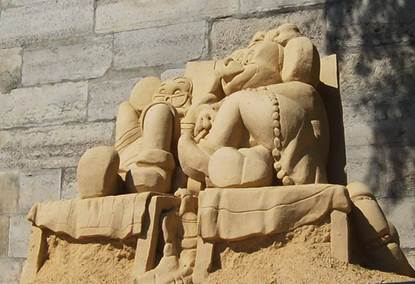
Sand
Castles at Paris Plage (Paris Beach), an event that
has now ended for this summer.
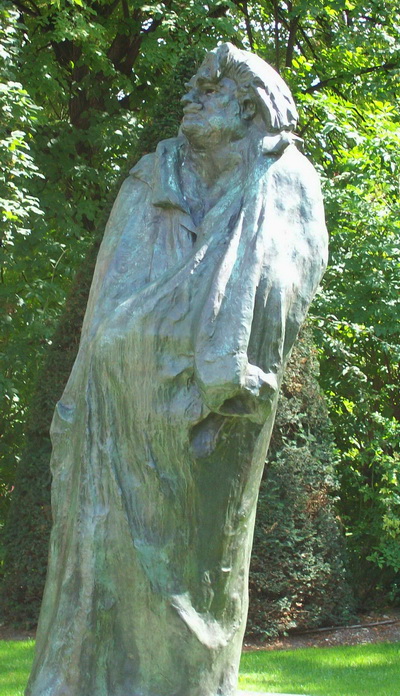
Rodin’s
sculpture depicting Balzac. The
sculptor Augustus Saint-Gaudens disliked this piece of art, saying something
about it looking like melting ice cream or somesuch.
The
Commerce pizza, with smoked salmon and crème
fraiche. |