Paris Journal 2015 – Barbara Joy Cooley Home: barbarajoycooley.com
Find me on Facebook ←
Previous Next
→ << Back to the beginning
|
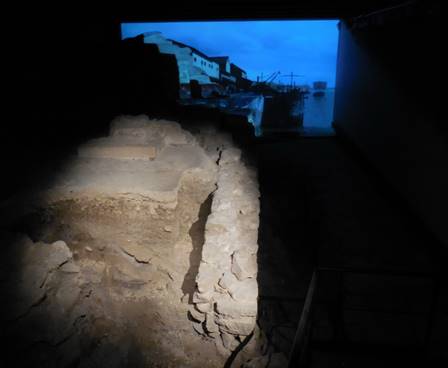
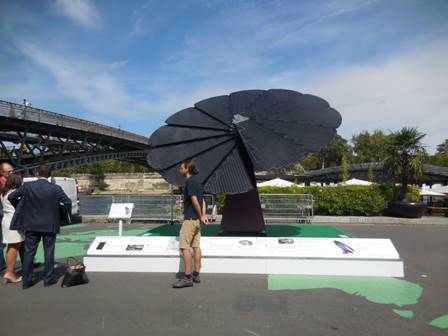
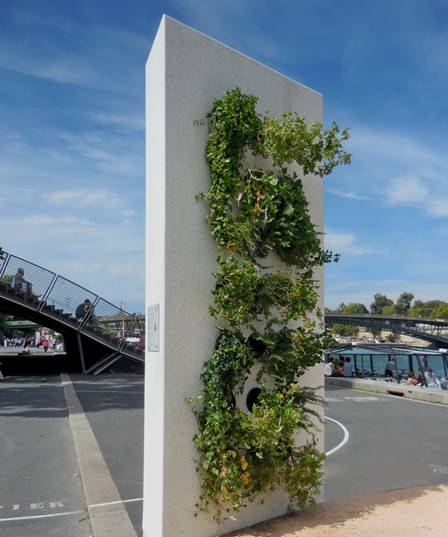
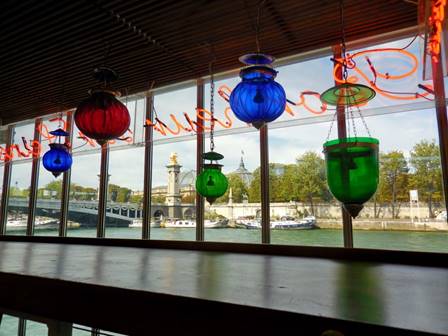
At the middle of an old city like Paris, wonders lie beneath the surface. We’ve seen the remnants of a Roman bath excavated at the Cluny museum, and we’ve read about Roman ruins found when the grand avenues were being constructed according to Baron Haussmann’s plan in the 19th Century. I knew that ancient ruins lay beneath the parvis in front of Notre Dame on the Île de la Cité in the crypt of the grand old church, and that archaeologists had been working on them in recent years. This summer, I saw billboards promoting the new 3D displays added to these ruins, now on view to the public. We decided to see the crypt yesterday. As Tom so aptly pointed out, usually museums bring things together from elsewhere so that we can see them in one place, but in this case, the museum came to the site of what is on display. The crypt, since late 1999, is managed by the city’s Musée Carnavalet. In addition to the excavated ruins, technology has been used to project images to show what the original site looked like when, for example, Paris was called Lutèce – its name during the Roman Empire. We saw the foundations of houses, taverns, hot and cold baths, and the port at the waters’ edge. The expository plaques were well-written – in French, Spanish, and English. Technology was also used to show Notre Dame at various phases of construction – in 3D, interactive images on large touch screens. The images also showed the surrounding neighborhood, with its wealth of half-timbered buildings and narrow alleyways, now almost entirely gone. With the touch or a swipe of a finger, you could change the 3D images so you saw Paris as a seagull would see it in the 12th Century -- flying, dipping, swooping, and curving above the rooftops and alongside the great cathedral. You could see it all from every perspective above the ground’s surface. The crypt displays much ancient history and plenty of medieval history, but there is an annoying dearth of information for the years 500 to 1100. I would love to know what my ancestors Constance of Arles, Robert the Pious, and Henry I thought of the changes that came to Paris during their lifetimes. I’ll just have to save that for more research and reading at some later time. However, the visit to the crypt was well worth the metro ride, the admission fee (7euros each), and our time (2 hours). I seem to be unable to see any museum in less than two hours, unless it is a small museum that I’ve already visited several times. I should note that there was one section of ruins not yet on display to the public, and the city’s web site says the crypt will be closed for work from September 21 to December 21. Plan your visit accordingly! When we left the crypt, a few small clouds were starting to appear, but the day was still gorgeous. We began walking along the left bank of the Seine, in the general direction of home. It is a long walk, requiring a break somewhere in the middle, so we stopped at the Rosa Bonheur café boat and had refreshments at about 3PM. We enjoyed the view of the Seine from our very casual picnic table on the boat where we rested our bones. After our pause, we walked on along the Berges de Seine, noticing a couple more environmental-related displays: a vertical garden, and a set of solar panels arranged on a stanchion as if they were petals on a flower, which could be spun around, angled, and fanned out to take full advantage of the sun’s rays at any time of day. At the Quai Branly, we walked up the ramp to the street level and entered the Musée du Quai Branly’s garden. We didn’t feel the need to stop and rest there, but by the time we’d passed through the Champ de Mars and went through our “hidden” exit on the other side, we were starting to be footsore again. We thought we’d rest on one of the benches in the Place Dupleix, but the available ones were covered in pigeon shit. Oh well. We soldiered on. The neighborhood was fairly quiet along the rue Violet and rue Letellier. Soon enough, we were home in time to rest and dress for dinner at l’Alchimie – my current favorite restaurant in Paris. Last night was one of the first evenings l’Alchimie was open after Chef Eric Rogoff’s vacation. We were the first to enter, and he was right there to greet us. We had a nice chat, and settled down at our table to discuss the menu, nibbling on a mis en bouche of spicy salmon rillettes on toast triangles.
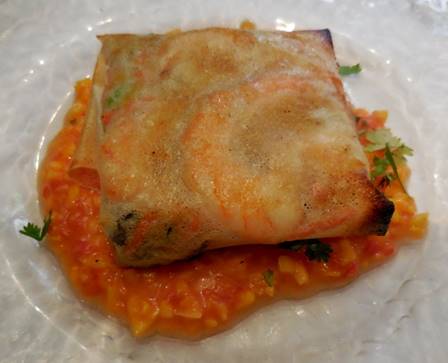
Chef Eric has someone he trusts working in the kitchen, so for the time being, he is doing all the serving himself – a task he seems to enjoy because his is an extroverted people-person. We started with the great, square croustillant de gambas, made with spring vegetables on the inside, including tasty fava beans, and resting on a bed of mango salsa on the outside. The croustillant is a fabulous, generous, delicious start to the dinner. The prawns were not the least bit overcooked.
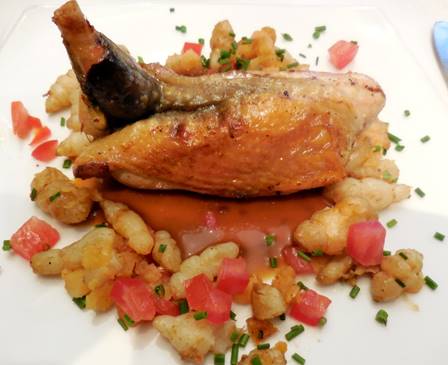
The post-vacation menu was all new. Tom ordered the steak, which was also generous in size, and I had the roasted guinea fowl breast with a mushroom stuffing, served on a colorful bed of diced vegetables.
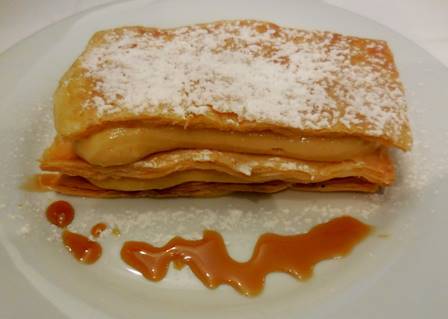
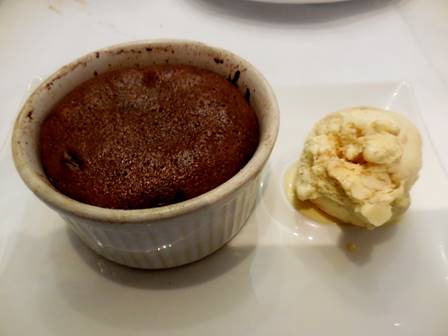
Dessert for Tom was a huge millefeuille with vanilla cream filling, and for me a tidy but rich moelleux au chocolat.
We redeemed some of my Lafourchette.com points on this sumptuous and delicious dinner, so it only cost us 48 euros. By the time we left, plenty of tables were occupied in the tiny resto. Outside on the streets, a very light rain fell as we walked the three short blocks to home. Today? Rain, rain, rain. Nonstop, cool, gentle rain. The balcony plants are happy. The sky is gray, and we’re productively at work at the computers, with papers spread out across half of the living room. |
Thursday, August 27, 2015
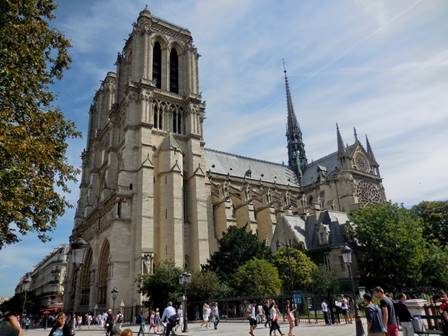
Notre Dame de Paris on a beautiful day.
Ruins of
the port of Lutece in the foreground, and an
animated, 3d image of the same area on the back wall. The sound system played a track simulating the
sounds of the ports, with all its various noises, including calls of criers,
some of whom were selling wares, and some of whom were calling out port
commands and signals.
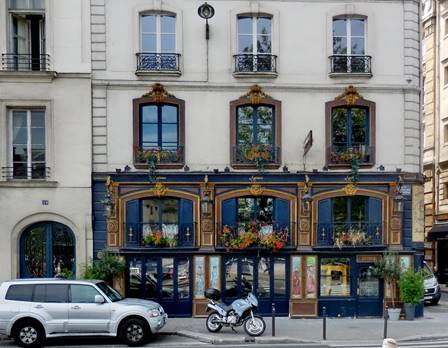
The famous
restaurant Laperouse.
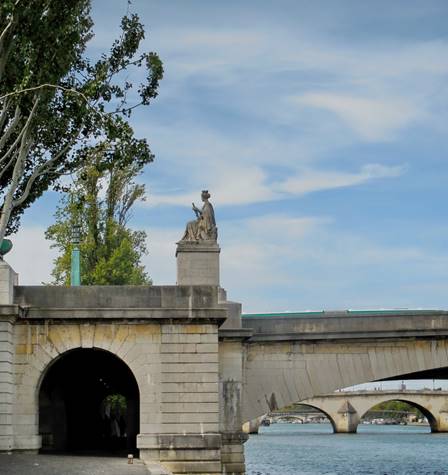
The statue
that represents the City of Paris (1846) on the Pont du Carrousel. The sculptor was Louis Petitot
(1794-1862).
Solar
photovoltaic power system on display on the Berges
de Seine. I’m not sure how well these
panels would hold up in a hurricane.
Vertical
garden wall on display on the Berges de Seine.
View from
inside the Rosa Bonheur café boat.
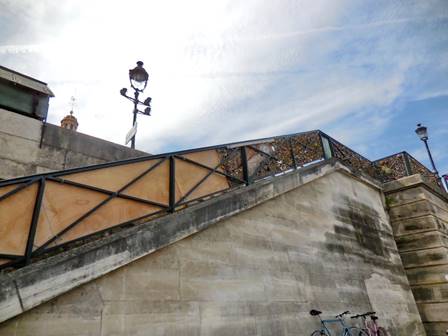
Steps
leading up to the Passerelle des Arts. Sections of the railings had to be removed
and replaced with plywood, due to damage done by those notorious “love
locks.” I think that if the police
began citing the perps for their vandalism, the “love lock” phenomenon would
fade away. |