Paris Journal 2011 – Barbara Joy Cooley Home: barbarajoycooley.com
Photos
and thoughts about Paris
Sign
my guestbook. View
my guestbook. 2010 Paris Journal ← Previous Next → ← Go
back to the beginning
|
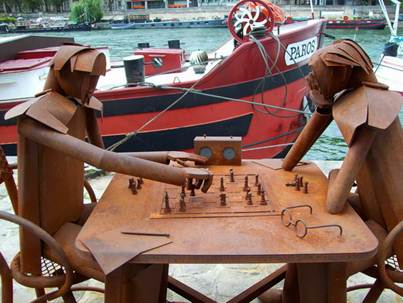
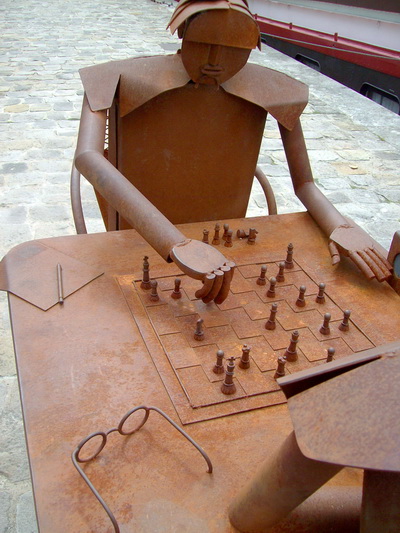
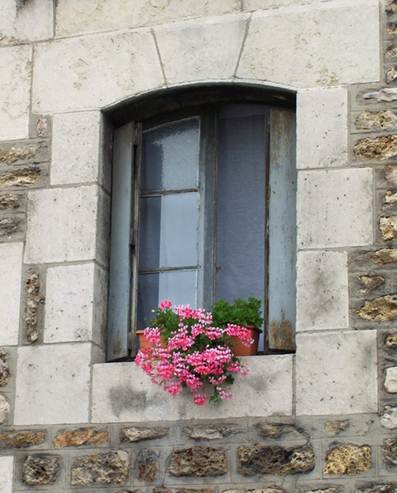
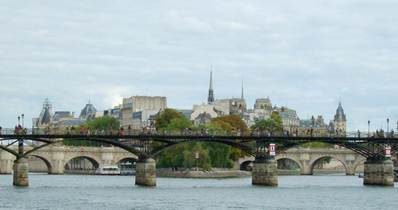
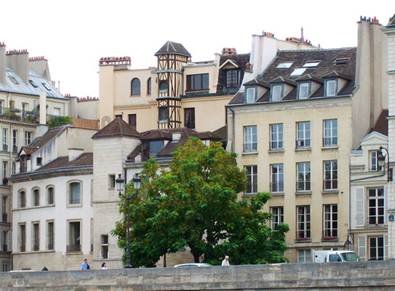
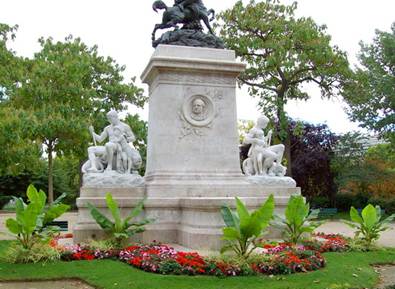
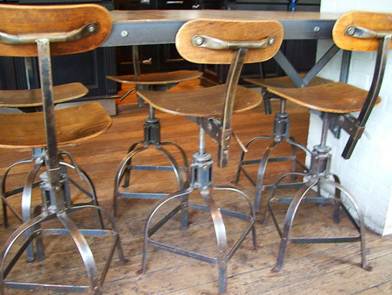
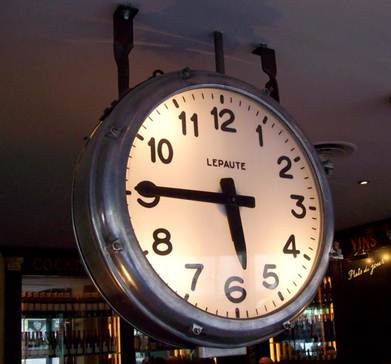
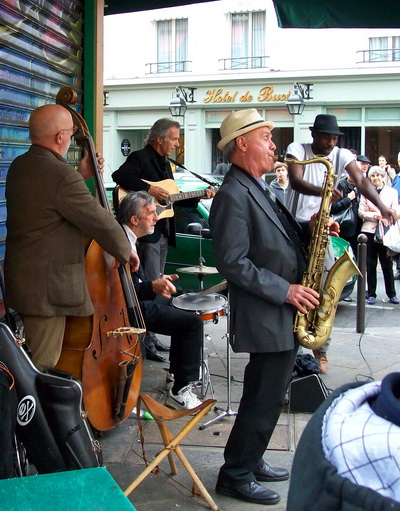
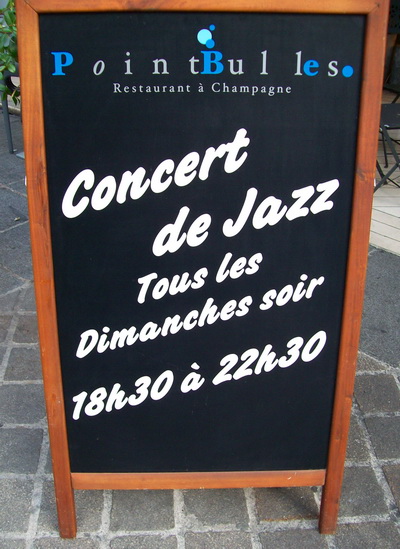
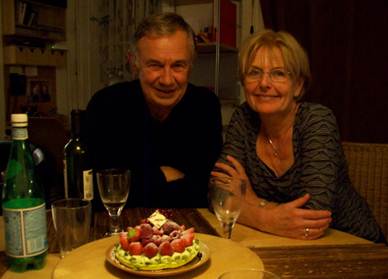
Feeling like children let out to play, we walked with enthusiasm up the rue du Théâtre, the shortest route to the Seine. Sunday afternoon had arrived! Now that we know about the interesting raised plaza and garden around the ugly high rises at the end of the street, we did our urban spelunking maneuver again, scampering up the already decrepit, dark stairs (c. 1975) into the light. Directly across the plaza on the Seine side more stairs led us down to the narrow, landscaped mini-park along the side of the Quai de Grenelle. We reached the end of the walkway, and there we jaywalked across the busy street during a break in the speeding traffic. More steps led us up to the unknown, unnamed, and slightly unkempt little park that has yet another set of stairs leading down to the Port de Grenelle, the calm riverbank. This elevated park and the steps served to get us over the RER C commuter train tracks. “Ah, the train to Versailles,” I thought. And so began our Sunday Seine walk through the heart of the great city, but away from the bothersome automobiles. The first delight along the river was the sight of another Carmona sculpture. We’d passed it before, but then it was occupied by photo-snapping, posing tourists, and we couldn’t get close. This time, we had it to ourselves. I think this is my favorite Carmona so far – two men engaged in a game of chess. As we walked on, a group of three illegal vendors of tower trinkets passed us. The police had obviously just chased them away from the base of the Eiffel Tower. When we reached the Passerelle Solferino some time later, we crossed to claim our usual seats on the steps in the passage to the Tuileries, so we could listen to Bernard Constant. He was taking a cigarette break when we arrived, so we quietly sat and waited. When he finished his break and turned back toward his ensemble of instruments, he saw us and smiled broadly. He came over to greet us, and as soon as we finished shaking hands and exchanging greetings, he asked about the hurricane. I told him what my mother had figured out: we have more than 40 relatives in the area affected by the hurricane. He was surprised and concerned. But Tom explained that this hurricane is serious, but not too serious. Bernard wanted to know if our family had experienced any damage. I explained that we did not know yet. Tom said there was a lot of rain with the storm, but its wind wasn’t too serious (pas si grave). I said, “C’est grave pour les arbres” because it is very serious for the trees, especially when the ground is soft and saturated, and there hasn’t been a major windstorm in the region in a long time. We have been concerned. Of course, in addition to all the relatives, there’s Tom’s publisher in New York, including the editors with whom he works and communicates almost every week day. And there is one of our banks. I’d planned on calling that bank today for something that I knew had to be arranged at the end of the month. But on Saturday, seeing the storm predictions, I decided to phone the bank’s call center on that day, because who knew what the situation would be on Monday. The service representative at the call center was very nice and efficient at taking care of the task at hand, and then we talked about the hurricane. She was a bit worried, and I told her we were thinking about all of the people like her in New York. Today, we’re happy to know that the storm weakened and wasn’t so bad at all. Our hearts go out to those who did suffer losses. But we also thank Mother Nature for being merciful. Bernard sat down to play, and he was very good indeed. How nice it must be to be just loaded with musical talent, “talent oozing out of every pore,” is the way Tom put it. After we’d listened and grooved for a while, we got up to leave between numbers. We put money in Bernard’s upturned tophat, and said our goodbyes. But as soon as we stepped away, he started to play “Take Five.” We had to come back to listen to that one! Moving on along the cobblestones with the Seine on our right and the wall that contains the city built up over time on our left, we noticed that the occasional door or window in this wall seemed to indicated spaces that were occupied, whether legally so or not. One of these places seemed to be an entire apartment. Indeed, as we gazed at it a large man in ordinary attire climbed out of one window and onto a sort of fire escape to come out and join all the rest of us pedestrians down on the cobblestones. One of his other windows boasted a lovely window-box of pink geraniums. As we looked toward the Passerelle des Arts, we noted how the old part of the city, perched on the Île de la Cité and the Île Saint Louis, looked like a medieval fairy-tale city, surrounded by a fantastic moat called the Seine. Moving on, I looked over to the middle section of the Île de la Cité and noticed a clump of buildings that looked older than the rest. They looked almost medieval, including a half-timbered tower in the middle of the clump. We had to cross back over at the Pont de Sully, because the next bridge, Austerlitz, was too far away, and we had dinner plans to meet. The Pont de Sully connects the right bank to the east end of the Île Saint Louis and continues on to connect that to the left bank. From the bridge, we could see the tango dancers and spectators down at the Square Tino Rossi on the left bank. Where the Pont de Sully crosses the Île is a pleasant park called Square Barye, configured in 1938 and named after the sculptor Antoine Louis Barye (1795-1875). Paulownia trees were intentionally planted in this park. This tree is considered to be an invasive exotic in the southeastern United States. Here, people like its big heart-shaped leaves, and dangling Spring blossoms which resemble foxglove blooms. Weeping elms, a big cedar of Lebanon, false acacias, a goldenrain tree, and four Irish yews also grace the little park on the east point of the Île. We reached the left bank at the eastern end of the boulevard Saint Germain. There, across from the Arab Institute, we popped into the Café de l’Institut for tea and a rest. I loved the authentic feeling of this café. In addition to the classic, decorative zinc-topped, dark wood brasserie bar, some of the furnishings looked like they came from old university/lab buildings. And there is a phenomenal, big old clock hanging from the ceiling. Tom consumed a café allongé, and I a glass of ice cold chardonnay. We shared a small cheese plate that included a Cantal that I adored. Fortified, we walked on down the boulevard to the busy little neighborhood around the Carrefour de Buci. The first of two Nicolas wine shops in that neighborhood was closed for Sunday. But the other one, on the rue de Buci itself, was open. I entered the shop, waited in line, and when it was my turn, I politely greeted the shopkeeper and asked, please, for a cold bottle of Pouilly Fumé, using my best French. The shopkeeper looked a little worried about whether or not he had a Pouilly Fumé in the fridge, but when he came back with one, he seemed to be very pleased with himself. He didn’t want to disappoint a regular Nicolas customer, and he knew I was one because I was holding my Nicolas frequent customer card, also known as a loyalty card or une carte de fidelité. With bottle wrapped in paper and in a bright yellow Nicolas bag, we walked over to the corner of the rue de Buci and the rue de Seine and voila! There was a jazz band performing in the space available because the fruit-and-vegetable store was closed for Sunday. The star was a tall, thin, muscular black man with a magical voice. He sang songs that we love, including “Summertime,” with wonderful finesse and feeling. When he spoke, he spoke in English, but it wasn’t American or British English. He was from a Caribbean island, we decided. But his music and style were heavily influenced by African-American spirituals from the U.S. We called Carol and Ron, and determined that the best time for us to arrive at their place would be in about a half hour. So Tom and I set off in that direction, intending to go to church at Saint Sulpice. As we passed by the Marché Saint Germain, we noticed a new restaurant there, sandwiched between the trattoria that we like and the Irish pub that we avoid. It is a little Champagne bar/restaurant! And a jazz trio was playing inside! Guitar, bass and saxophone! On the sidewalk was a board announcing that these “jazz concerts” occur every Sunday from 6:30 to 8:30PM! Hooray! What a delight that will be! When we entered the great, hulking, haunting, wonderful church of Saint Sulpice as mass was underway. We quietly took seats in the not-so-occupied part of the church. The real congregation was clustered around in the middle part of the church, by the choir area, and the magnificent organ above and behind us was being played. I listened to the priest, but didn’t try too hard to understand his French because the echo in that grand space was distorting the sound of his speech. A woman with a beautiful, strong alto voice led the congregation in singing a few short hymns. At 7:30, it was clear that the mass was about to end, so we quietly exited. Around the corner on the tiny rue du Canivet, we entered the door code by the ancient, heavy wooden door that is listed on the registry of historic monuments (c. 1640). In the charming, small stone courtyard with its potted plants, we took stairway to our left up to the first floor, where we were greeted by Carol. I gave her the Pouilly Fumé. Ron popped it into the freezer to chill a little more. In the familiar apartment, Carol, Ron, Tom and I shared our stories of adventures of the day. Then we had a delightful dinner prepared by Carol. The Pouilly Fumé complemented the fish and vegetables that she’d lovingly cooked en papillote – in little paper bags made for cooking. She is such a good cook! For dessert, we shared one of those gorgeous concoctions called an entremet -- from the famous Gérard Mulot patisserie, located nearby on the rue Lobineau. This entremet was a macaronnade, consisting of a pistachio macaroon base, pistachio cream, and a raspberry marmalade flavored with violet. The entire thing was meant to be consumed by one person, but we cut it into four pieces and that was just right. The whole day was like that – just right, we thought as we rode the number 10 metro home. Sign
my guestbook. View
my guestbook. Note: For addresses & phone numbers of
restaurants in this journal, click
here. |
Monday, August 29, 2011
Carmona
sculpture of chess players.
Place in
the riverbank wall where someone is living.
The old
city looking like a fairy tale with a moat.
A cluster
of ancient buildings on the Île de la Cité.
Square de Barye, on the east end of the Île
de la Cité.
Seating at
the Café de l’Institut looks like it’s from an old
laboratory or drafting room. Below,
the Café’s clock.
Jazz band
on the rue de Buci and rue de Seine.
Point Bulles, a new restaurant featuring Sunday live jazz.
Ron and
Carol and the entremet
from Gérard Mulot. |