Paris Journal 2008
Sign
my guestbook. View
my guestbook. ←Previous Next
→ Barbara’s
home page
|
We went to dinner with Jim and Maddy shortly after their arrival in Paris on Friday evening. At Le Séraphin (see restaurant recommendations), we had a peaceful and fun dinner at the best table in the house. The restaurant wasn’t too busy, so the bartender was playing around with inventing a new cocktail. He gave it to Jim to see how a customer would like it. The drink had an intense color of aqua marine, and it had some mint liquor in it, which made it very refreshing. He asked us to think of a name for it, and the best we could come up with was “bleu marine,” but unfortunately that means navy blue – not quite the right color. “Blue lagoon” is already the name of another cocktail, so that wouldn’t do. Jim and Maddy started with a cold beet and ginger soup, which Jim thought was too tart in taste, but Maddy seemed to be okay with it. He couldn’t think of the French word for tart, and I could only come up with half of it until I got home, when the other syllable came to me: piquante. My entrée was great. It was called a crumble de legumes, but it was really like a ratatouille with a crumble topping added. Then it was topped off with a little scoop of tomato sorbet – just the right complement. I ordered the duck leg because the menu says it is a house specialty, and it was good. Now of course I cannot remember what anyone else had for their main course. Maybe Jim had steak? Tasty but a bit tough? That’s the way it usually goes. Tom ordered dessert: three little dishes of chocolate mousse, each one a different kind of chocolate. Maddy and I cheerfully helped him consume these. There were several reasons I didn’t get around to writing in this journal yesterday, but one was my delight in devouring every word of the big feature story in Le Parisien from the day before. (Another reason: I updated the web site campuspartners.osu.edu yesterday.) Every day, Le Parisien comes out with a splashy cover with a photo or two and big, eye-catching headlines. Then pages 2 and 3 have the feature of the day – several articles on one subject, often a subject that we find banal. For example, one day last week, the feature was about the price of peaches. Yawn. But on Friday, the feature was about NUCLEAR WASTE. Anyone who knows me knows that I am fascinated by this subject, and that I know something about it, having worked on a huge government-funded nuclear waste study project when I was young (early to mid 1980s). If you don’t know this about me, you don’t really know me at all. As a science writer, I used to write about this subject in an attempt to explain it to the general public. So yesterday, I had the opportunity to review a French writer’s attempt to do what I used to do. I give him/her an A minus. The first article came with a graphic that shows where in France the nuclear waste is now located. Here’s a list: · A center of military research at Valduc · A nuclear waste treatment facility at the Hague · Nuclear sites with provisional storage at the Hague, Le Tricastin, Marcoule, and Cadarache. These last three places are in Provence. · Three centers for storage of moderate duration, i.e., three hundred years. One of these is at the Hague and two are in the Aube at Morvilliers and Soulaines. The Aube department is, believe it or not, in Champagne country! · Finally, the crown jewel – a deep underground storage repository (enfouissement) at Bure, in the Meuse, which Le Parisien claims is in Champagne country, but it is actually in the region next to Champagne, Lorraine. A second article lists the four basic types of nuclear waste: · “Les substances de ‘haute activite a vie longue’,” which is what we call high-level nuclear waste. It is dangerous for 10,000 years, or longer. Spent fuel rods from nuclear power plants are in this category. · “Les substances de ‘moyenne activite a vie longue’,” which we call transuranic waste. This waste isn’t so hot, but it is still somewhat dangerous for thousands of years. · “Les substances de ‘faible et moyenne intensite, a vie courte’.” This we call transuranic and mixed low-level waste. It generally isn’t so hot, and it needs to be isolated for only 30 years or so. · “Les substances a ‘tres faible intensity, a vie courte’.” This is what we call low-level waste. In France, much of it is pieces of buildings from nuclear installations that have been dismantled and are slightly contaminated. French high-level waste is now temporarily stored mostly at the Hague, Le Tricastin, Marcoule, and Cadarache. Transuranic waste is at Bure, the mixed low-level waste is at the Hague and Soulaines, and the low-level waste is in Morvilliers. Next comes an article about “the sites that pose a problem.” The problems described don’t sound too serious, and mostly are a result of some of the older storage – that dating back to the 1970s. There is also a slight tritium contamination problem around the military base at Valduc. The author of the articles was especially enthralled by the high-tech, sci-fi nature of the deep underground repository at Bure. (This was the subject of the next article.) The repository is 500 meters underground: imagine one and a half Eiffel Towers deep. For the time being, the underground facility is only being used for studies. But the plan is to store all the high-level nuclear waste there, starting in 2015 as the law requires, if this site is approved by the Parlement and then the people. That is one huge “IF,” as I know from my work in 1987 when the US Congress defunded the scientifically based high-level nuclear waste repository study project in Texas. Now, the US is planning to use Yucca Mountain in Nevada for storing high-level nuclear waste. But that mountain, made of a volcanic rock called “tuff,” is tectonically unstable. Yucca mountain probably won’t be judged to be suitable for high-level nuclear waste. If it is, the Earth is in trouble, maybe. The site at Bure, on the other hand, is seismically stable. Let’s wait and see, but the French may very well do a better job of dealing with their high-level nuclear waste than Americans will do. One of the most interesting studies done in the nuclear waste project that I worked for involved figuring out how to mark the repository as a place where very dangerous material is stored. This is a difficult problem to solve because no civilization has lasted for as long as 10,000 years. The challenge is to find a symbol that will retain its meaning, almost forever, in human terms. The study I remember concluded that the best symbol to use would be the skull and crossbones. In France, researchers have selected reproductions of Munch’s well-known painting, “The Scream.” Now there’s a difference between French and American cultures! Another short article describes the varying attitudes of people located near the proposed storage repository. The situation is much like it was in the US – some public officials are in favor of the project because of the jobs and economic growth that it will bring, and others are opposed to it, not wanting to be the nation’s “poubelle nucléaire” (nuclear garbage can). Many people don’t care; whatever happens will happen – that’s what Le Parisien says they think. The anti-repository group called “Bure stop Meuse” accuses the government agency, ANDRA (Agence nationale de gestion des déchets radioactifs), of distributing “propaganda” to school students and teachers, whom the agency brings to the facility for field trips. For its part, ANDRA says “Yes, we do this, for the purpose of transparency.” In other words, ANDRA doesn’t have anything to hide and the agency wants to share information about the plans for Bure and the facility’s function. Ah, yes, this makes me nostalgic for my old job at the Office of Nuclear Waste Isolation (ONWI, pronounced like the French word for “boredom”) at Battelle. But I would never do this public information work for the Yucca Mountain project. Alas, my old job no longer exists. If I were young and French, there’s nothing I would like more than to do public information programs for ANDRA. Think about it – to have a job working on a project that has significance for more than 10,000 years? Now that is a job with real meaning. |
Sunday, August 3, 2008
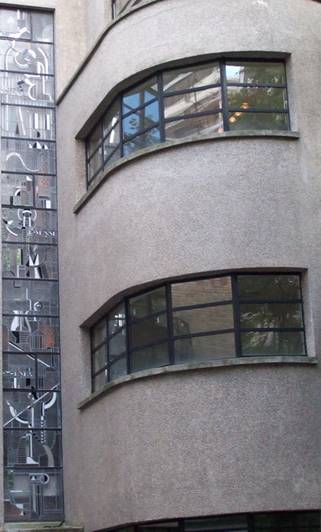
We walked to see the Atelier Barillet
yesterday evening. Louis Barillet was a
master glassmaker.
The Atelier is located on a tiny street called Square
de Vergennes. Traffic is limited to
those who live on the street. This
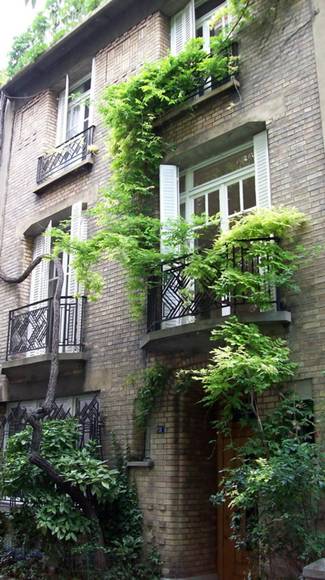
house, on the secluded Square de Vergennes, is where I would love to live in
Paris. Most houses on the street, like
the Atelier, seem to have been built in the 1930s. Notice the ancient vine.
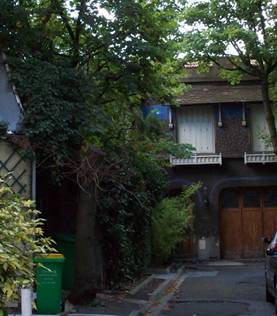
Another corner of the Square Vergennes.
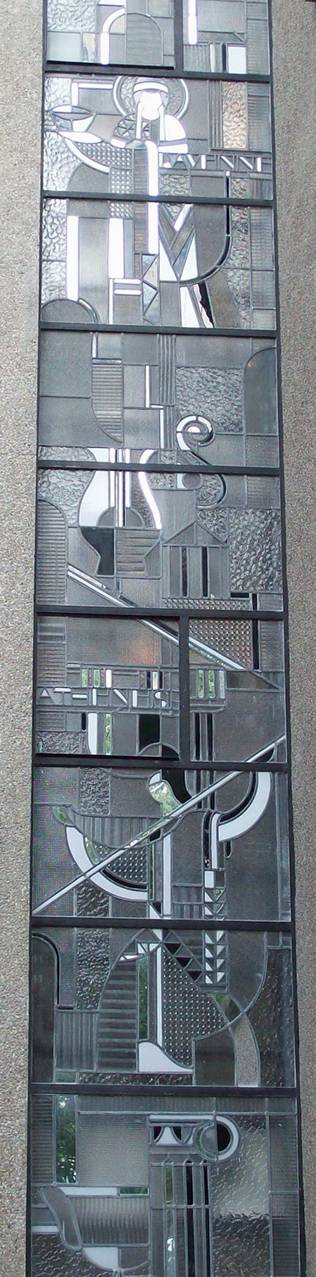
The fabulous window on the Atelier Barillet. |