Paris Journal 2012 – Barbara Joy Cooley Home: barbarajoycooley.com
Find me on Facebook 2011
Paris Journal ← Previous Next
→ Go back to the beginning
|
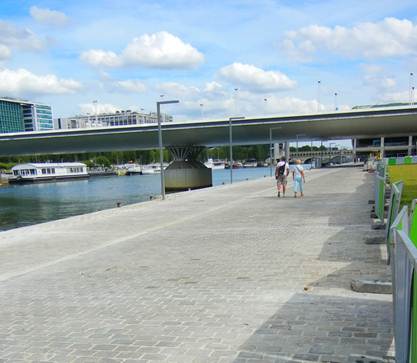
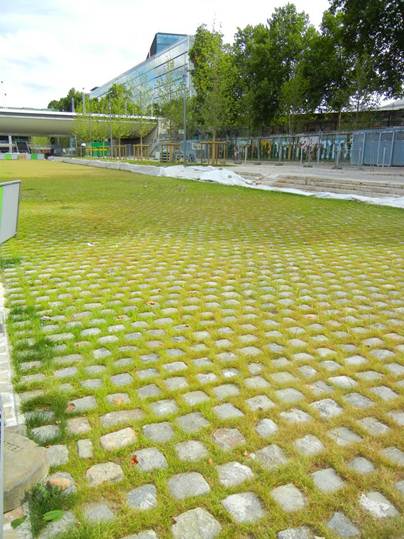
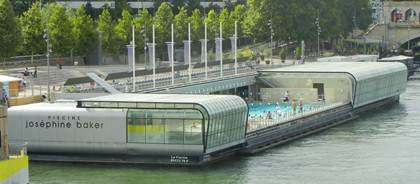
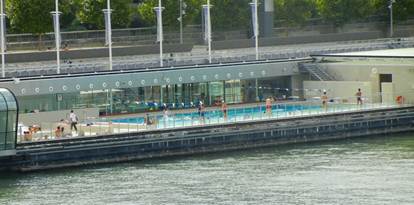
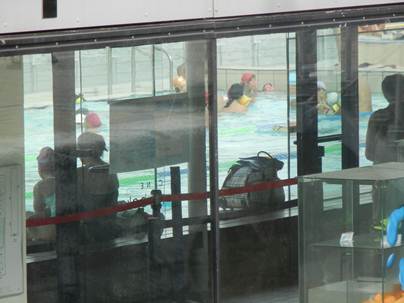
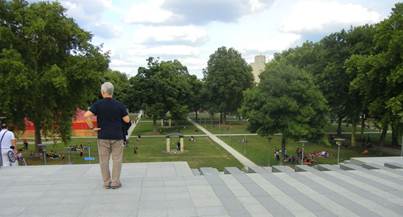
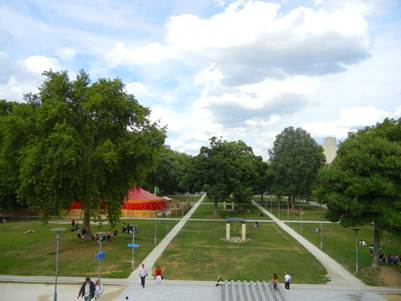
We’ve grown accustomed to thinking of Sunday as the day for our grandest walks along the Seine. That’s because the highways along the river are closed to automobile traffic on that heavenly day. But with all the changes that the Delanoë administration has been making, and is continuing to make, the grandest walks along the Seine are slowly becoming available to us just about any day of the week, weather permitting. I’ve often wondered what would happen if one would combine the efforts of Bertrand Delanoë (the mayor of Paris), and my friend Darla Letourneau, of the BikeWalkLee organization in southwest Florida. That would be the happiest collaboration imaginable for pedestrians and cyclists. Yesterday, we took the metro’s line 10 out to its farthest point east, the Gare Austerlitz. We exited the station, turned the corner and voila, there is the Seine. When we walked from that point eastward last year, we were in a great construction zone, where the highway was being ripped up and was about to be replaced by pavers and pedestrian amenities. Yesterday, we found that this place is still a construction zone, but the project is nearing completion. The walking was so easy there, especially because it was Saturday, and no construction workers were present. In an area called Les Docks, the nearby buildings are being improved along with the riverfront. One formerly very ugly building that was plagued by a really seedy riverbank beneath it is now a trendy-looking school for business management, fashion and design. Young people were lounging at tables and chairs on a deck above us as we walked by; a DJ was setting up equipment near them. Party time at the school of design was approaching. As we reached the end of the construction zone, we were entering a stretch that had been renovated not that many years earlier. In the past few years, this had been made part of the Paris Plage (Paris Beach) summertime event. But this year, it just is what it is – a nice, pedestrianized stretch of riverbank with café/club barges/boats and outdoor terrasses for drinking, sunning, and relaxing. Why spend Paris Plage money here, where it is already like the beach in so many ways? It was like bringing coals to Newcastle. So this year, no Paris Plage here in the 13th. But it doesn’t make much difference. Who needs sand when you have such beautiful granite pavers? Most of the newer pavers in this long stretch of the left bank are smooth and flat – much easier to walk on than the old cobblestones. But here and there, we encountered sections with old cobblestones that had been dug up and then re-installed. My favorite areas we saw early on in our walk, in the construction zone, where pavers are spaced just so that a bit of grass can grow between them. The grass has been planted and is starting to grow now. The effect is pleasing, as long as the grass is trimmed from time to time. We passed under the Pont de Bercy, which is very like the Pont de Bir-Hakeim over in the 15th arrondissement. These two bridges are multi-level; a train uses the upper level, and the main level is for cars and pedestrians. The main level is an arcade of arches decorated by hanging lamps. The architecture is romantic. I know that the Bir-Hakeim bridge has been used in movie scenes; the Pont de Bercy probably has been, too. Between the Pont de Bercy and the pedestrian bridge called the Passarelle Simone de Beauvoir are several long boats. A few are cafés/clubs, but one barge is the relatively new Piscine Josephine Baker – a floating municipal swimming pool “Piscine” is one French word that I dislike. It sounds like what you should not do in a swimming pool. Pools are important to me. When I’m in Florida, 9 months of the year, I am a long-distance swimmer; I swim 6,000 feet per day. That’s well over a mile. I recently figured out that if I add a few more lengths to that swim, it will be an even 2 kilometers. That’s what I plan to start doing in October, when we return. I’m spoiled by the swimming pools available to me in Florida, and therefore I do not swim in the municipal pools in Paris. Most Paris pools are indoors, and that is not appealing to me. The Piscine Joséphine Baker comes close to being a pool I’d swim in, but it is too crowded with other swimmers and kids playing. That just doesn’t work out for a serious swimmer like me. And that’s okay; a break from long-distance swimming for a few months a year is not a bad thing for the body. Still, it was fun to see the Piscine Joséphine Baker, and to think about this long tradition in Paris. You see, there was a pool on the left bank as long ago as 1785. Back then, the facility was called “baths,” and it was named La Deligny. The original baths were built on stilts. Later, I think in the 20th Century, La Deligny became a floating pool, on a barge, as the Piscine Josephine Baker is now. La Deligny was near the National Assembly building, which is like the French version of our U.S. House of Representatives. Only the representatives are called “deputies” in France. The original baths at La Deligny became a swimming school in the 19th century. Other amenities were added, such as a bar. The 20th century brought topless sunbathing to La Deligny. That bothered some of the deputies in the nearby National Assembly. So the facility’s manager designated one area only for topless sunbathing, and children, for some reason, were not allowed in that area. Wouldn’t it have been easier and more logical just to ban adult men from that area? La Deligny drowned, sinking in the summer of 1993. The Piscine Joséphine Baker is considered to be its replacement. Tom and I walked up the cobblestone ramp to the Passarelle Simone de Beauvoir. This relatively new pedestrian bridge, already famous for its architecture and its peculiar vibrations, is now starting to attract lovers’ padlocks, just as the Passarelle des Arts has done. The Simone de Beauvoir pedestrian bridge connects the Mitterand national library on the left bank with the grand Parc de Bercy on the right bank. From this passarelle, we had a great view of the Piscine Joséphine Baker and other Seine delights. The bridge ends atop a high floodwall/dike that borders the park. The park’s designers cleverly turned this higher structure into a water cascade as well as wide banks of steps going down to the park level. From the top, we had a good view of that end of the park. It was a perfect vantage point for us to use to look for Dan and our twin granddaughters, who were coming to meet us. Dan and the girls had been walking along the Promenade Plantée. They got a little lost after that, but via the cell phones, we redirected them. They were able to catch a metro to get back to the Bercy neighborhood. When we spotted them, we waved them on up to where we were standing, so we could take the girls out on the passarelle and show them the view of the floating swimming pool. I also pointed out the bridge vibrations; they thought that was cool. They walked along, sliding their hands on the railing, to better feel the vibrations. Then the five of us had a nice walk through the length of this superbly designed park. The Jardin Yitzhak Rabin, in the middle of the park, is formally beautiful. The water features were all turned off in the park; I am not sure why, because the drought must have ended this spring, when northern France was soaked by rainstorm after rainstorm. The girls kept asking if there was a playground in this park. Tom spotted one at the end, and so we adults rested on a bench while the girls played. Our girls were the best-behaved kids there. I was so impressed with how gentle and careful they were when smaller kids were near them. We enjoyed being a part of a diverse mélange of ethnic types and races at that playground. The “Bercy Village” on the Cour St. Emilion borders that southeastern end of the park. This clever use of an old cobblestone lane bordered by quaint little old stone former wine warehouses is now a pedestrian-only shopping and dining area. We’d told the girls that there was a pet store there, and that if it still existed, we could visit it.We saw fancy, expensive, cute cats, dogs, rats, gerbils, fish, etc., etc. The girls loved it. The wine trade was bolstered in Bercy by the fact that outside of Paris, wine sales were not taxed. Bercy also developed a reputation for deviant drunkenness – a problem called the “fever of Bercy.” |
I especially like the areas where grass is growing amongst recycled
cobblestones.
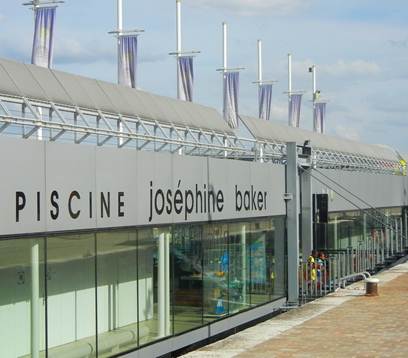
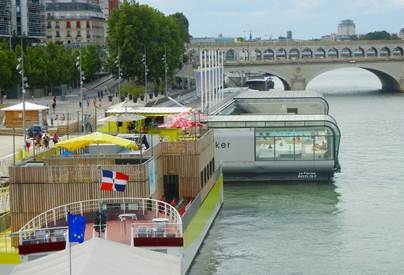
Piscine Josephine Baker – a floating municipal swimming pool.
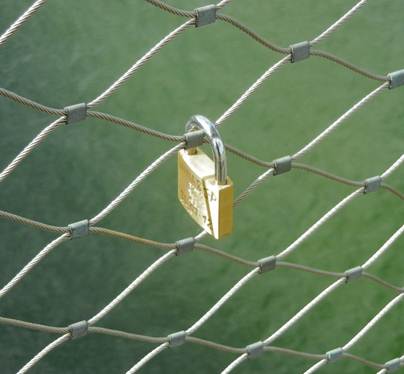
Lovers’ padlock on the Passerelle Simone de
Beauvoir.
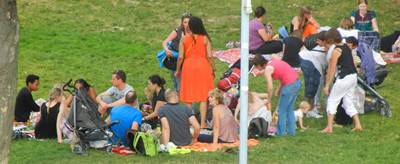
A group of families enjoying a Saturday in the park.
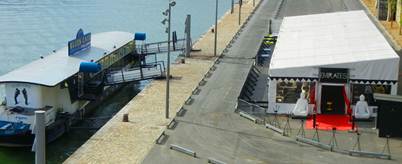
Two clubs on the right bank at Bercy: the Blues Café, and the Emirates. |