Paris Journal 2010 – Barbara Joy Cooley Home: barbarajoycooley.com
Photos
and thoughts about Paris
Sign
my guestbook. View
my guestbook. 2009 Paris Journal ← Previous Next
→ ← Go
back to the beginning
|
Disclaimer: You may have
noticed that I often link to items in Wikipedia. While I do enjoy this resource, I don’t
consider it to be the necessarily the best.
And I absolutely deplore Wikileaks and hope that its leader, Julian
ASSange, is deprived of his ASSets for his total disregard for safety and
security. I’ve been thinking about France’s colonial past again. I do love France, but for years I wondered why it is that France’s former colonies – generally, or on average – do not seem to do so well as, for example, Britain’s former colonies. Some will argue that Britain had more of a practice of making sure there was a functional government in place in each colony. Maybe that’s part of the answer, I’ve thought, but it isn’t everything. Then the horrible earthquake hit Haiti, a country that hasn’t functioned well ever since well before its independence in 1804. As we felt like our hearts were broken as we read and saw news accounts of the devastation, that nagging question was still burning in my mind. Late last year it was announced that my church had finally found its new permanent pastor, John Danner. He has a Ph.D. in history, and his dissertation was on the history of the church in America. As soon as John started the job in January, he announced that he’d be offering short courses that would meet on Wednesdays for a couple of hours in late morning. Each course would have three or so sessions. One of the first courses he gave was on the history of Haiti. I signed up at the first opportunity. Maybe, I thought, this would give me at least a part of the answer I was seeking to my question about former French colonies. John wasn’t an expert on Haiti to begin with; he approached the subject as a scholar, and one who is trained in the field of history. He studied the subject, then he was ready to teach the course, which consisted of three lectures on three consecutive Wednesdays. I took copious notes, which I do not have with me here in France. I got the answer I was seeking. Here’s a nutshell version of what I learned. There is much more to it, of course, but here is the essence. I’ve since discussed what I learned with a couple people who have lived and worked in Haiti, and they’ve confirmed the essence of this. Haiti, which is now the poorest country in the Americas, was once an incredibly productive colony with a particularly brutal version of slavery. It was first exploited by the Spanish, who began importing slaves from Africa in the early 1500s, but the Spanish lost Haiti to the French in 1697. There had already been French people living in Haiti before that, in the form of pirates who operated in the region. More French colonists arrived and established plantations because, quite frankly, they could make a lot of money. The profits from raising sugar, indigo, tobacco, and coffee quickly made Haiti, then called Saint-Domingue, into the richest French colony in the world. These economically analytical French colonists figured out that it was more profitable to “amortize” a slave than to allow the slaves to procreate. In other words, slaves would be worked to death, typically surviving only 4 to 7 years after arrival, and then would be replaced by newly imported slaves. It was a particularly brutal version of slavery practiced by the French in Haiti; John shared some gory details which I will spare you in the interest of brevity. Let me just say that the French behaved very, very badly in regard to the operation of their plantations, sacrificing human life and decency in the pursuit of riches. Meanwhile, later in the 1700s back home in France, a Revolution happened. At the same time, the pressure for human rights and freedom from slavery was mounting in Haiti, and in other colonies as well. Independence came to Haiti in 1804, but at an incredible price – literally. There was an embargo against produce from Haiti, which the U.S. did not help with because many Southerners in the U.S. did not want to do anything that could be construed as encouraging a slave rebellion in their states. Without the ability to sell their produce, Haiti went from being rich to being impoverished. In 1825, France blackmailed the new country by insisting that an enormous sum of money be paid by Haiti to the French in compensation for loss of property when the French had to leave their plantations. And this loss of property, for which Haitians had to pay, was not only for the real estate – it was for their very own bodies. They were the only former colony that had to purchase themselves. The debt, as I said, was enormous (150 million francs), and would not be paid off until 1946. In all the many intervening years, the debt crippled Haiti economically, and functional governments were not possible. The lack of functionality bred a culture of corruption. As I look around Paris, I see evidence of the prosperity that came to the city of light in the 1700s – so many grand buildings were built; so much wealth was infused into France during this period of colonial plundering, abuse, and bloodletting. If any one country should pay for the rebuilding of Haiti, it should be France. I do remind myself that in the 1700s these awful deeds were committed by only the upper crust of French society. The masses were, for the most part, poor and suffering. While most were not enslaved, they were living a miserable existence, and were longing for their own freedom from oppression. And as I read about the history of philanthropy in this period, I realize that among the upper crust of French society, only a handful of aristocrats seemed to care about the poor. The same names are seen over and over when one reads about who established which charities. No wonder the French had a revolution. Tom occasionally reminds me that it was largely Africans who sold other Africans into slavery. And there are still many problems among African leadership today. On July 14, President Sarkozy invited many African leaders and their spouses to sit with him and his wife in the viewing stand for the phenomenal traditional Bastille Day military parade on the Champs Elysées. He was photographed with some of those who have committed terrible atrocities and injustices against their own citizens. For that, President Sarkozy was roundly criticized, and I think he deserved it. His approval ratings are now down to around 35%. That’s pretty low. President Obama, on the other hand, did not invite African leaders to the recent celebration of African history that happened in the U.S. Instead, he chose to focus his attention on young people from Africa who are learning to be leaders. The African leaders snubbed by President Obama did feel the sting; but that was the point. If President Sarkozy had done the same thing, the effect would have been all the more intense, and the message to the snubbed leaders would have a greater impact. Treat your people like people. Respect their rights, and the rest of the world will respect you. Pat and Stanley came over to our apartment yesterday evening. We had drinks and enjoyed showing them around here, then we walked up to La Gauloise for a very fine dinner. We were greeted very warmly by almost the entire restaurant’s staff, and we were given a sizeable, very comfortable table in a prime spot. Stanley had the spinach salad, which is fresh and generous. Then he followed that with the salmon, which he said was delicious. Tom ordered the beef bourguignon again, which he said was, if anything, even better than before. Pat and I each had the volaille jaune, a chicken breast prepared the way Julia Child would do it, served in a copper pot with a delicious sauce, pommes vapeur, and morel mushrooms. We both thought the dish was astoundingly good – especially the sauce. Here’s a recipe that is close to what we were served. The “jaune” in this dish does not refer to the chicken, but to the wine that is used in the sauce. It is a “yellow wine,” a vin jaune from the Jura region of France. Pat enjoyed an Ȋle Flottante as she told a touching story about how her grandmother, who lived on a tiny farm in Tennessee, would go to the henhouse, collect a few eggs, and make her a meringue each time she’d come to visit when she was a little girl. When we left, once again, practically the entire restaurant staff thanked us and bade us farewell. After dinner, we walked quickly through a light drizzle of rain to the cover of the portico of the École Militaire, where we watched the Eiffel Tower twinkle for five minutes at 10PM. Pat and Stanley had been to the Eiffel Tower when they visited Paris years ago, but they’d not seen it twinkle until last night. Then we scurried back to the taxi stand on the corner of the avenues Suffren and la Motte-Picquet, which mercifully is in a bus stop shelter. It is nice to see somebody recognize that bus riders and taxi customers can peacefully coexist in the same shelter. I stood out in the rain and hailed the taxi. It didn’t take long. Tom told the driver where to take Pat and Stanley, and we both thanked the driver waved goodbye to our dear friends. It was a lovely evening, in spite of the rain. Pat and Stanley had walked over to our neighborhood. I had directed them down the rue de Grenelle and then the avenue de la Motte-Picquet. On the walk, Pat was impressed at the beauty of Les Invalides, so at dinner we told them about the history of that place and about the museum and Napolean’s tomb inside. I think they plan to visit there soon. It is a delight to see these two friends enjoying Paris so much. |
Sunday, August 8, 2010
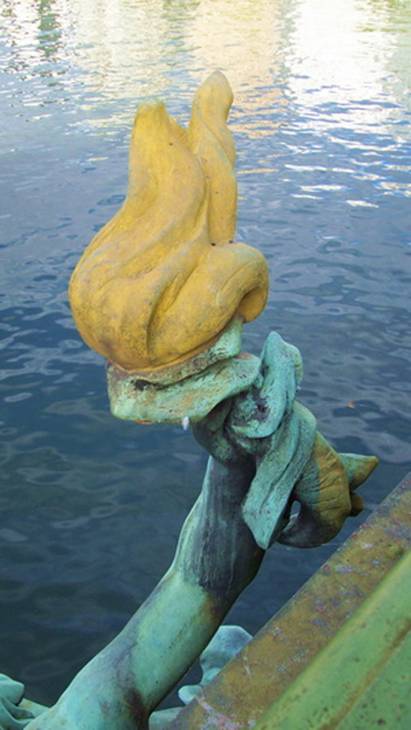
The
Liberty flame is
repeated in several places not far from the Statue of Liberty on the Allée
des Cygnes. Here, it is on the Pont
Mirabeau. The bridge is named for
Gabriel Riquetti, the Count of Mirabeau (1749-1791), a famous orator, French
statesman, and moderate Revolutionary.
His
story in Wikipedia is entertaining reading.
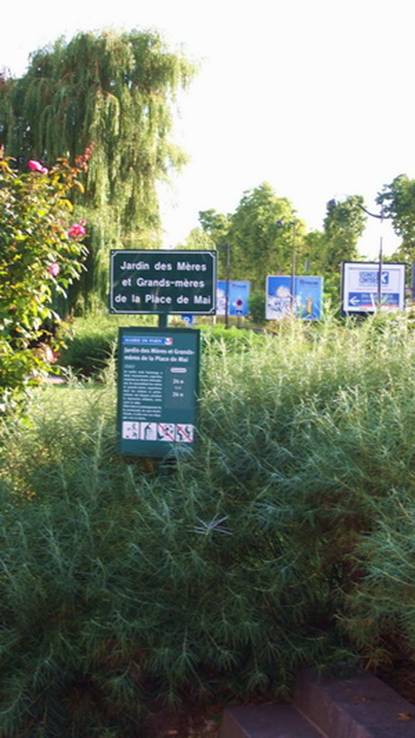
A
park dedicated to mothers and grandmothers who were assassinated in Argentina
between 1976 and 1983, located near the left bank end of the Pont
Mirabeau.
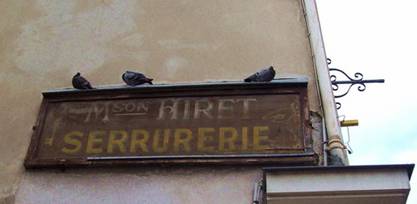
An
old locksmith sign remains on the rue de Passy – an act of historic
preservation that is much appreciated by pigeons. I find this word for a locksmith’s shop to
be one of the most difficult words to pronounce in the French language.
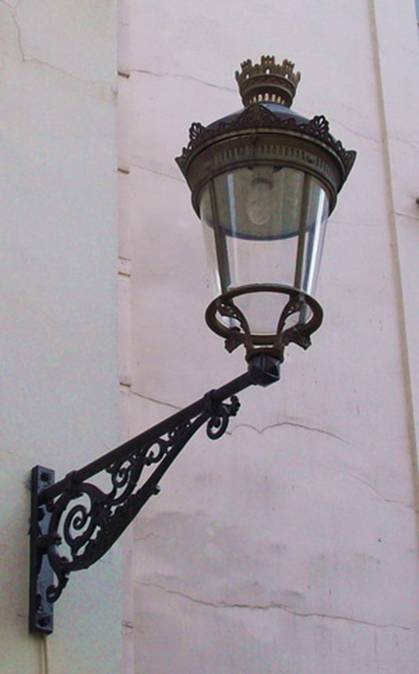
Picturesque
streetlight attached to the side of a building just off the rue de Passy.
Flowers
at the rue de l’Alboni in the Passy neighborhood. Some say the Last Tango in Paris was filmed here. The street is named for Marietta Alboni
(1826-1894), an Italian opera singer.
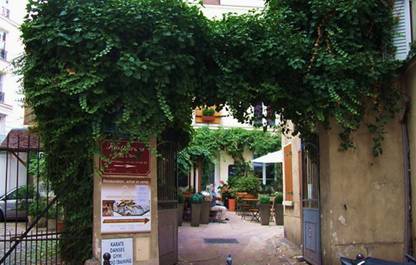
An
impasse off the rue de Passy. Note: For addresses & phone numbers of
restaurants in this journal, click
here. |