Paris Journal 2009 – Barbara Joy Cooley Home: barbarajoycooley.com
Sign
my guestbook. View
my guestbook. ← Previous Next → Back to the beginning
|
We had a slower day
yesterday. I have been pouring over a
book of photos by Charles Marville. In
the mid-19th century, he was an illustrator for a newspaper called
Paris Nouveau. His cartoon-like drawings are full of
detail and humor. Somehow, he took up
photography in the 1860s. Then he set
about taking several years worth of photos documenting Paris in the late
1860s and early 1870s, at a time when much was changing. Haussmann had been hired
to transform the city from one with mostly narrow, tangled streets to one
with some narrow streets and some big, wide avenues with stately
buildings. The destruction that entailed
is mind-boggling, and Marville captured it on film even at a time when
photography was in its early stages.
His photos give you the impression that there are almost no people in
Paris at that time; that’s because of the long exposure time – people would
move in and out of the picture well before the exposure was complete, and so
you can only see them as ghostly blurs, and only if you look closely. The photos are arranged
geographically in this book, so it is like visiting one neighborhood after
another. Even with all the change that
occurred, I still can recognize some street scenes on the smaller streets
that I know, because many of those buildings are still standing. The destruction caused by the
construction of the big avenues is like that of a massive bombing. The photos show landscapes with huge piles
of rubble all around, many of which have been sorted through so the piles are
of similar materials, and ruins of pieces of medieval buildings standing here
and there, and lots of workhorses standing about. You can’t even imagine what it must have
once looked like. Now, when we walk along the big
Haussmannian avenues and boulevards, we don’t even think about it. But occasionally we see the incongruous
medieval lane poking into the boulevard, and we remember, it all looked like
that once. Before the change, places like the
Champs Elysées where just wild country territory. Vaugirard and Grenelle were little villages
that you had to get to by taking a country lane that is now called the rue de
Vaugirard or the rue de Grenelle, it what seems like the middle of
Paris. Parts of the 16th
arrondissement, like Auteuil and Passy, were little villages, disconnected
from Paris by woods and fields. Paris was just this old part
where we are now, I’d say the first six arrondissements, and was the setting
for Victor Hugo’s Les Miserables. Napoleon III commissioned
Haussmann to manage this transformation of Paris to modernize it. Tom and I believe it was a
political/strategic project, too, to prevent the people from being able to
barricade themselves into impenetrable parts of the city, as they did in Les Mis. I get so confused with the
various different Napoleons. I guess
Napoleon I started this modernization idea with the construction of the rue
de Rivoli next to the Tuileries. But I
hate it when someone asks me “Now which Napoleon did this, or that?” Someday, I’ll have to study the Napoleons
more to try to get them all sorted out in my mind. Supposedly, Napoleon III was
affected by a visit he made to London, which changed with the industrial
revolution. He decided then that he wanted
to transform Paris, too, continuing the work of Napoleon I but on a far
grander scale. Beginning in 1852, laws were
passed to allow for the transformation, including laws that allowed the
government to expropriate buildings not only on the site of one of the new
avenues, but alongside the avenues as well. Talk about big government. Whew. It wasn’t all just about the
network of big avenues. It was also
about public facilities and green spaces.
Better water and sewer services were an important part of the change,
too. Now, as we walk through Paris,
we enjoy both the old medieval streets, and when we tire of them we enjoy
walking along the big avenues with the roomy sidewalks and towering trees. Today, we’ll be going to have lunch with a young
lady we know who runs a chocolate shop in the 17th arrondissement
– a place that was in the countryside in the 18th century. Now it is a bustling urban neighborhood
full of shops and activity. Last night we took a stroll
through the Luxembourg Gardens to the boulevard Montparnasse (yes, it is one
of THOSE big avenues) to dine at l’Abri Cotier, our favorite Corsican
restaurant. For the first time, I took
advantage of their inexpensive 15-euro fixed-price menu, which brought me a
nice, fresh green salad, followed by a tasty slice of leg of lamb in a little
bit of brown sauce with a few slices of sautéed potatoes. Tom had the steak again – the
one that is like a small Chateaubriand.
We noticed that both dishes were prepared differently; so maybe
Wednesday is the regular chef’s night off.
That’s okay; the food was good. The restaurant was very busy –
we were glad that we had arrived early.
By the time Tom ordered dessert, the kitchen must have been going
crazy. He ordered the pain perdu, which is sort of like
French toast soaked in eggs, sugar and cream, and served hot with something
like poached pears (in this case) and caramel sauce. It is a great, rich dessert whose name
means, literally, “lost bread” because it is possible to make this dessert
with bread that is slightly stale. So the dessert was taking a
long time to arrive at the table. The
server stopped by to say, by way of amusing “explanation,” that the bread had
been lost (le pain est perdu). We laughed.
When he brought the dessert finally, he said that the bread had been
refound. We laughed again. It had rained a little during
dinner so the streets were cool, damp and refreshed as we walked home in the
night air. Now that it is truly dark
after dinner, we can see into people’s apartments as we walk by at night, if they
have their lights on. We saw some
lovely places overlooking the Luxembourg Gardens. Even though they replaced quaint medieval
buildings, the Haussmannian apartment buildings provide some gorgeous living
space throughout the city. The best
floors of Haussmannian buildings include apartments with ornate moldings, paneled
walls and ceilings, elaborate mirrors over marble fireplaces, crystal
chandeliers, tall French windows/doors, lovely cast iron and stone balconies,
carved wooden doors, hardwood or ceramic or mosaic tile or marble floors, and
so on. I pause now to take a moment to
tell you how much I appreciate your reading my journal. The responses I receive from you all are so
heartening and encouraging. Today’s e-mail even brought me one message from a
former high school classmate that moved me to tears. It is very important to know
that this Journal is bringing joy to someone.
I know we are very fortunate to be here, and the best I can do with
that is to share it with you. Bless you for being there. |
Thursday, September 10, 2009
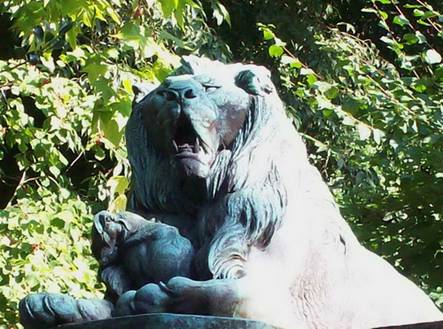
Lion
and the lamb in the Jardin des Plantes.
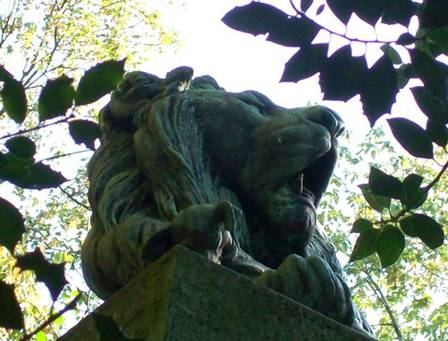
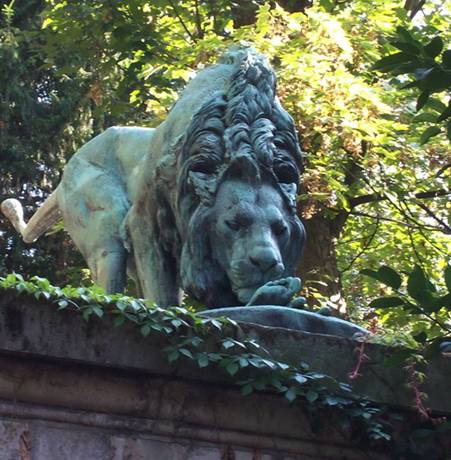
Lion
with a human foot in the Jardin des Plantes.
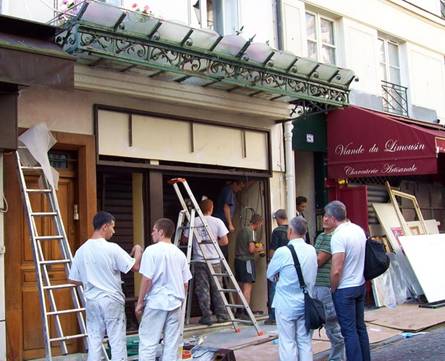
Workers
remodeling a shop on the rue Mouffetard.
I love the verriere (glass
and metal awning) over the façade.
A fun decoration on a
building on rue Mouffetard. |