Paris Journal 2010 – Barbara Joy Cooley Home: barbarajoycooley.com
Photos
and thoughts about Paris
Sign
my guestbook. View
my guestbook. ← Previous Next
→ ← Go
back to the beginning
|
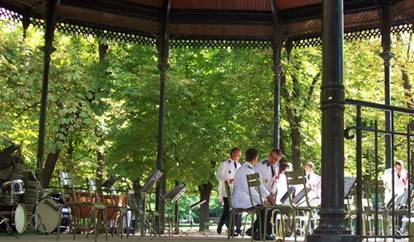
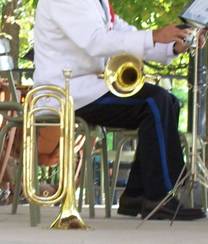
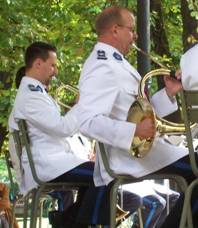
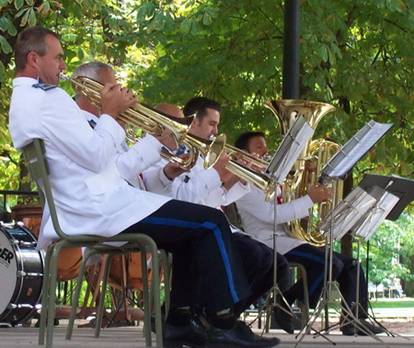
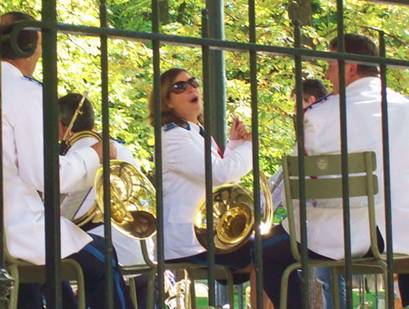
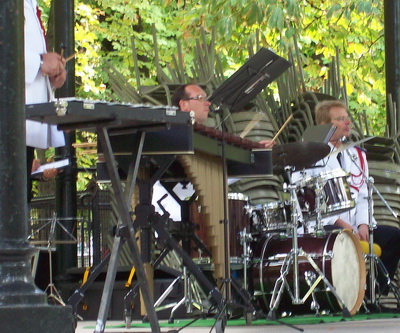
The sun was supposed to shine but yesterday we also had intermittent rain. Fortunately, it did not rain on the concertgoers. You can see that the band was protected by the beautiful canopy of the gazebo in the Luxembourg Gardens. After the concert, we were able to buy newspapers at the kiosque on rue Vaugirard, across from the Luxembourg Palace. All is back to normal for now. The next big day of strikes is the 15th, and after that, the 23rd, when we will probably be in the south of France. The police band formed in 1929, and was directed by Jules Bleu and Denis Roussel. It disbanded in 1942, during the occupation, and became a resistance unit. Members of the band are recruited at the police academies, and each must be a cop and a very accomplished musician. We evidently heard only a part of the band. It has over a hundred members, but there were only 23 performing in the park yesterday. The band gives about 100 concerts per year in Paris. In studying the web site for the band, I now see that what we heard was the batterie-fanfare of the group, not the entire orchestra. The 122-person orchestra plays more typical instruments (e.g., horns with valves) in concert halls, like the one at the National Superior Conservatory of Music and Dance of Paris, in the 19th arrondissement, where they will give a free concert on September 28. There were some predecessor bands of police before this orchestra formed in 1929. One was a batterie-fanfare formed in 1919. It consisted of 40 musicians, and came out of a French tradition of using “natural” horns – that is, horns without “mechanisms de pistons.” No valves. Bugles of various kinds, cavalry trumpets, contrebasses, percussion. That’s the batterie-fanfare. It was originally meant for protocol ceremonies and open air performances, but now this batterie-fanfare offers a rich and varied repertoire, including jazz and baroque chamber music. The tambour-major, or drum major, for this batterie-fanfare is normally Jean-Jacques Charles. But he was not the one leading the group yesterday. Charles comes from the Nord-Pas-de-Calais region, the “cradle of music of harmony and fanfare.” But it was in the Paris area that he did his music studies. He won first prizes in trombone, chamber music, jazz, and composition at the École Nationale de Musique de Créteil. He then went to the Conservatoire National Superieur de Musique de Paris where he won first prize in chamber music. After that, he taught and produced music of various kinds, from classical to jazz. He then took the job as director of the Conservatoire de Musique et de Danse de la Brie, until 1996. He’s had this job of drum-major for this batterie fanfare since 1993. He also has concentrated on composition, orchestration, and musical arrangement for diverse forms of music. According to the web site, all of these musicans are supposed to be cops, too, but I don’t see anything about that in Jean-Jacques Charles musically impressive bio. Likewise,
Pierre Walter, the chief of music for the entire orchestra of La Musique des Gardiens de la Paix,
has a musically impressive bio, with no mention of his being a
policeman. And the big boss, the chief
adjoint, is a woman named Pascale Jeandroz who, too, has a great musical
background. And there is no mention of
her being a policewoman. Last night, the weather wasn’t too great so we went to the nearby Bistrot de la Grille Saint Germain and ordered from the blackboard. Tom had the grilled lambchops and a moelleux au chocolat, and I had a most satisfying blanquette de veau (slow-cooked super-tender pieces of veal in light gravy, with rice and some veggies). My dessert was a crème renversée, which is like a deeper crème brulée that has fruit in it. In this case, the fruit was peaches. It was light and delicious. I think crème renversée usually is prepared more like a crème caramel, but this one was definitely finished off as a brulée -- no caramel sauce involved. It was good, delicious comfort food for a cool, rainy evening. We recommended both main courses to the couple of older Americans from Pittsburgh who were seated next to us shortly before we left. They did not speak French, but she could read French, at least to a point. I realize from talking to her and to another visiting American earlier this month that many Americans who learn to cook French food (thanks to Julia Child) inevitably learn to read some French. We walked home through the wet, dark streets around the hulking Saint Sulpice, under a single umbrella, hugging each other in the rain. Ah, Paris. Sign
my guestbook. View
my guestbook. Note: For addresses & phone numbers of
restaurants in this journal, click
here. And here’s the 2009 Paris Journal. |
Friday, September 10, 2010
The
batterie-fanfare of La
Musique des Gardiens de la Paix, or Music of the Guardians of the
Peace band, begins to arrive onstage yesterday afternoon at the gazebo in the
Luxembourg Gardens.
Their
horns have no valves.
The
one woman in the band jokes around with her colleagues.
The
wooden canopy of the gazebo has been restored and beautifully maintained.
The
drummer, in the middle, was the star of the show. |