Paris Journal 2009 – Barbara Joy Cooley Home: barbarajoycooley.com
Sign
my guestbook. View
my guestbook. ← Previous Next
→ Back to the beginning
|
Google Books has been in the news quite a bit in France this summer. Today’s issue of Le Parisien has a fairly succinct article that explains in plain language (well, much plainer than Le Monde’s articles on the subject) just what the European issues are with Google Books. Tom would not want any of his textbooks to be available on Google Books because those textbooks are money-making ventures. But his academic books are another story. Academic books generally are written to contribute to the culture, not to make money. This summer we discovered that the University of Massachusetts Press has already gone ahead and made large chunks of Tom’s The Ivory Leg in the Ebony Cabinet: Madness, Race, and Gender in Victorian America available on Google Books. That’s fine with us, although nobody asked Tom. This is probably something that’s covered in the contract. And it is a way, we believe, to promote the book. Ivory Leg is still in print, so the UMass Press didn’t make the entire book available in Google Books – just enough to entice the intellectually curious. Tom’s first book, Educated Lives: the Rise of Modern Autobiography in America, was published in 1976 and is now out of print. This book, however, is still cited by other scholars, and so having it entirely available on Google Books would be good, and would help ensure its longevity. I checked. Educated
Lives is not available on Google Books.
It
is merely listed. The blurb that
describes the book on Google is dreadful.
That must change. I e-mailed the director of the
publisher, The Ohio State University
Press, and he replied that since the book is out of print, all rights
revert to Tom, the author. He added
that the Press would be delighted
to see the book available on Google. So we shall go about submitting
it this Fall. Back to the French news story
about the Google Books court case.
Below is my translation of it, followed by Google Translation’s translation of
it. (If you haven’t tried Google Translation yet, you should. It is fun to play with.) I hope that you will find my translation to
be the more understandable one. Barbara’s: France wants “to guarantee respect of author’s rights in
the contentious case that pits Google Books against American authors and
editors,” confirmed the Minister of Culture and Communications in a statement
on Tuesday. After having digitized, starting in 2005, millions of
works copyrighted by the authors using funds from American universities,
Google and the holders of US copyrights are coming to an agreement at the end
of 2008 that will include procedures for digitizing books in the US. The US courts must decide on the decision’s validity in
October. “Beyond the issue in particular of injury to authors and
publishers, this case poses a question of principle in which France is
particularly interested: the respect
of the author’s right, that guarantees compensation to creators and the
foundation of cultural diversity,” said the minister. In a September 4 letter addressed to the US court hearing
the case, France argued that “the projected transaction does not conform
either to the rights of intellectual property nor to the right of fair
competition, and that constitutes a threat to cultural diversity.” Paris (the Ministry of Culture) intends to “ensure that
any terms of approval” by the judge “do not create any precedent that would
reinforce a notion of fait accompli
in this Google case.” France intends to develop this argument during the
hearings to be conducted soon by the European Commission on this subject. On Monday, the American search engine company made the
first concessions to European authors and publishers by announcing that the
books published and marketed in Europe would not be sold in the US in the
electronic form without “the express permission of the copyright owners.” European publishers fear that in effect Google would try
to use the agreement signed with US authors and publishers to offer European
books on the pretext that they are no longer commercially available in the
US. And now, Google’s Translation: The France wants to "ensure respect of copyright in
the dispute between Google Books authors and U.S. publishers, "said
Tuesday the Department of Culture and Communication in a statement. After scanning from 2005 to millions of books protected
by copyright from the funds of U.S. universities, Google and holders of U.S.
copyrights are the end of 2008 reached an agreement that includes the
procedure for 'operating on U.S. soil of digitized books. The U.S. court must decide in October on its validity. "Beyond the specific case of authors and publishers
injured, the case raises a question of principle which France has always
shown a special commitment: the respect of copyright, which guarantees
compensation of creators and cultural diversity based, "the ministry. In a letter sent September 4 in U.S. court hearing the
case, including the France argues that "the proposed transaction is
consistent, the right of intellectual property, nor in competition law, and
that constitutes a threat to cultural diversity, "the ministry said. Paris intends to "ensure that the terms of any
approval" by the judge "did not create any precedent likely to
reinforce the policy of fait accompli in this case followed by Google." An argument that France intends to develop during the
hearings to be conducted shortly by the European Commission on the subject. On Monday, the American search engine has made the first
claims to authors and publishers in Europe by announcing that the books
published and marketed in Europe still may not be sold in the United States
under their electronic form only with "the express permission of the
owners right. European publishers fear that
Google would benefit from the agreement signed with U.S. authors and
publishers to offer for sale without permission of European books on the
pretext that they are no longer commercially available in the United States. Last night we had a lovely dinner with Roy and Barbara, the owners of the apartment where we stay in July and August. We met in the middle of the 7th arrondissement, at Le Petit Nicois on rue Amelie. This is very close to Roy’s office. Roy and Barbara ordered the dorade which was identical to the dorade we had when we first visited that resto earlier this summer. It was beautiful. Roy said his shrimp starter course was very good, and I had the eggplant beignets on a green salad – very yummy! These cooks can fry right! Tom and I each ordered the supreme de volaille (chicken breast) which came on a base of ratatouille covered by an interesting, frothy green sauce. It was delicious. Roy is a true wine connoisseur, so he ordered the wine – a fine Medoc. The crowning touch of the dinner was Tom’s baba au rhum. The server plunked an entire bottle of rum on the table, from which Tom was to pour a little onto his hot, donut-shaped baba. The only person to abuse the bottle was Roy, who poured just a small amount into his water glass. We talked until the restaurant was getting ready to close. By the time we reached home after walking through the silent 7th, it was 11PM. I waited for a couple more hours, then called my dad in Florida. He was just hospitalized for gall bladder problems. He’s doing much, much better, and will have the gall bladder removed tomorrow. Please send positive thoughts his way. He is the most faithful reader of this journal. I love you, Dad. |
Sunday, September 13, 2009
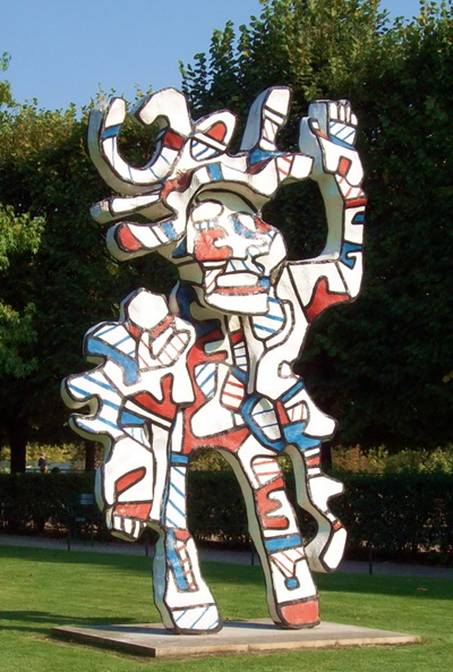
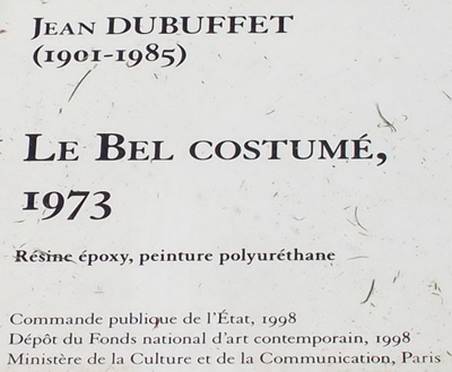
Sculpture
by Jean Dubuffet in the Tuileries.
Well, he’s no Lichtenstein,
but he’s pretty good.
Tom
buying newspapers at the newsstand that never stops on the boulevard Saint
Germain, not far from the Deux Magots.
People
line up out the door to buy macaroons at Pierre Herme on the rue Bonaparte.
The
florist must live above the shop at this address on rue Mouffetard. |