Paris Journal 2009 – Barbara Joy Cooley Home: barbarajoycooley.com
Sign
my guestbook. View
my guestbook. ← Previous Next
→ Back to the beginning
|
Sometimes people who are only
going to be in Paris for a few days or just a week will ask us what to do –
what’s most important, what not to miss. That is a very tough
question. But one thing we always tell
them now is that one of the first things you can do is to take a boat tour on
one of the Bateaux Mouches on the Seine.
It will give you a good overall orientation to Paris. We don’t mean that the tour guide’s spiel
is the best, but we are referring to the chance to experience the geographic
and historical layout of the city.
Paris is very oriented to the Seine, because the very start of the real city was on an island in the
river, the Ile de la Cité. But maybe it is cold outside,
and the tourist doesn’t relish the idea of a boat ride. What to do? The TravelingProfessor came out
Monday with a
great idea in his newsletter. He
suggests taking the number 69 bus.
This would cost you a mere fraction of the cost of a Bateaux Mouches
ticket, but you wouldn’t have the benefit of the tour guide’s spiel. Nevertheless, if you make a
list of the places he mentions in his article, you can do a little research
on your own ahead of time and have a nice, inexpensive tour and orientation. At this point, for us, the tour
isn’t necessary. We know central Paris
so very well. We even know something
of the Paris that is no more. I
finished pouring through the big book of photographs by Charles Marville
documenting Paris in the 1860s and 1870s.
We recently noticed that an exhibition of similar photos was being
advertised at the Louvre des Antiquaires. The Louvre des Antiquaires is right
across the rue de Rivoli from the Louvre.
It is an antique mall of the highest order. There is no junk here; everything is
expensive and oh, so ritzy. The building housing the mall
is historic. The brothers Emile and
Isaac Pereire developed it in 1860.
For decades, the building, known as the Grands Magazins du Louvre, was
a centerpiece of Paris activity, with luxurious shopping and interesting
exhibitions. But it fell into
disrepair. A British investor decided
to renovate it in 1975. The work took
three years. In 1978, it reopened on
the first three levels as the Louvre des Antiquaires, and on the upper
floors, expensive office space. The Antiquaires part consists
of 250 stores. We’ve strolled through
it many times, marveling at how much great stuff is there and how few
shoppers there are. These days, the jewelry,
collectibles, furniture, and porcelain don’t appeal to me much, but the
paintings still do. There are many
fabulous paintings for sale there, at very high prices. I digress. The reason we went there yesterday
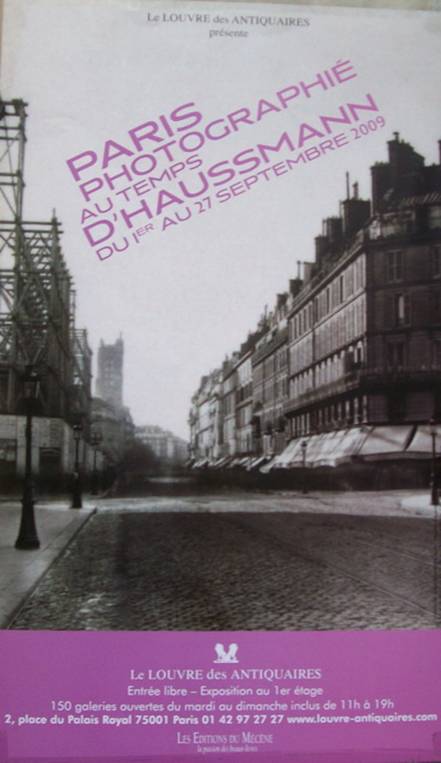
afternoon was to see the photographic exhibition. The poster that we’d seen in a shop window
on the rue Jacob (above, right) did not say whose photographs these would be,
but that they would be from the time of Haussmann. I wasn’t surprised at all to
see, when we entered the exhibit space, that these were indeed Charles
Marville’s photos. Because I’d studied
the Charles Marville book in the apartment so assiduously, I was able to
serve as a guide for Tom as we went through the exhibit. There was only one photo on display that I
did not remember from the book. This collection is particularly
important because the revolting workers burned down the Hôtel de Ville (Paris
city hall) in 1871, destroying all the Haussmann archives that documented
Paris pre-Haussmann. Marville’s photographs
are now what we have to look into the past, to see Paris as it was before the
great transformation wrought by Haussmann and Napoleon III. When we left the exhibit, we
strolled around and around through the halls of the Antiquaires, and then
decided to go back to the apartment.
When we entered the Cour
Carrée at the Louvre (click
link at left for panorama), the space seemed so calm, quiet and lovely in the
evening sun, that we decided to sit on a bench just to soak up the
atmosphere, surrounded by the great palace known as the Louvre. A young man was playing the
flute in the arched passageway leading to the Pont des Arts. His music drifted magically into the
courtyard where we sat. We stayed for
a while to listen to him playing mostly Vivaldi. Enchanting. I couldn’t bear the thought of
walking down the rue de Seine yet one more time – not that there is anything
wrong with that street; I’m just tired
of it. So after we crossed the Seine
on the Passerelle des Arts, we walked along the Quai de Conti, past the Hôtel
des Monnaies where coins and medallions are made, and turned right on the rue
de Guénégaud. That old street is named for
the stately home of financier Henri de Guénégaud (1609-1676), who was Minister
and Secretary of State. The home was
on the site of what is now the Hôtel des Monnaies. At the rue St. André des Arts,
we decided to find the rue du Commerce St. André, one of those ancient little
streets with rough cobblestones on a surface that is so warped it is
difficult to walk upon without looking like you’re drunk. This street is home to Le Procope, which claims
to be the oldest restaurant in Paris, but we think La Petite Chaise’s
claim is better because it is a little older and has remained in business
continuously. Then we walked the boulevard
St. Germain up to the rue de Four so we could use the ATM. The exchange rate isn’t so good now! Earlier in the late afternoon,
we’d been to the food market at St. Germain, so we had plenty of good things
to eat at home. We decided to call it
a day, and to simply dine at home. |
Wednesday, September 16, 2009
Poster
in a shop window on the rue Jacob, advertising the current exhibition at the
Louvre des Antiquaires.
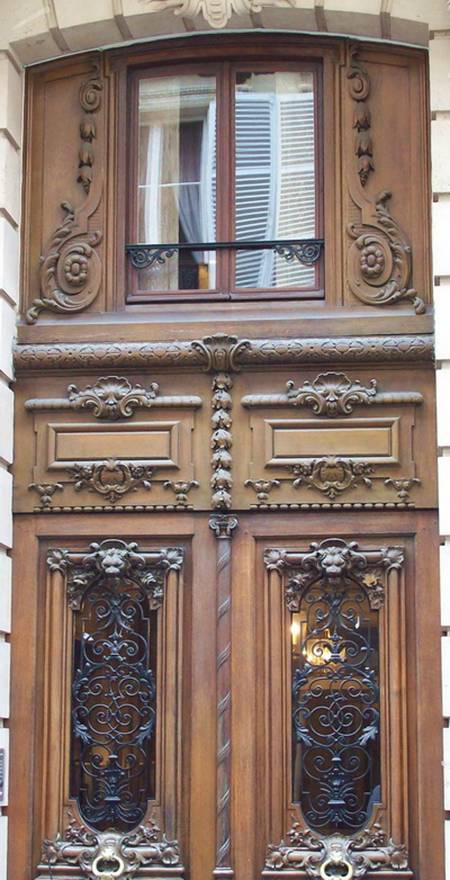
A
doorway that we like on the rue de Grenelle.
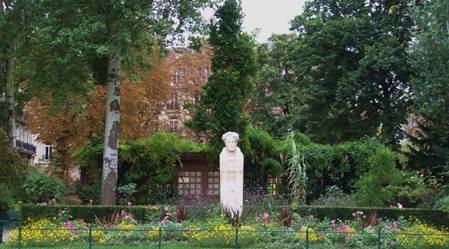
Square
des Missions Etrangères on the rue de Bac. |