Paris Journal 2013 – Barbara Joy Cooley Home: barbarajoycooley.com
Find me on Facebook 2012
Paris Journal ← Previous Next
→ Back to the Beginning
|
About seven
years ago, Mr. Sanders, the fromager
(cheese monger), was the person who first made me aware of Laguiole
knives. I’m sure I must have seen them
in shop windows, but had not really paid attention to them. We’d been
buying Laguiole cheese from Mr. Sanders at the Marché Saint Germain. (Pronunciation: lah-e-ole) I’m not sure
how or why we first tried Laguiole cheese, but I’m glad we did. Maybe the Sanders offered us a taste; I
don’t remember. Laguiole is very
similar to Salers cheese, which is what we buy at Sanders’ fromagerie when
Laguiole is not available. Laguiole
accounts for only a very, very tiny percentage of French cow’s milk cheese
production – only one half of one percent.
It is only made with raw milk collected from French Simmental or
Aubrac cows between May and October, in the mountains of the Aveyron, Cantal,
and Lozere departments of France. It
takes six to twelve months to mature. French-cheese.com
describes it as “surprisingly tender on the palate leaving a persistently
wettish sensation. Its first hazelnut taste quickly transforms into a subtle
acidic bouquet, in which touches of floral aromas with a very slight bitter
sensation are mixed together with a low acidic piquant taste because of the
salt.” I’d agree with
that description except that I’d change the word “wettish,” which I don’t
agree with at all, to “velvety.” As far as
things go in France, this is not an old type of cheese. It was invented by monks in the 19th
century, although its roots probably go back to ancient times. Now, only one cooperative, Jeune Montagne,
is licensed to make this cheese, which is sometimes called Tome (or Tomme) de
Laguiole. It was the
construction of burons in the 19th
century that led to the production of what we now know as Laguiole
cheese. Burons are rough stone buildings with rough slate roofs that are
constructed at high elevations in this rugged territory. The burons
were used seasonally (spring and summer) for the production of cheeses like
Laguiole, Saint Nectaire, Cantal, and fourme d’Aubrac, from mid-May to
mid-October. A few burons may still be used for this
purpose, but I believe that most of these cheeses are now made in clean,
modern facilities which are made affordable by the formation of cooperative
associations. There is a particular
type of mashed potatoes made with cheese, cream, and butter, called “Aligot.” Laguiole is the type of cheese you are
supposed to use in this dish. Every May,
there is a Festival of Transhumance (migration) when the herds of cows are
moved up to the mountains. Cows are
decorated with flowers, benedictions for them are said, traditional music is
played, folk dances are danced, and feasts of traditional food like Aligot are consumed. In the autumn, one of the towns in the area
has a celebration for the herds’ return to the lowlands. After Mr.
Sanders pointed out that there is also a type of knife called a Laguiole, I
started to notice them in shop windows.
There are pocket knives, steak knives, cheese knives, and all kinds of
Laguiole knives. They are beautiful. Last night, as
I went through my emails, I noticed a set of Laguiole steak knives offered by
Joss & Main. Hmmmm, I
thought. Our steak knives at home are
really lousy, and not very attractive.
For some reason, we have only five, not six. As much as Tom likes to use his barbeque
grill, we should have good steak knives. The set offered
by Joss & Main, however, was $85 or so, and those knives had light wood
handles – not really exactly what I wanted.
I fooled around a little looking for Laguiole steak knives on the web
generally, and on amazon.com, but then went to the best source: ebay. You see, we do
not have checked luggage, so it is impossible to buy the knives here in
France and take them home with us.
Knives in carryons are real no-nos.
And besides, here in Paris, these knives are very expensive. Sure enough, I
found just the set I wanted on ebay:
six Laguiole steak knives with lovely pearlized handles. Very pretty. I put in my bid and went to bed. In the morning, I found that I had the
winning bid and I paid up: $24.50. Ironically, the
vendor selling the knives is located in Naples, Florida! So close to home. We didn’t need
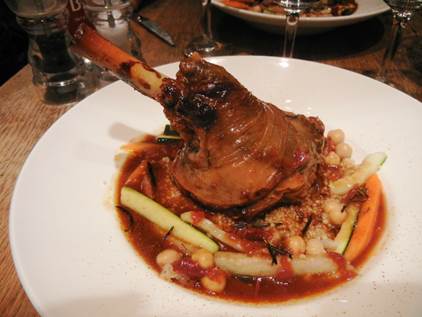
sharp knives at dinner last night. The
lamb shanks on our plates were so tender that they almost fell apart at the
light touch of a fork. Each lamb shank
rested on a bed of couscous sprinkled with chick peas and vegetables, and
soaked in a delicious romarin (rosemary and meat juice) sauce. This was the
main course offering for Tous au
Restaurant week at Coté Bergamote.
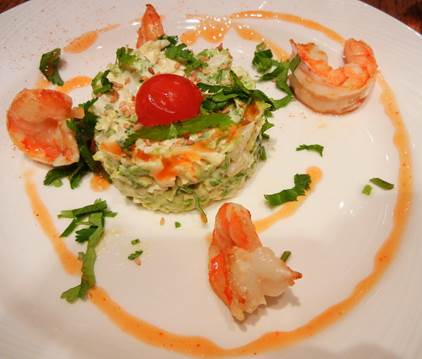
The starter course was a super fresh slaw made with coriander and
shrimp. And for dessert? Crêpes.
Tom’s was a bergamote (yellow orange) and sugar crêpe, and mine was
Nutella! I’d never had Nutella
before. It was much more chocolatey
than I thought it would be. It was a
lovely, delicious dinner, but the service was not good. Let’s just say it was abysmal. Oh well.
Normally the service is good at Coté Bergamote, so maybe that was
simply an off night. Other nights
when we’ve dined at Coté Bergamote, great jazz was played on the restaurant’s
sound system. Last night, the music
was rock, until it was drowned out by the diners. The restaurant was fairly busy, especially
by 8:30PM. Speaking of
time, today on the Google.fr search page (the default when you use Google in
France), the standard graphic (Google Doodle) has been changed to an animated
depiction of Foucault’s pendulum. Is
it the same for Google.com in the U.S.?
I hope so. I’ve been playing
with the Doodle’s time and earth controls.
What fun. This Doodle is
in honor of the French physicist, Léon Foucault, for today would have been
his 194th birthday. The
Pendulum is in the Panthéon, not far from where I sit. It demonstrates the that the Earth rotates
every day, and thus it illustrates the way we measure time, in days, hours,
minutes. Maybe later
today we’ll visit Foucault’s Pendulum. “Any person, brought
into the presence of this fact, stops for a few moments and remains pensive
and silent; and then generally leaves, carrying with him forever a sharper,
keener sense of our incessant motion through space.” – Léon Foucault |
Wednesday, September 18, 2013
Our
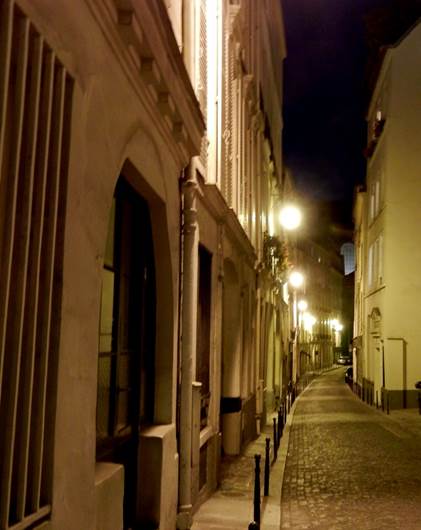
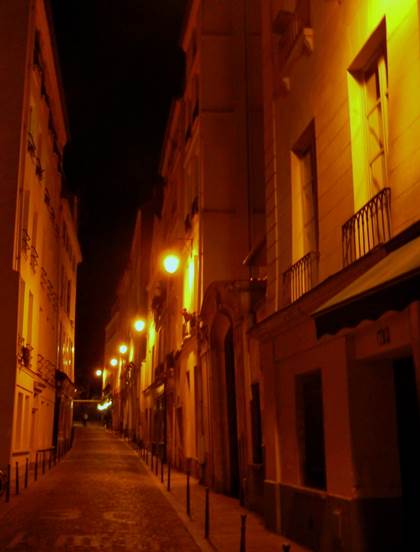
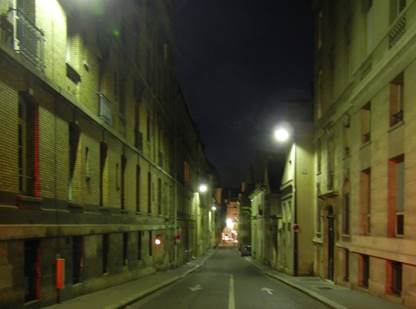
neighborhood at night.
Poêlée
de crevettes à la coriandre fraîche at
Coté Bergamote.
Lamb
shank with vegetables and couscous, in a rosemary-meat-juice sauce. |