Paris Journal 2011 – Barbara Joy Cooley Home: barbarajoycooley.com
Photos
and thoughts about Paris
Sign
my guestbook. View
my guestbook. 2010 Paris Journal ← Previous Next → ← Go
back to the beginning
|
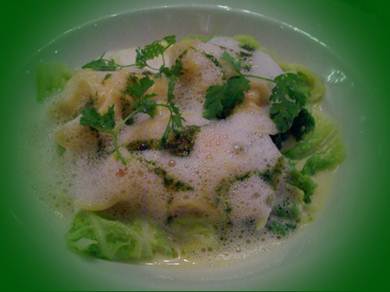
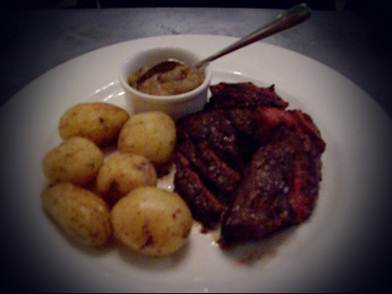
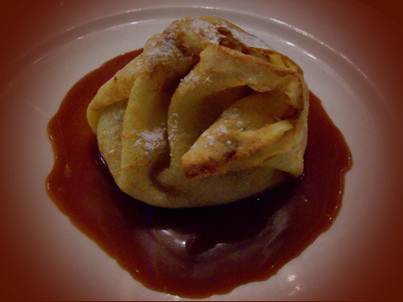
The air quality this summer has been very good in Paris. But today as I gaze out the window at the hot air balloon in the sky over the Parc André Citroën, I can see that the lower layer of the atmosphere looks a bit dingy. Sure enough, when I check out the air quality for this area on the AirParif web site, it tells me that the air is only of average quality today, not good quality, as it has been. I cannot think of any reason for this other than the fact that more people are back from vacation, more businesses are open and operating, and therefore there are more vehicles spewing out particulate matter and carbon dioxide and such. There doesn’t seem to be any kind of atmospheric inversion, and there is no heat wave cooking up the dangerous gases. So it must just be the automobiles and trucks. Industry moved out of Paris long ago. Some of the last remnants of it were probably right here in the 15th arrondissement, and one of the very last factories to go was probably the Citroën plant, now the site of that glorious park. Before the Citroën plant, there was a chemical factory that made bleach on the property. Bleach is known as eau de Javel, or “Javel water,” in French because the little village that was once out there, just beyond and between Grenelle and Vaugirard, was Javel. All three villages were incorporated into Paris in 1860, a time when Napoléon III and Baron Georges-Eugène Haussmann were utterly transforming the city. It was in 1785 that Claude Louis Berthollet (1749-1822) discovered the active ingredient in household bleach, sodium hypochlorite and in 1789 built the bleach factory in Javel. If Berthollet’s name sounds familiar to you and it isn’t because of Berthillon ice cream, it is probably because he and Antoine Lavoisier and others came up with a nomenclature which is the basis for the modern system for naming chemicals. Berthollet also researched dyes in addition to bleach, and he figured out the composition of ammonia. He was also among the first chemists to recognize a reverse reaction, and therefore, equilibrium. He even has a chemical compound, potassium chlorate (KClO3), named after him: Berthollet’s Salt. Did I mention that I’m a science writer? Really, my B.S. is in medical communications, 1979, from the Ohio State University College of Medicine. So I really cannot help myself – I feel compelled to write about these scientists, the history of medicine, etc. That sort of thing is not what most people think about when they think about Paris, but I do. Yes, I really do. And bleach is, of course, very important to those of us who live in warm, humid swamps much of the year. For those who think of Berthillon instead of bleach when they hear the name Berthollet, I’ll move on now to the subject of food. That’s a subject near and dear to my heart, and it isn’t all that far away from chemistry. I realized suddenly, yesterday evening, that it is time once again to try to get into the restaurant called Cristal de Sel. Finally we succeeded. The owners are back from vacation, and when we telephoned, they said that yes, a table is available. I’d already read plenty about this restaurant, which has been strongly recommended to us now by a few people. In 2007, when it first opened, I remember peeking in the windows and noticing that the décor was too minimal, and a bit bleak. That little problem has been corrected. The décor is pleasant now. The old wooden beams are exposed, but painted white. The walls are shades of pale gray, and the tables are covered in zinc. Most of the older, plain Windsor/bistro chairs have been replaced by wooden chairs with a more Italian-deco form. (Here are some photos on a viamichelin web site.) We arrived a few minutes before our 8PM reservation so that we’d have the best table for two. And so we did. Only one other table was occupied at that point – by a Japanese-American couple. Both servers spoke English, but our server only spoke French with us. The second server was clearly not a regular there, and the regular guy who runs the front of the house, Damien Crepu, must have had the night off. But the chef, Karil Lopez, was in the kitchen. Wonderful! We did not order appetizers, but were given a tasty mis en bouche made with puréed lentils, served with thin toasted slices of baguette. For my main course, I ordered the ravioles de langoustines, embeurrée de choux et beurre de nage (prawn raviolis and green cabbage leaves cooked in butter, topped by a light, frothy white butter sauce). The prawns were perfect – fresh, soft, delicious, and cooked just right. The entire dish was absolutely delicious. Tom ordered one of the restaurant’s “classics,” the onglet de boeuf Simmental, grenailles confites à la graisse de canard. This steak is what the British call a hanger steak (because it is a muscle that hangs from the diaphragm of the cow), roughly the equivalent of a flank steak, which must be marinated and cooked somewhat quickly. I notice that some reviewers call the onglet a rib steak, but I think that is wrong. My observation is that it is closer to a flank steak, the way the muscle fibers go. The Simmental is a breed of cattle whose existence is recorded all the way back to the Middle Ages in Europe. These cows are black or dark red in America, but are tan and white in Europe. That’s how much change the breeding can do in over 100 years. (The first records of Simmental cattle in America were in the 1880s in Illinois, where my great-great-grandfather, William McAdams, was a cattle breeder.) The steak came with little potatoes (grenailles) cooked in duck fat. Tom shared a couple of those with me, and he gave me a bite of the steak. Both were excellent. For dessert, we each ordered another one of the restaurant’s “classics,” the aumônière de crêpe, pommes confites au caramel sale -- baked apples in a sack made from a crepe, served in a pool of caramel sauce. What I love about desserts like this in France is that they are not too sweet. This is important with apples, because if you use too much sugar, you kill the taste of the fruit. Chef Karil Lopez totally understands this. After this divine dessert, we decided we had to buy some
of Karil’s
fruit preserves. We selected a jar
of the strawberry-raspberry preserves, which was only 6 euros. This morning, we put some on toast (Poilâne bread) and
it was delicious. When he saw Karil, Tom exclaimed, “He looks like he’s about 12!” Actually, he looks like he is about 15, but he must be closer to 30. He formerly was the second chef at the Bristol, the five-star hotel in the 8th arrondissement. The restaurant there has three Michelen stars. (The main chef at the Bristol is the famous Éric Fréchon.) The word “aumônière” for sack comes from the term used for a small
leather drawstring purse that would be used to hold coins, a small offering,
for church or charity – “alms,” or aumône, in French. And so we give thanks, for another wonderful day in France. Sign
my guestbook. View
my guestbook. |
Friday, September 2, 2011
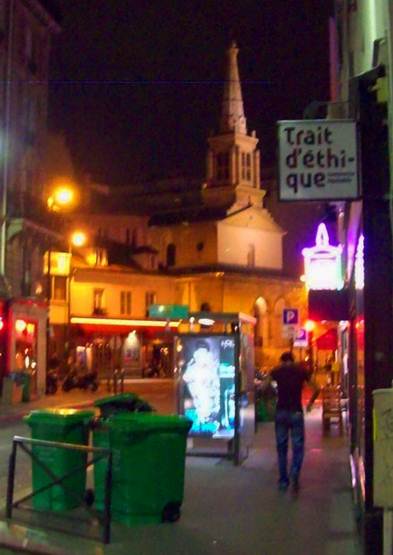
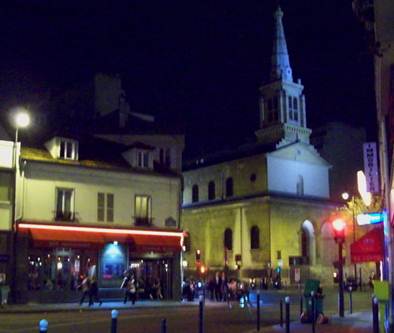
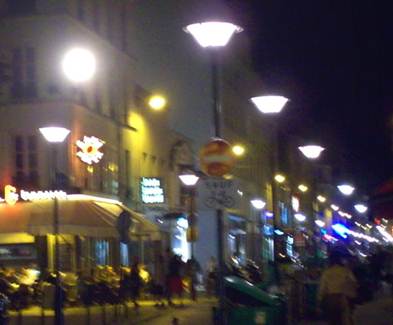
Rue Mademoiselle, looking toward the church of St. John the Baptist of Grenelle, as we left the restaurant Cristal de Sel.
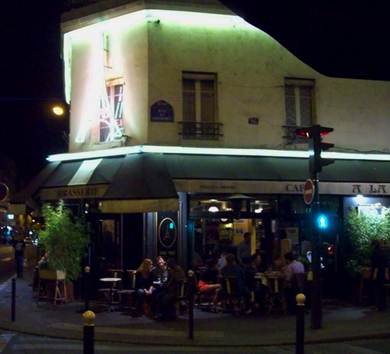
The brasserie called Café a la Tour Eiffel.
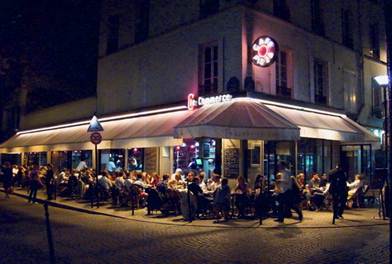
The
Commerce Café was doing a fine business last night.
The rue du Commerce at night.
Prawn ravioli with buttered cabbage and frothy white butter sauce.
The beef steak and small potatoes cooked in duck fat. The steak came with a little dish of almost-carmelized onions.
The apple aumônière with caramel sauce. |