Paris Journal 2011 – Barbara Joy Cooley Home: barbarajoycooley.com
Photos
and thoughts about Paris
Sign
my guestbook. View
my guestbook. 2010 Paris Journal ← Previous Next
→ ← Go
back to the beginning
|
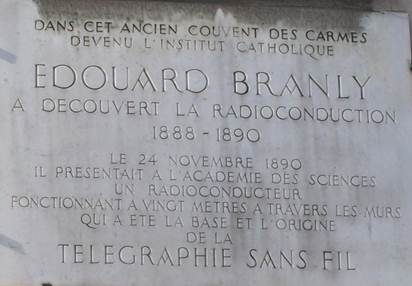
I’m a sucker for hot and sour soup – called potage pekinois here in France. As we were leaving the Saint Germain food market, heavy bags in hand, we passed the Chinese carryout booth. I’ve looked in that case before for potage pekinois and there was none – probably it had sold out. But yesterday, voila! There it was. So we bought a small container – the equivalent of one medium/large bowl of soup, or two smaller cups of soup. A little while later, at the apartment, I heated it and we consumed it – one small serving each. It was delightfully tasty and spicy. Very satisfying. (That, and a bit of country terrine that we consumed later, was it for dinner.) Fortified by soup, we went for a long walk in the Luxembourg Gardens and the two parks to the south of it. As we were about to go home, I suggested we go to the gourmet grocery, Hé. To go there from the Luxembourg Gardens, we took the Allée du Seminaire. I’m glad we did because this made us aware that the construction that had been going on there in the past two summers is now done – and the Allée is once again a lovely place to walk. It was about 7PM, and the Gardens were about to close because the days are so much shorter now. The Luxembourg Gardens has its own rules about opening and closing times, as well as security, because it is unique: it is owned by the Senate. A little earlier, I had noticed and commented to Tom about the fact that we have never, ever seen a single Gypsy beggar, con artist, or illegal vendor of trinkets in this park. The Senate keeps a very tight lid on security. You’re not even supposed to smoke cigarettes in that park – although a few people do – usually young women who are used to getting their way. Inside Hé was another young woman who is used to getting her way. She was accompanied by her little daughter, who was running helter skelter through the little gourmet grocery, and a nanny. Neither the nanny nor the young mom made any attempt to control the little girl. I saw the owner of the shop and we exchanged “bonjours,” but he looked annoyed at the ruckus and disappeared into the back room. A woman who seemed to be in charge (perhaps his older sister or mother?) nicely said hello to us, but she, too, disappeared. It was hard to take the chaos. The young mom and nanny were buying a huge amount of groceries – at very high prices! We only buy a few carefully selected items at this place, because it is somewhat expensive. I tried to stay out of the way and when we were finished shopping, I waited patiently off to one end of the cashier’s counter. Nevertheless, the young mom a.k.a. prima donna made her displeasure at my presence known by brushing up against my back, even though there was plenty of room behind me. I muttered something which she did not hear, but decided that if she tried this again, I was going to tell her, in French, to please not touch me. I think she picked up the vibe, and she didn’t come close again. I didn’t mind waiting at all; we aren’t in a hurry in Paris, as a rule. After several minutes, one of the two clerks decided that it was time to help us, and that was fine with me, but not with the prima donna who, in protest, loudly popped a few more morsels of something into her mouth. She is one of those people who picks up stuff in the grocery and starts eating it before she pays. The presence of the nanny and the purchasing of so much overpriced food was a clear indication of wealth. And although this young woman is probably one of the grocery’s best customers, I could sense that the owners and the clerks despise her. The French made it clear a long time ago that everyone is now an aristocrat, not just a chosen few anymore – ever since the Revolution. The prima donna did not get the memo. Or she flunked history. We left with our mere 23 euros worth of food in a small sack, grateful to get away from the prima donna and her brat. How the nanny tolerates those two, I do not know. Around the corner from the little grocery, on the rue de Vaugirard, is one of those big institutions owned by the Catholic church. In fact, this one is called the Institut Catholique. Several days ago, I noticed an old marble plaque on its façade that solved a mystery for me. The mystery came up when I was looking at a very nice, new map of the 6th arrondissement that is on the fold-out back cover of a booklet called “Notre 6eme,” a sort of seasonal guide to the arrondissement. In small italic type, on one corner of the Institut Catholique on this map, were the words “Mus. Branly.” The Musée du quai Branly is the newish museum way over on the west side of the 7th arrondissement, on the street called the quai Branly. It features ethnic art from around the world. I now know that the “Mus. Branly” noted on the map of the 6th is a reference to an older museum – one that is now open by appointment only. The old marble plaque high up on the wall on the rue Vaugirard explains that there in this building, Eduoard Branly (1844-1940) invented the wireless telegraph, also known as radio.
Was he really the first to invent radio? I don’t know. Like so many of these things, multiple people probably claim to have done so. But what Branly did, while he was working as a professor and researcher at the Catholic Institute, was invent the coherer, the first widely used receiver for radio. He was building upon the earlier work of others, including a guy named Temistocle Calzecchi-Onesti. Branly also worked with Guglielmo Marconi, who is known as the father of radio transmission. The coherer was only relevant in radio reception for about a decade, when a more refined, British invention then took over. (I’m sure my older brother, Mr. GPS, knows all about this subject.) But Branly’s breakthrough was significant. How did a scientist like him end up at the Catholic Insitute? He was originally on the faculty of the Sorbonne, but he was such a devout Catholic that he decided to go to work for the Catholic Institute instead. He was once nominated for the Nobel prize but did not receive it. He was elected to the French Academy of Sciences in 1911, but not without controversy. He was considered controversial because of his deep religious faith and the fact that he ditched the Sorbonne. His rival for the position, Marie Curie, was controversial because she was a woman. Of course he won – being a woman was evidently more offensive than being devout – but only by 2 votes. Branly lived to the ripe old age of 96. But Marie Curie, of course, had unwittingly irradiated herself and she died at age 66. Curie, however, received two Nobel Prizes, was the first female professor at the Sorbonne, and was re-buried in the Pantheon in 1995. Her second Nobel Prize, interestingly enough, was granted to her in 1911 – the same year the French Academy of Sciences elected not to elect her. Just a month after receiving her second Nobel Prize, she was hospitalized with depression and a kidney ailment. I wonder if the rejection by the Academy had anything to do with that? She was the first person to receive two Nobel Prizes. She is one of only two people who have received Nobel Prizes in two separate fields (physics and chemistry). The first woman elected to the French Academy of Sciences was one of Madame Curie’s students – and that didn’t happen until 1962. Another factor in Madame Curie’s depression must have been the tragic death of Pierre Curie. He was killed in 1906 when he fell while walking in the rain on the rue Dauphine, here in the 6th. A horsedrawn carriage crushed his skull. Madame Curie was devastated. She said that this incident caused her to become “an incurably and wretchedly lonely person.” In France, it was okay for men to have affairs in those days (and maybe still), but not for women. The widowed Curie had an affair with a married man, Paul Langevin, who was separated from his wife. Plus, at the xenophobic time of the Dreyfus affair, there was (inaccurate) speculation that she was Jewish just because she was Polish. News of the affair came out in 1910-11, just before the French Academy election. She was portrayed in the media as a “homewrecker.” Years later, her granddaughter married Langevin’s grandson. That is sweet. And Marie Curie remains the only woman interred in the Pantheon. Sign
my guestbook. View
my guestbook. Note: For addresses & phone numbers of
restaurants in this journal, click
here. |
Wednesday, September 21, 2011
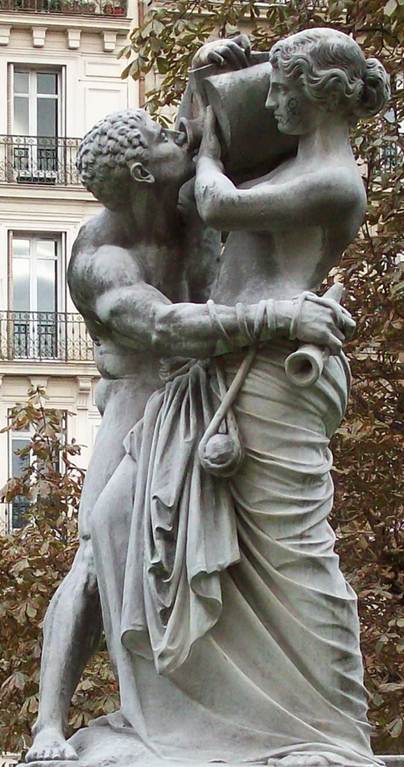
Statue in
the Jardin Marco Polo.
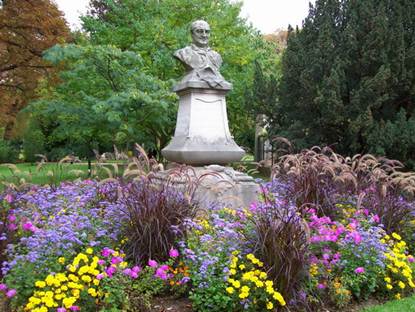
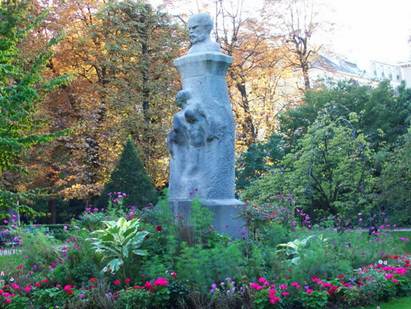
Scenes in
the Luxembourg Gardens.
“In this
former Carmelite convent that became the Catholic Institute Edouard Branly discovered radioconductivity in 1888 – 1890. On November 24, 1890, he presented to the
Academy of Sciences a radioconductor transmitting
20 meters, through walls. This was the
basis and origin of the wireless telegraph.”
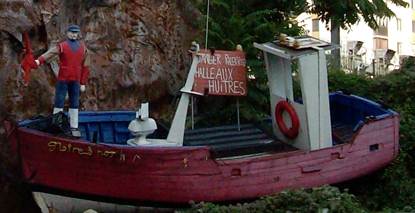
Fake
lighthouse and fishing boat warns traffic to slow down because the bargain
Oyster place is just ahead, on the rue Castagnary.
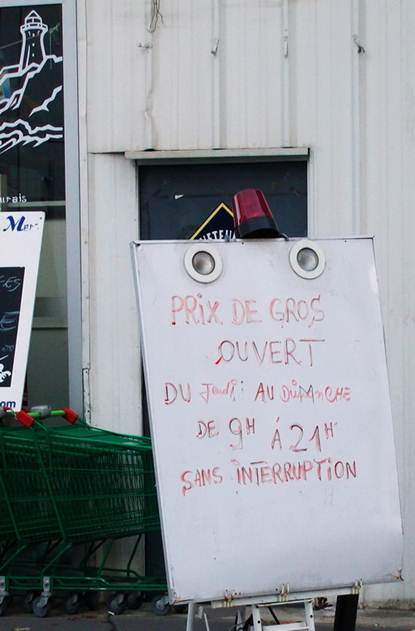
The oyster
place: “Wholesale prices. Open from Thursday through Sunday, from 9AM
to 9PM, without interruption.” |