Paris Journal 2012 – Barbara Joy Cooley Home: barbarajoycooley.com
Find me on Facebook 2011
Paris Journal ← Previous Next
→ Go back to the beginning
|
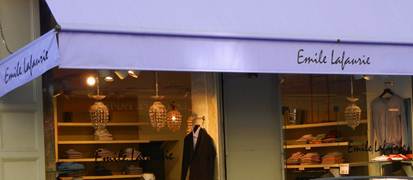
Emile Lafaurie designs men’s clothes, and his creative and administrative office is on our tiny street, next to our building. We walk by it often, and this year in particular, Emile seems to be hard at work, designing and handling orders. In Paris, there are four Emile Lafaurie boutiques. There is one in Aix-en-Provence in southeastern France. In New York city, two boutiques called “Sean” feature Emile Lafaurie’s creations. Here’s how Carolyn Murnick of nymag.com describes Emile Lafaurie’s menswear, as featured in these boutiques named for Sean Cassidy: Cassidy’s two New York locations, each outfitted with clean, raw
wood shelving and modern elements like hanging Lucite clothing racks, have
gained a cult following among style-conscious professionals of all ages, who
come seeking Lafaurie’s wearable suiting—also
available as separates—and casuals like crisp trousers and soft, slim-fitting
dress shirts. Smart linen shirts come in watercolor hues like lavender, sage,
and pea green, and the colorful array of knit sweaters and T-shirts channel
J. Crew via the Rue de la Paix. But the top-sellers
here are Lafaurie’s inimitable boxy painter’s
coat—a slouchy, mid-thigh length shirt-jacket in cotton, corduroy, linen or
wool that fairly emanates hip, languid masculinity—and his impeccably
tailored poplin shirts in twelve seasonal colors, all made from 100% Egyptian
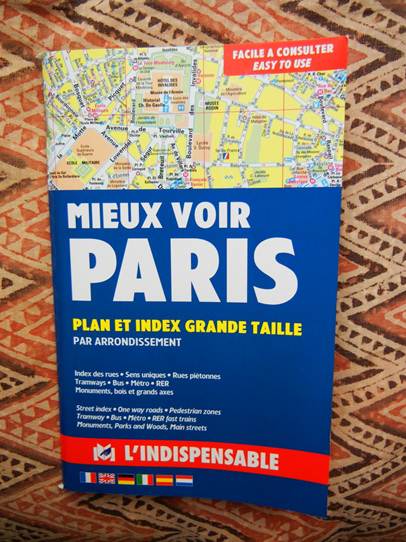
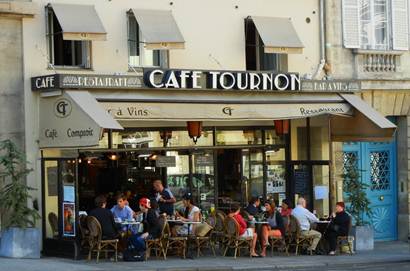
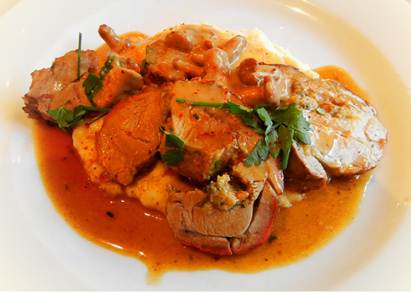
cotton. I’ve always admired the few items Emile shows in his creative office window downstairs, and so I was curious about the nearest boutique, after having walked by the creative office so many times. So I set out for 22 rue de l’Odéon. I’d wanted to further explore all the streets immediately to the east of us anyway, and this destination fit with that itinerary. Shortly after I started out, at the corner of rue Servandoni and rue de Vaugirard, I saw that the New Zealand restaurant called Kiwi was gone. In its place is a very interesting-looking traditional French bistro called Philippe. As I stopped to enter its phone number in my smartphone, an English-speaking man and woman paused nearby, and he said to her, “I’m just sure this is where it was.” I said “Are you looking for Kiwi?” He said yes. “It is gone. This is the restaurant that his replaced it,” I explained. “What kind of cuisine is it now?” he asked. “Traditional French,” I answered, with enthusiasm. He, however, was disappointed. He and his wife sounded as if they were from Australia, but maybe New Zealand. To console them, I explained that farther up the street, on the rue Servandoni just past the rue du Canivet, there is a sign on the former location of the Australian/New Zealand travel agency that was owned by the same man who owned Kiwi. It explains that the agency has moved, and it gives a little map of the new location. “Maybe Kiwi has moved there too, I don’t know,” I said. They said thank you, and felt a little better as they trudged up the street, in the direction of rue du Canivet. While I felt sorry for them, I myself prefer traditional French cuisine and I want to dine at Philippe. I never felt motivated enough to try Kiwi. Why come to Paris just to try to dine on your own country’s cuisine? Makes no sense to me. I don’t go to the American Tex-Mex places, for example. On my way again, I paused to look at Café Tournon from the other side of the street. It looks all clean and shiny, as if it had a deep-cleaning during vacation. And the awning looks new. I crossed to look at the special of the day: epaule d’agneau. Lamb shoulder roast. Sounds good. I stopped at the newsstand on the leafy, spacious corner across from the French Senate, the Square Francis Poulenc, just before the rue de Condé. I selected a new big-size version of L’Indispensable, the book of maps of Paris that includes every single street, including the shortest one, rue Henri de Jouvenel (which is very close to “our” apartment). I used to own a smaller version of this publication, but it became too difficult to read as my presbyopia intensified with age. Then I bought the larger one, and have left it in the other apartment, in the 15th arrondissement. Every apartment should have one of these. I decided that the apartment in the 6th needed one. I don’t carry maps with me anymore, because I know Paris well enough to get by without them. In a pinch, I can use Google maps on my smart phone, but Google maps are simply not as good as L’Indispensable maps. The database used for Google maps is probably the same one used in conjunction with GPS, and we all know about the problems with that database, don’t we? Plus, Google maps don’t color code the pedestrianized streets, as L’Indispensable does, and Google does not include as many names of parks and churches. Heck, Google maps sometimes don’t even include a street name for little streets that aren’t that little, like rue Marie-Pape Carpantier! I tried going without L’Indispensable, but I could not hold out for even one week. L’Indispensable lives up to its name, for me anyway. I use it when I write this journal. My memory and the photos take me most of the way, but when there’s a gap, L’Indispensable and the internet take me to the finish line. The version that I wanted was in a rack in front of the news kiosque. I pulled one out, and examined it front and back, looking for a price. There was no price on the cover. I decided that it didn’t matter; I had to have this necessary booklet. So I took it to the counter, and said “bonjour” to the vendor as I placed it next to the coin tray. He was friendly and animated in returning the “bonjour,” and he showed me the price on the title page inside. Six euros. Not bad. I had thought it would be more. I said “D’accord,” and he said “c’est un très bon plan.” A very good map, indeed. As we concluded the transaction, he asked me if I was from les Etats Unis (the U.S.). I smiled and nodded, and said “Je viens de Floride.” “Ah, Floride!” came the common response. Then followed quite the little French conversation: He proceeded to ask me if we had a lot of hurricanes this year. I responded that no, not this summer, but in 2004, a large hurricane, Charley, was chez nous. It was a category 4, I told him. He made all the right sympathetic noises, and he said it was “terrible!” I agreed, but I didn’t get into the details of how the terrible part was the four weeks after Charley, with three more hurricanes criss-crossing the state as we were trying to clean up the debris. That summer in Paris had been cut a little short by Charley. We had to return six weeks early. But now it looks like we’ll probably make it to the end of September without any hurricanes chez nous. I said thank you and good-day to the vendor, and walked away from that Square Francis Poulenc on the rue de Condé. Skirting around the edge of the Place de l’Odéon, home to a French national theatre of that name, I turned north on the rue de l’Odéon, and voila! There was the Emile Lafaurie shop. The boutique is about to be re-stocked with the fall line of apparel, and so there were still some sale items. There were a number of shirts priced at 2 for 50 euros, and some light pullover sweaters for 30 euros. A few smaller-size sport jackets were available for 50 euros. I knew that Tom would like this boutique, so I made a mental note to suggest a visit there on our evening walk, before dinner. Like most shops, the boutique would be open until 7:30PM. I slowly walked up the rue de l’Odéon, noticing that the women’s clothing store at the site of the original Shakespeare and Company bookshop (the one run by Sylvia Beach) has changed hands. The new shopkeeper, unlike the former one, no longer displays photos of James Joyce and the like at the shop, along with the clothing. The new shopkeeper does not feature this rich history as the former one did. Too bad. It would probably be good business for her to make something of it in her window display. Perhaps she underestimates the buying power of well-educated Brits and Americans, of whom there are many in the 6th arrondissement. The historical plaque mounted high up on the exterior wall will have to suffice. At the rue de Quatre Vents, I turned back to the west to the point where it changes names to rue de Lobineau. There I saw that the Gérard Mulot bakery was open for business. I checked one entrance door, and then the other, until I found the listing of the open hours. Ha! The bakery is open six days a week; Wednesday is the only day it is closed. And it keeps long hours: from 6:45AM to 8PM. Great! I stopped in the Marché to buy Italian espresso grounds for making filtered coffee; for some reason, the Greek deli vendor is the only booth that stocks coffee. Then I bought orange juice at the fromagerie. When Tom and I went out in the evening, he did want to see the Emile Lafaurie boutique. So we went there, and he even bought one of those lightweight pullovers, which will go nicely with his Gap jacket and his sport coat. We strolled around for a while, and then circled back down the rue de Tournon. It was time for dinner at the Café Tournon, the place where Duke Ellington had made his Paris debut. Patrick Canal, the owner/chef, greeted us at the door, and showed us to our table. We each ordered the lamb shoulder roast, which came as tender, moist, thick slices atop a pile of smooth-as-can-be puréed potatoes. The crowning glory of this dish was the mushroom sauce, made with flavorful girolles and some heavenly, rich stock and just enough wine to give the sauce a slight fruity interest. The entire course was superbly delicious. At some point, the woman who’d been tending bar came around to help with the serving and busing. By then, we’d shared one of the desserts of the day: an apricot/pineapple/coconut upside-down cake that was excellent. We told her how good it was, and she spoke to us in English. She was American, we could tell instantly. In fact, her lilting, nasal, laid-back accent I quickly identified as probably Californian. So I said to her, “You sound like you’re from California.” “Yeah,” she said, “and where are you from?” “Florida,” we answered. She came to Paris 17 years ago from San Francisco to set up Gap stores in Paris. I remembered that Gap is headquartered in San Francisco. But she was laid off, so now is working part-time at Café Tournon, and part-time at some other restaurant. She especially likes Patrick’s cooking at Café Tournon. She said her mother was Navajo and her father was Chinese. Only in America, I thought. She actually looked like a native Hawaiian. She also chatted up a couple of older American women who were seated not far from us. Maybe she enjoys chatting up American customers more than the other server would like. But she was careful to quickly leave us Americans if someone came in the door or other work needed attention. Between us and the table with the American women was a large French woman whom we’ve seen just about every time we’ve dined at Café Tournon. In fact, I’d seen this woman at the restaurant earlier in the day, when I’d walked by in the mid-afternoon. When the woman had left, we asked our Californian server about her. I’d already heard the other server address the woman by first name. Here, I’ll call her “E” because I don’t want to invade her privacy. Remarkably, E dines every day, twice a day, at the Café Tournon, according to the Californian. That’s why we’ve seen her just about every time we visited the place. E was a little upset because her check had not been delivered promptly enough. So she got up and moved to a table in the middle of the room, where she could not be ignored. The attention paid to the Americans in the room had no doubt troubled her. She is, of course, the most loyal customer, and most appreciates Patrick’s cuisine. I’d like to know her story. |
Friday, September 7, 2012
The Emile Lafaurie
boutique on rue de l’Odéon.
The
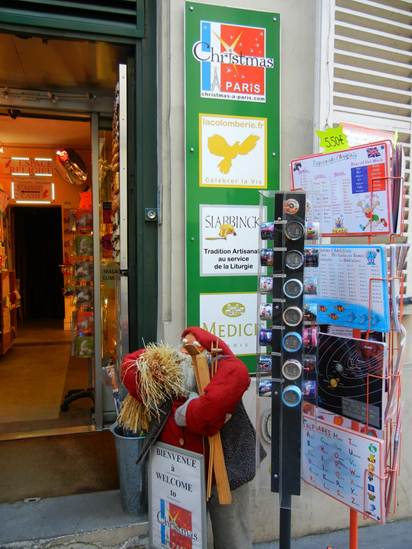
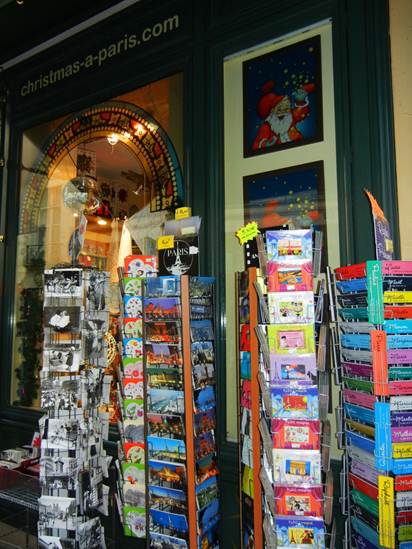
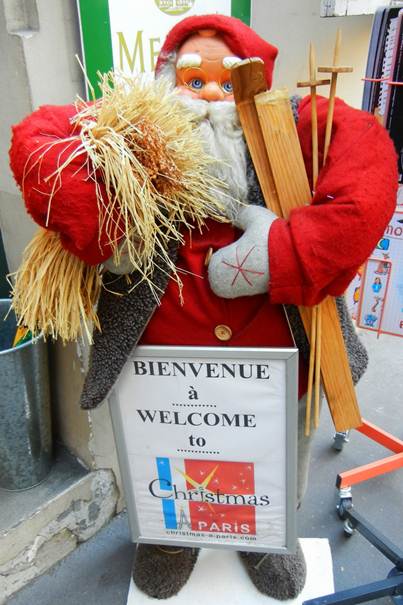
Christmas a Paris shop on the rue Condé has a unique assortment of kitsch,
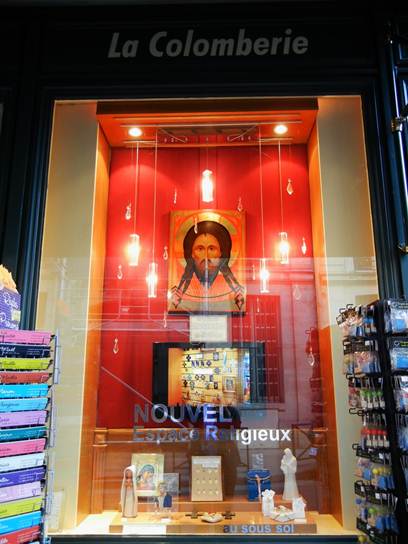
and a downstairs room that sells religious items, including clerical
robes. The little round drums on the
stand next to Santa, above, are actually music boxes that you play by turning
a small crank on the side.
Christmas
a Paris also has a section downstairs where religious items are sold.
Epaule d’agneau, with puréed potatoes
and a great girolle
mushroom sauce. |