|
Just
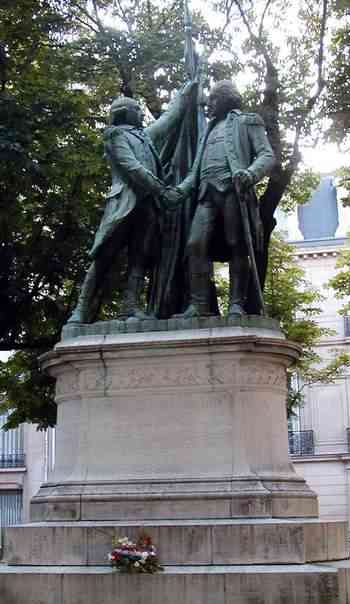
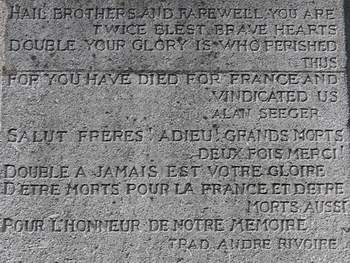
to show you how difficult French can be, I give you this inscription, first in English,
then in French, on the base of the statue (below) at the Square L'Etats Unis (Square of
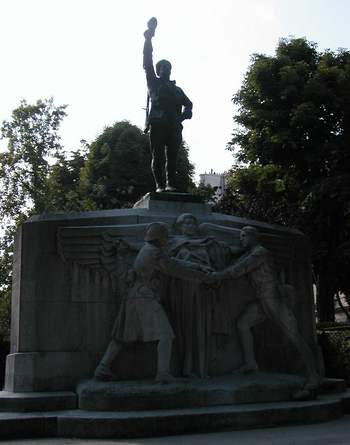
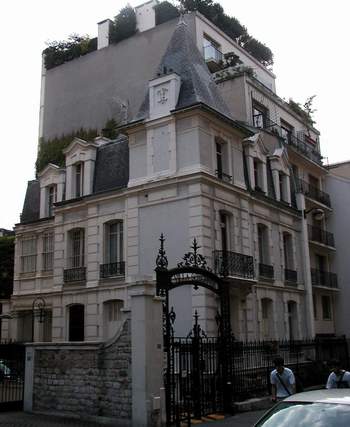
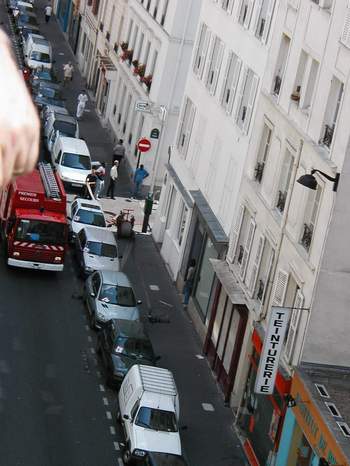
the United States). First, the English, as they have inscribed it here: "Hail brothers and farewell. You are twice blest brave hearts double your glory is who perished thus for you have died for France and vindicated us." Now, that's bad enough,, but if I were to translate the French literally, word for word, into English, it is something like this: "Hail brothers! Farewell! Great deaths two times thank you! Double at never is your glory of to be deads for France and of to be deads also for the honor of our memory." So we both consider it to be a great accomplishment that we can read a French newspaper every day, and that we can actually understand it. We are a long way from being able to carry on a rapid and smooth conversation in French, but we're good enough to have a little fun. Last night, at the Auberge du Mouton Blanc in the 16th, Tom had the house specialty, leg of lamb, served on a generous pile of tender white beans, cassoulet-style. He was absolutely stuffed after he finished it. The maitre d' came over to the table to ask (in French, of course) if he wanted a little more. To which Tom replied, "Merci, non. Je suis mort." (No, thank you. I am dead.) The maitre d' pretended to be shocked at this remark, but they both then chuckled at each other. Tom also has fun telling the wait persons, as he gives them the wine glass he will not be using, "Je suis un buveur d'eau." This literally means "I am a drinker of water," but it really means "I am a teetotaler." The phrase gets a smile every time he uses it. It got more smiles when he used to say "Je suis une buveur d'eau," mixing the feminine article with the masculine noun form. I looked it up and corrected him about a week ago. Now I think maybe I should not have. The top four pictures at left are from the Square L'Etats Unis, in the 16th arrondisement. The ambassador from Kuwait is renovating a lovely home facing this park. The park and its monuments are a beautiful testimony to the French people's gratitude for all the Americans who came to set them free from the Nazi occupation. They have not forgotten the Americans (like my dad's big brother) who died for France, in France. The French have been taking pains lately to show that they still like Americans, in spite of all our faults. I already mentioned that they included a contingent from West Point in the Bastille Day parade. Also included in the parade was a French military unit that fought alongside Americans in Afghanistan. And right before the parade, there was an interview on TV with a representative of the military academy at St. Cyr. He explained how they choose six St. Cyr students, every year, to be sent for a period of study at West Point. And of course there were the firemen from the FDNY in the parade. I found out that the FDNY fire truck was sent over here by boat via the port at Le Havre. It is part of an exhibition, along with French fire trucks, outside city hall. The approval for its participation in the Bastille Day parade came through at the last minute. There was a group of a few dozen NYC firefighters and families of firefighters who died on September 11 who were given a great vacation here. They were shown all the major tourist sights such as the Louvre. The TV commentator explained that for many of them, this was the first vacation they'd had since September 11. The firefighters here are called "sapeurs pompiers," or just "pompiers." We saw some in action on our street the other day. I heard the sirens first, and noticed that they seemed to stop right outside our building. So I called Tom out of the study (where he is diligently WORKING at the computer every day) and we watched as the pompiers pulled a red hose down the little passage called Cité Thuré - it intersects with our street very near our building. They frantically tried to attach the larger fire hose to a hydrant hidden beneath a metal plate in the sidewalk (so that's where the fire hydrants are!). But it turned out not to be necessary. The fire was evidently extinguished with the hoses that came from the trucks. The pic at bottom left is taken from our balcony. You can see the firetruck (partially obscured by Tom's hand on the balcony railing) and people watching the pompiers at work, down in the little passage. You can even see the hole in the sidewalk with a tall socket wrench sticking up - the device used to turn on the hydrant beneath the pavement. We spent some time yesterday evening, on the balcony as darkness was falling (about 10:30 to 11pm), with several French dictionaries from the 10,000-book library in the apartment. We were trying to figure out the origin of the word "sapeur" and how it came to be applied to firefighters. "Pompier" is easy, of course - it means one who pumps. As far as we can tell, "sapeur" is used because firefighters use pick axes. In the news:In the square across from the fire station in our arrondisement, the 15th, there was once a statue honoring the pompiers. It featured a fireman carrying an unconscious little girl whom he'd rescued. The town hall for the 15th recently decided to reproduce the statue, or to commission a new one. I'm not sure what happened to the old one. |