Paris Journal 2009 – Barbara Joy Cooley Home: barbarajoycooley.com
Sign
my guestbook. View
my guestbook. ← Previous Next → Back to the beginning
|
Yesterday, Dan and
Mary arrived from Kentucky, following a harrowing flight during which their
plane was shaken badly. Mary’s nerves
were also shaken badly. But she seemed
to recover quickly enough once in Paris, a city she clearly loves. (For not-so-regular readers, Dan is my
stepson and Mary is my daughter-in-law.) Mary and I went
for a short walk so I could orient her to that neighborhood. I showed her where the market, grocery,
newstand, bakery and wine stores are located, and pointed out the Italian
restaurant, Le Petit Mabillon, that Tom and I think she will like. We also stopped in to see the Saint Sulpice
church. Tom and I did a
lot of walking yesterday, because we walked all the way to the 6th
and all the way back to the 15th.
I was carrying a fairly heavy bag on the way back – good for toning
the arms. When we were
almost home, Tom found a kilim, probably from Afganistan or maybe Turkey,
folded and discarded on the sidewalk.
He took it home, laundered it, and now it is dry, on the balcony. I don’t know what we’ll do with it. As he said, too
many hours went into weaving it by hand; it cannot be simply thrown away as
trash. Are any Parisian readers
interested in having it? It is very
neutral in color; mostly tan or light brown, with some off white, dark brown,
and a little bit of black. After their
anti-jet-lag nap, Dan and Mary took the metro over to our apartment in the 15th,
and we all went out for a family dinner at La Gauloise. The restaurant is spacious, comfortable, and
the servers are all men of a certain age, wearing white shirts and black
ties. The
restaurant’s business was very slow.
Now I’m trying to puzzle this out.
Why is business slow at a place like La Gauloise (and many others),
but business is still good at places like Oh! Duo and Le Petit Niçois? What is the difference? The observable
difference is that La Gauloise, Bouillon Racine, and the other places where
business is slow tend to cater to older French people and to knowledgeable
tourists who look for traditional restaurants. The more strictly traditional restaurants
are hurting, and the restaurants with the modernized cuisine are doing just
fine. I ordered the
traditional food at La Gauloise, in spite of the fact that I think it may have
disgusted Mary. Sorry, Mary. I had the terrine de tete de cochon (terrine made of pig’s head), and the
rabbit in country-style mustard sauce.
Both were accompanied by little salads. Mary wasn’t
terribly hungry, so she ordered an appetizer, the shrimp cocktail with
avocado and grapefruit, as a main course.
I don’t know if she noticed it, but our server was smitten by
her. He thought she was cute and
funny. Well, she is. Every time he turned away from her, he was
grinning. Tom had the red
trout again, and Dan ordered the duck breast.
Both were very, very good. Mary and Tom
each had crème brulée for dessert.
That is a great choice. When I
think of excellent crème brulée, I always think of La Gauloise. As for the
clientele, I guess that the older French people who were regulars at La
Gauloise were living off their investments, which now probably don’t provide
so much income to be used on niceties like eating out. And there are probably fewer knowledgeable
tourists who care to seek out traditional restaurants because there are just
fewer tourists all around. It’s the
economy, stupid. Yet there are plenty
of people with good enough incomes who are frequenting the restos with the
modernized cuisine. These do not tend
to be older people. Two notable
exceptions were the two older ladies at the table next to ours at Le Petit
Niçois the other night. These two
chatterboxes were the ones who’d ordered the whole dorade that attacted us
into the restaurant to begin with. One
of them was a real character; when the
server asked how she liked the main course, she replied, “there wasn’t enough
of it; very much.” At first it sounded
like a complaint, but then the server figured out that it was a compliment. It’s nice to
understand French well enough to pick up on little things like that. When I don’t want to understand, I can
fairly well switch it off in my head. This morning,
I’ve been writing to a friend from high school days about everything that’s
happened since high school. That, plus
this talk about the French reminds me of Mrs. Moskowitz, my first French
teacher. She was really and truly
French, a Parisian, and she had a very low tolerance for us, her dull,
American students. She was as cute
as can be, in her mini-skirts, stylish short brown hair, freckles, and big
brown eyes loaded with mascara and eyeliner. She was also
angry as can be, at us, for being so stupid and klutzy in our attempts to
learn her language. She would stamp
her feet, clench her fists, turn red, and shout at us. It didn’t do any good. She only lasted
for a year or two in that job. She was
replaced by Mrs. Horowitz, an American who wasn’t the least bit perturbed by
us, and whose French pronunciation was almost as bad as ours. Funny, I can’t
remember the name of my French professor in college. I took an accelerated course for three
quarters; that was supposed to be the equivalent of a year and a half or two
years of instruction. The professor
gave me all A’s. He was American, but
he earned his doctorate at the Sorbonne in Paris, where he met his wife, a
French Canadian. He and his wife
communicated well, because she’d left Canada and had learned Parisian French
as opposed to her native provincial French.
But when he went to the Canadian countryside to meet her relatives, he
could not understand a word they said. After all that
effort to learn French while I was young, I didn’t use it for decades so I
lost it. Please, parents who have kids
who’ve studied a foreign language, please encourage them to go live or study
abroad for a while so they don’t forget it.
If you don’t use it, you lose it, and later you might have to learn it
again, when that is harder to do. |
Monday, July 13, 2009
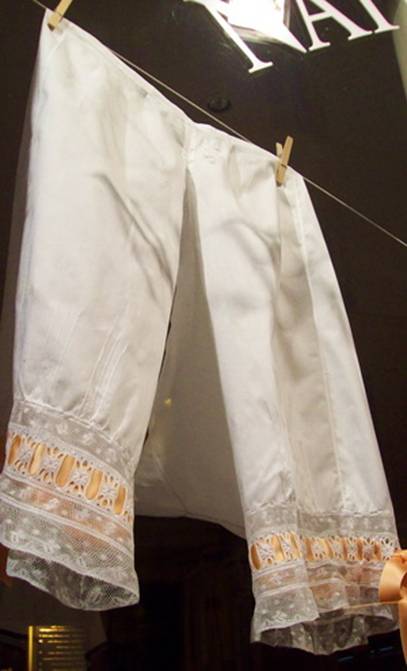
Pantaloons
hanging in the laundry window on the rue Amélie in the 7th
arrondissement.
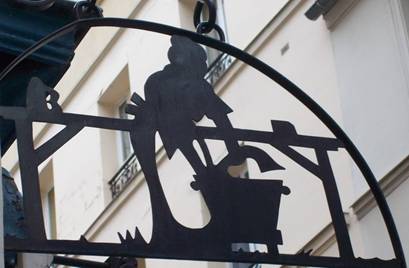
Old-fashioned
sign for the laundry.
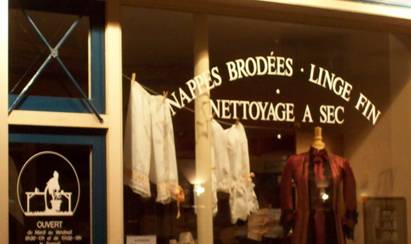
The
laundry, with vintage clothes on display.
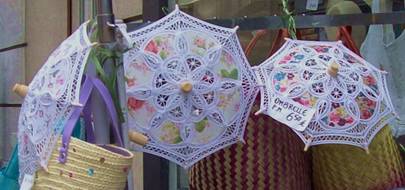
Child-sized
parasols on display outside an Asian-import shop. The sign informs us that these are
“ombrelles,” for making shade (ombre), as opposed to “parapluies,” literally
“rain shields,” which are what we call umbrellas. Sometimes French makes more sense than
English does.
A
hat, suitable for Derby Day, in a shop window in the 7th
arrondissement. |