Paris Journal 2009 – Barbara Joy Cooley Home: barbarajoycooley.com
Sign
my guestbook. View
my guestbook. ← Previous Next
→ Back to the beginning
|
When somebody
asks why we spend our summers in Paris, one of the reasons I give is that we
are really city people, even though we live in the swamp most of the
year. We need our dose of urban life,
I say. When I say I am
really a city person, it means more than you might think, unless you’ve known
me well for a long time. As I wrote to
a friend from high school days recently, when I was a teenager, I thought the
suburb where I lived was too homogenous and insulated, so I’d sneak away on
the city bus and go downtown when I could.
I liked the variety, color, and texture of the city. I wanted to
attend Kenyon College, but it was too costly for us back then, so I went to
The Ohio State University, in the middle of Columbus, instead. It was a blessing in disguise. As soon as I
arrived in Columbus, I made a decision to live in the city, not the
suburbs. And so for nearly thirty
years, I did just that. It was a
political and philosophical decision.
I didn’t like what the flight of the middle class to the suburbs was
doing to American cities everywhere.
The creation and preservation of historic urban neighborhoods was the
only way to keep some of the middle class near or in downtown. I believed, and still do, that people of
all different types and socioeconomic categories should live in close proximity
to each other. The cities aren’t just
for the poor; the suburbs aren’t the only place for the middle and upper
middle classes. I acted on my
beliefs. I became a community
activist, working as a volunteer to promote viable, diverse urban neighborhoods. I even wrote legislation to prevent the
intentional neglect and demolition of historic buildings. It passed, and so did historic district
nominations that I worked on. Paris is ideal
in many ways. People live everywhere,
in every arrondissement. There’s no
financial district that goes dead at night.
There is “social housing” (below-market-rate or subsidized housing) in
every arrondissement, I believe. It is
true that some arrondissements are more well-to-do than others, but even so,
each area has a mix. Nothing, no place
is homogenous in Paris. To accomplish
this, Paris and successful cities everywhere must maintain control over
certain things, such as crime, and environments that invite crime. What invites crime? What makes people feel unsafe? Many things do
that. One of them is the presence of
graffiti. Now, I admire
skillful graffiti as much as anyone (see the first photo in this year’s
journal). But face it; most graffiti is about marking turf;
some is overtly gang-related. When a neighborhood
becomes overwhelmed by graffiti, some people just refuse to live there, or to
even be there. The presence of
graffiti signals the possible presence of unpleasant happenings. Every city
person knows this. Even most
suburbanites know it, if they think about it. I saw, back in
early June, that Paris’ Fondation Cartier was going to have a special exhibit
on graffiti this summer. (And then
later, Bob S. pointed it out in the guestbook for this journal.) While I acknowledge that some graffiti artists
are quite talented, I am not amused by attempts to elevate most graffiti to
the level of respected art form. It isn’t. It is too damaging, too intrusive, too
detrimental to the environment and property values. Most of it is disrespectful of others. Most of it is too “in your face.” It is easy for
some elite people to think they’re cool by promoting a show about graffiti,
but I’d like to discuss with them the real consequences of the stuff. I’m betting that those people would not
choose to live in a neighborhood overwhelmed by graffiti. So, you
probably won’t find us at the Fondation Cartier to see this exhibit, unless I
get an invitation to come in and discuss it with the board and curator. |
Tuesday, July 14, 2009
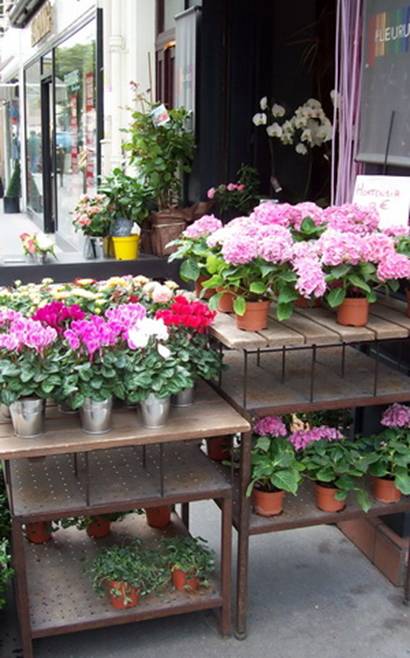
Flower
shop on the rue du Commerce in the 15th.
Takara,
and Asian import shop on the rue du Commerce.
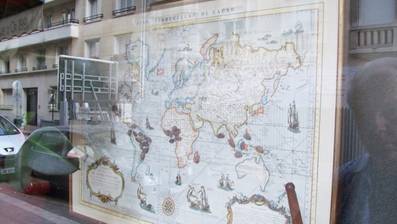
Map
in a chocolate shop window, showing where chocolate comes from. |