Paris Journal 2011 – Barbara Joy Cooley Home: barbarajoycooley.com
Photos
and thoughts about Paris
Sign
my guestbook. View
my guestbook. 2010 Paris Journal ← Previous Next
→ ← Go
back to the beginning
|
Cynthia asked me to “enlighten us about the whole check business” when it comes to dining in Parisian restaurants. I will try. The way it works 99 percent of the time in real restaurants here is the way it ought to work in American restaurants as well. That is to say that the server or maître d’ should not bring the check until you ask for it. The way to do that is to do precisely what Cynthia says – to ask politely for “l’addition,” which means “the tab.” We usually combine this verbal request with a hand gesture imitating the writing of something on a pad of paper. So if the server is across the room and cannot hear you, he/she understands what you want because of the gesture. The problem that Cynthia experienced is that even when she’d do this, and the server would acknowledge the request with a nod of the head, she and her dining companion would still have to wait for a long time to receive the check. What’s happening then is one of these things, I think: 1. It isn’t a real restaurant, but a much more informal venue such as a bar/tabac or maybe even a crêperie or tea room. At a bar/tabac, I think it is very common to go to the register at the bar to request and pay the tab. But for me this is theoretical, because we don’t go to the bars/tabacs. I still associate them with clouds of obnoxious cigarette smoke. 2. If it is a crêperie or tea room, you may have to figure this out by observation or you might simply ask if you pay at the bar or counter. The tea room, or salon de thé, that we recently went to on the way home from the Parc André Citroën was clearly a patisserie that had morphed into a bit of a tea room. At a patisserie or bakery, of course one always pays at the register at the counter. We were just having refreshments and a snack on the terrace, and we wanted to get going when we were done so that we’d not miss the end of the day’s Tour de France stage. So we just used the nature of this place as an excuse to go up to the counter and ask to pay our tab. Perhaps the server would have brought us a check if we’d asked, but it didn’t seem to be necessary and was maybe even a bit too formal for that place. 3.
At real restaurants and full brasseries, the problem
can be that if you dine early and are attempting to pay the check at peak
dinner time when the servers are racing around with too much to do all at
once, you’re just out of sync with what they’re prepared to do at that
moment. In their minds, it just isn’t
the time for bringing checks and operating credit card machines just yet.
Now, when we really do not want to wait long for the check and the restaurant is so busy the staff isn’t ready to bring it yet, we use non-verbal cues. One of them is to get the credit card out and place it on the table where the server will see it. Don’t do this when you’re sitting on the terrace on a sidewalk in a busy, touristy area, however. Your card might be snatched. But inside a nice restaurant or brasserie, that is not likely to happen. Another non-verbal cue is that first one of us will get up and leave the table to use the restroom. If that doesn’t work, then the other does the same thing. If that doesn’t work, we start putting on our jackets or coats, or gathering up our things such as umbrella, camera, shopping bag, etc. If we are not having dessert or coffee, which often is the case, we ask for “l’addition, s’il vous plait,” and when they say what, no coffee or dessert? We reply “merci, non, c’est tout” with a smile of satisfaction that says we are happily full of good food already, thanks to their work. Speaking of the increasing sense of being business-like and wanting to make money, we noticed that many more restaurants are open on Bastille Day than in the past. Some, like La Gitane, are doing something that is very American – offering a special Bastille Day menu for families/groups who want to celebrate by dining out together! C’est une bonne idée, oui? Already, I have a sense that fewer restaurants are going to shut down completely for the summer vacation. They’ll rotate the staff instead, if they can possibly do so. The profit margin is small enough in the cut-throat restaurant business that the idea of closing for a month just does not make sense, and many of the Parisian restauranteurs are now acknowledging that. Back to the subject of chip-less American credit cards: At Dia (discount grocery that almost reminds me of a third world country), the first day we shopped there this summer, the cashier was not able to get the American credit card to work in her machine. We realized that this was probably a training issue (she did not remember what she’d been taught about how to use such cards in her machine), and we just paid with cash. Sure enough, when we went there yesterday evening, the top cashiers were working because it is a busy time of day for a grocery – right before dinner. And sure enough, these cashiers knew exactly how to use the chip-less American credit card in their machines. Then we went to our favorite neighborhood pub, the brasserie called Le Commerce Café, for dinner. The amusing Charles served us, as usually is the case. But when it came time to pay, he said our card would not work. Tom noticed that the message on the machine’s screen said something about the bank (it did not say the card was not read by the machine). The transaction was “abandoned,” according to the print-out. We’d just used the card at the grocery, and it was fine. I checked online after we got home from the brasserie, and the card’s account is just fine. The problem here, I think, is in the brasserie’s relationship with its bank. When a restaurant is new, and has not yet established a track record with its bank, it is hard for them to get the account required for accepting credit cards. The same thing is true when a restaurant gets into trouble with their bank – they lose the ability to accept credit cards. Generally, they can still accept European debit cards with chips, however, and those are mostly what the locals use. Because this problem can happen on any given evening, we always have enough cash on us to pay the tab in cash if necessary, which we had to do last night. I’m surprised that Le Commerce Café is having this problem. The business seems to be hopping. But then French banks have a reputation for being very difficult. For the fun of it, we tried to use our card the other day in the Emile Zola metro station to buy a carnet (group of 10) of tickets. Of course, the machine’s screen said “carte non lu,” meaning “card unread.” That’s because the machine can only read cards with chips. A clerk was present at the window where tickets were once sold. We went to the window, and explained that the machine does not seem to accept American credit cards – the cards without a chip (“pas de puce”). (That was our agenda, really: to point out the deficiency in their system that cannot accept American credit cards. We figure that if this happens hundreds of times a day, maybe the transportation authority, RATP, with do something about it. We’re just trying to do our part.) The young woman was sympathetic, but I noticed that the cash register and credit card machine no longer exist inside the ticket window. They simply are no longer equipped to have real people sell tickets there. To buy tickets, one now must use the machines. She could only offer to come out and help show us how to use paper Euros (banque notes) in the machine (we did not have coins with us). Tom declined her help and went down the stairs to the platform, because we already had some tickets. But I stood there and thanked her and made sure she realized we understood and were not miffed. Tom had not realized that the cash register and credit card machine were gone. I, being the daughter of “Mr. Cash Register” of southwestern Ohio, had noticed the absence of the cash register and credit card machine in the booth. On the metro, when I explained that to Tom, he accepted that the clerk was doing all that she was able to do to be helpful. A male clerk had been present in the booth, too, but he did not offer to help. But we both wonder, what do the clerks do in those little offices that were once ticket booths? Their jobs do not involve security; we know that from previous experience. We do not know what they do, however. Sign
my guestbook. View
my guestbook. Note: For addresses & phone numbers of
restaurants in this journal, click
here. |
Sunday, July 17, 2011
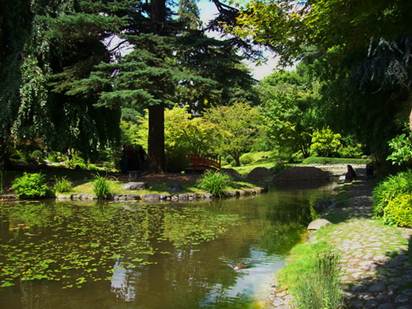
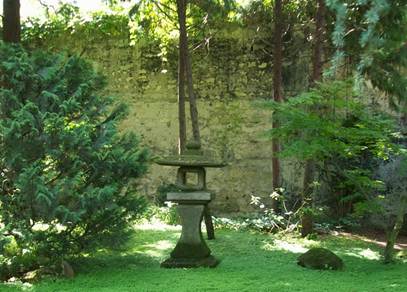
Above, more scenes from the Albert Kahn Gardens in
Boulogne-Billancourt.
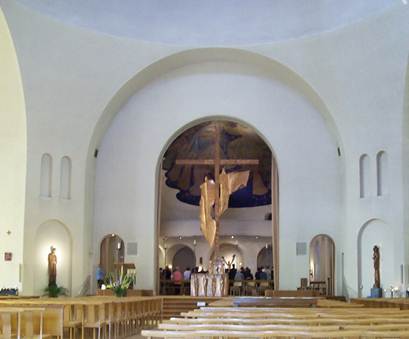
Modern interior
of the Sainte Jeanne de Chantal church on the Place de la Porte de Saint
Cloud. |