Paris Journal 2010 – Barbara Joy Cooley Home: barbarajoycooley.com
Photos
and thoughts about Paris
Sign
my guestbook. View
my guestbook. 2009 Paris Journal ← Previous Next
→ ← Go
back to the beginning
|
After a couple nights in a row at fairly substantial restaurants, we decided to keep it simple last night. We went to Le Commerce Café, our “neighborhood pub.” Our server was so good and professional, that I decided she may be one of the owners. I wanted to order one of the 13-euro specials on the blackboard, a souris d’agneau (lamb shank), but its accompaniment was pasta – tagliatelles. My French just rolled right off my tongue when she asked if we were ready to order: “Yes please, but I have a question. With the lamb shank, is it possible to have fries instead of the tagliatelles? I have a wheat intolerance.” She understood me perfectly and instantly, and nodded yes. So that’s what I ordered. It was delicious, and so was its sauce: a savory gravy made with thyme. I gave much of the lamb to Tom. Tom had the grilled veal scaloppini, and we both had fries. Bless our server – she never even thought about treating us like Americans by bringing ketchup (horrors!) or using English. I really like her. The café must have run out of their hand-cut fries, because what we were served were definitely machine-cut. But like the others, these were perfectly done and not the least bit greasy. The cooking is very “correct” at this café. I must say that I was stunned at how quickly our food arrived at the table. It was delivered by a big, burly older guy, straight from the kitchen and piping hot. Tom thought that the kitchen staff were probably expecting a big night, and so had certain dishes all ready to go. After dinner, I was very tired for some reason, and went to bed early. I slept in pretty late, and when I woke up, I was very hungry. So I weighed in. I’ve lost another kilo somehow; I have no idea why. It must be from not eating wheat – or eating only the tiniest amounts of wheat, like just enough for a sauce made with a roux. I did go out yesterday during the day for a short walk to buy newspapers and wine. We read two newspapers a day. One is rather highbrow (The International Herald Tribune), and the other is decidedly lowbrow. The lowbrow one is, of course, Le Parisien. It is like a cross between USA Today and a tabloid. Every once in a while, Le Parisien contains a news story that is written in a way that makes me angry. Such was the case yesterday, in the central section of the paper, which is for the very local Paris news. The article describes a situation which is disturbing a neighborhood called La Goutte-d’Or, in the 18th arrondissement, east of Montmartre. The rue Doudeauville is the center of the problem. The reporter, Cécile Beaulieu, makes the story sound like one about criminals, whom she labels as “prostitutes” and their pimps, making life miserable for the residents. In this case, the “prostitutes” are very young black women from Nigeria and Ghana. Their pimps are women who were once prostitutes themselves. The young women take their customers in the hallways, vestibules, courtyards, and places where the garbage cans are kept. But hold on! Not until the very end does Cécile tell us the real story, which is about human trafficking. Yet amazingly, Cécile never uses the word trafficking, which is definitely used in French, and she doesn’t use the word for slavery. Cécile does not seem to understand what the real important story is here, because she suppresses it until the end, and she emphasizes mostly the plight of the poor, disturbed neighbors. Finally Cécile tells us that the girls are lured by the false promise of good jobs and an agreeable life in Europe. When they arrive, they are tied up and forced into prostitution to pay a debt they’re told that they owe; usually, the amount is about 10,000 euros, and they’re never really able to pay it off. Cécile explains that the girls often come from villages where witchcraft is practiced, and that the women use that to scare the girls, to make them comply. They don’t stay in the 18th very long; they’re moved to other European cities by the “powerful network” that is abusing them, and are immediately replaced by “comrades of misfortune.” There are usually about 50 of these girls forced to do this work in La Goutte-d’Or/Chateau Rouge neighborhood at a given time. The article explains that unfortunately for the neighbors, the situation is very “complex” because the girls are “considered as victims by the law.” Duh, yes, Cécile. They ARE victims, you idiot! And furthermore, the article states, the Law of 2003 on “racolage” (dressing very provocatively) does not work because the girls dress normally, not wearing clothing that is too alluring. Even if they seem to be very young, these young women act like adults and bone tests generally do not prove them to be minors. Is it possible that the anti-trafficking laws here only protect minors? The article doesn’t explain any of that. The article is focused on the exasperation of the residents. I don’t doubt that they are exasperated. But the article does not mention “trafficking” or “slavery,” and it should, because that is the real story here. And not one word is said about the “johns,” or “customers” of these girls. Why can’t law enforcement go after them? I think that the answer to that is that prostitution is legal in France; only pimping and “racolage” are illegal. Yes, indeed. I just found a web page on www.rue89.com that says: Les relations avec
des prostitués ne sont pas interdites en France (seul le racolage et le
proxénétisme le sont), sauf quand le ou la prostitué(e) a moins de 18 ans.
L'article 225.12.1 du code pénal dispose en effet : « Le fait de
solliciter, d'accepter ou d'obtenir, en échange d'une rémunération ou d'une
promesse de rémunération, des relations de nature sexuelle de la part d'un
mineur qui se livre à la prostitution, y compris de façon occasionnelle, est
puni de trois ans d'emprisonnement et 45 000 euros d'amende. » Translation is: Relations with
prostitutes is not forbidden in France (only racolage and pimping are) except
when the prostitute is younger than 18.
Article 225.12.1 of the penal code says: “The act of
soliciting, accepting, or obtaining in exchange for remuneration or promise
of remuneration, sexual relations with a minor who offers herself/himself as
a prostitute is punishable with three years of prison and a 45,000 euro
fine.” What about laws on human trafficking? Surely there are some! A web page on the US State Department site about French laws seems to imply that the anti-trafficking laws in France may apply just to children. Is that possible? The web page is somewhat out of date, dating to 2003-04. I wonder if the story would have been written differently if the girls were white. I wonder if the situation would be handled differently if the girls were white. Sorry, but I just can’t help but wonder about whether racism is involved in the lack of dealing with this situation. Hey, Paris: this isn’t prostitution, it is modern day slavery right here in your city. |
Saturday, July 24, 2010
The
Seine and a piece of Notre Dame, as seen from the Six-Huit café boat.
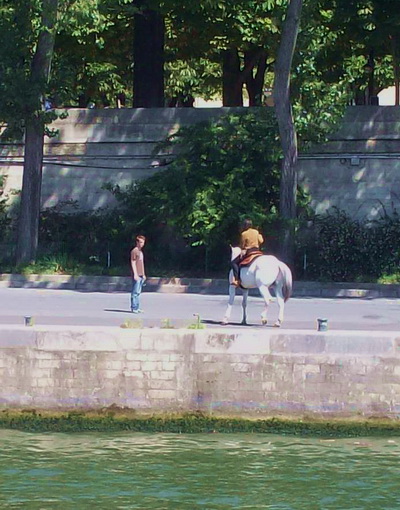
The
filming of a person on horseback on the right bank of the Seine.
Near
Notre Dame is a monument to the 1940 concentration camp victims. Note: For addresses & phone numbers of
restaurants in this journal, click
here. |