Paris Journal 2010 – Barbara Joy Cooley Home: barbarajoycooley.com
Photos
and thoughts about Paris
Sign
my guestbook. View
my guestbook. 2009 Paris Journal ← Previous Next
→ ← Go
back to the beginning
|
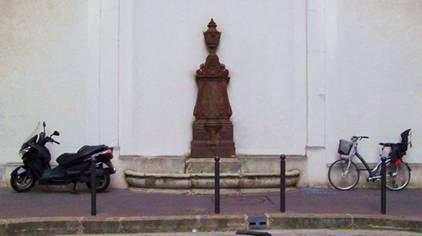
We took a long walk over to the far end of the boulevard Montparnasse to meet Jim and Maddy for dinner at l’Abri Cotier. They seem to each be enjoying Paris in their own way. The opportunity inspired me to concoct yet another new route for walking over there. Maddy was effusive in her praise of the Yves Saint Laurent Retrospective exhibition that is happening now at the Petit Palais. The popularity of that exhibition is evidently the cause for the long waiting line that we saw there last Sunday. We really like the permanent collections at the Petit Palais. Even better, for the permanent collections, entrance is free. And the café in the courtyard is so nice . . . . But Maddy is educated in fashion design, so the timing of her visit to Paris was perfect for seeing this special show. After seeing it, I think she felt inspired. Our dinner at l’Abri Cotier was good, and the service was warm and friendly, but I don’t think the kitchen was in its most inspired form. Luckily for me, Jim was interested in sharing the fish soup appetizer. While the soup wasn’t quite as flavorful as I remember, I was happy to be able to share it because if I have it to myself, I’m not able to have a main course. It is just too much food. We went there because Maddy wanted sole meunière, and because this is one of our favorite restaurants in Paris. I just had the sole meunière a few nights ago when Tom and I went there together, and it was excellent. Maddy said her sole was delicious, too. My Saint Pierre (fish) in aumonière (very thin pastry packet that looks like a sack) was a bit overcooked, and the sauce was a little heavy and dull for it. Tom said his filet mignon de porc was good, but not the best he’s had there. I suspect that perhaps the main chef was not in the kitchen last night. Jim had the cochon de lait, which was a much more reasonable size than the giant portion of cochon de lait I was served earlier this month at Le Minzingue. I think he liked it, but it is very rich, as Tom told him it would be. Then Maddy topped off the dinner with an Ile Flottante, which looked absolutely gorgeous. Going home, Tom and I decided to walk only halfway and then take the metro from the Duroc station, which is near the Institut National des Jeunes Aveugles, or National Insitute for Young Blind People. One end of this school is conveniently right across the street from one corner of the Necker Children’s Hospital megablock. The Institut National des Jeunes Aveugles was the first school specifically for blind kids in the world. Until this school was established in 1784, blind kids were considered to be uneducable. The inventor of braille, Louis Braille, was one of the blind kids who was educated in this school, and as an adult, he taught there. In the first half of the nineteenth century, a number of kids at the school took organ lessons, and went on to become organists in Paris cathedrals. The school in Boston that Helen Keller attended was founded by John Dix Fisher after he visited the Institut National des Jeunes Aveugles in Paris. It inspired him, just as Helen Keller went on to inspire so many others. The founder of the Institut National des Jeunes Aveugles, Valentin Haüy, was from a family of weavers. His father rang the abbey bells as a second job, and in return the monks taught Valentin a number of different languages. I must share with you the following paragraph from Wikipedia, about what inspired Valentin: Haüy's need to help the blind reached an
all-time high in 1771, after he stopped for lunch in a cafe on the Place de la Concorde, Paris. There, he
witnessed an ensemble of people from the Quinze-Vingts hospice for the
blind being mocked during the religious street festival, "Saint Ovid's
Fair". They were given dunce caps, oversized cardboard glasses and told to
play their instruments which resulted in a cacophony of noises. Yes, people can be cruel. The hospital/hospice mentioned in the paragraph, the Quinze-Vingts, was established for blind people in a state of great distress in 1260. Some of the inmates were crusaders who had had their eyes gouged out when they went on the Seventh Crusade. The name of the hospital comes from the name of the neighborhood, which comes from a way of counting money way back when. It means literally fifteen twenties, or 15 times 20, which is 300, a unit in the système de numération vicésimal, or vigesimal, or base 20 numbering system (20 being the number of fingers and toes which we have to count on each normal human body; why the oldentime French came up with quatre-vingt instead of huitant, or eighty – they had to count fingers and toes in order to count). In fact, the hospital did have 300 beds as well. Nowadays, Quinze-Vingts is still the big public hospital specializing in opthalmology. For those who know Paris, you will remember that there is a big, modern, sort-of ugly hospital attached onto the back side of the Opera Bastille. That is Quinze-Vingts. In conjunction with other institutions in France, it hosts dozens of research teams and eight businesses that work to discover and test innovative treatments for eye disorders and diseases. One of the other institutions is, like Quinze-Vingts, also located in the 12th arrondissement of Paris. It is the Rothschild Foundation, a private hospital dedicated to ophthalmology, founded by Adolphe de Rothschild, of the famous Rothschild banking family, in 1905. That reminds me of a vignette I remember reading in a book about the Rothschilds years ago. One of the female members of the family had the habit of walking around Paris in attire that was pretty worn out and shabby, just because she was eccentric. But she was, as are almost all Rothschilds, quite wealthy. Still, a warm-hearted, philanthropic Parisian saw her once, on the streets, in the vicinity of the Rothschild Foundation, I think, and said “mon pauvre,” to her as he handed her some money. She was so stunned that she was speechless. While we were walking to dinner, I found another one of those beautiful passageways lined by elegant Hausmannian buildings. This one, called avenue Constant Conquelin, is most likely named for Benoît-Constant Coquelin (23 January 1841 – 27 January 1909), a famous French actor who was once with the Comedie Française. The cute street is located right across from the Institut National des Jeunes Aveugles. At the dead end of it is an intriguing metal fountain, unlike any other I’ve seen in Paris. Note the little piece of rolled up carpeting in front of the drain on the curb in front of the fountain. This is one of many used throughout Paris by the “little green men” who wash the streets and sidewalks – almost daily, in some neighborhoods. I do like clean streets. |
Wednesday, July 28, 2010
Shop
window with colorful light fixtures on the boulevard Montparnasse.
Entrance
to the National Insitute for Young Blind People on the boulevard des
Invalides, near the boulevard Montparnasse.
Notice the little white car parked on the sidewalk. Paris drivers think they can get away with
this.
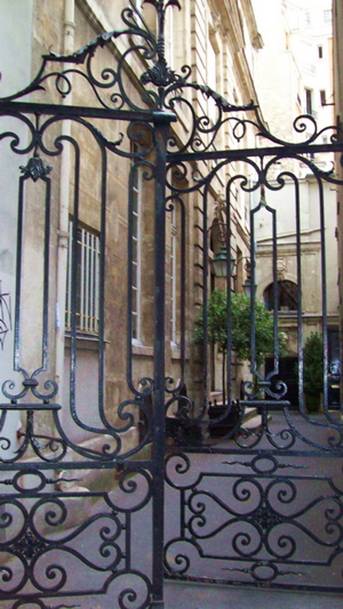
A lovely iron gateway on
the boulevard Montparnasse.
Montparnasse
1900, a pretty restaurant on the boulevard Montparnasse.
Note: For addresses & phone numbers of
restaurants in this journal, click
here. |