Paris Journal 2010 – Barbara Joy Cooley Home: barbarajoycooley.com
Photos
and thoughts about Paris
Sign
my guestbook. View
my guestbook. 2009 Paris Journal ← Previous Next
→ ← Go
back to the beginning
|
A version of some of our favorite walks in Paris begins with a stroll down through the length of the Luxembourg Gardens, and then the Marco Polo Gardens. At that point, we sometimes turn right on the boulevard Montparnasse, but occasionally we go on for another block to the avenue Denfert Rochereau. Soon, on our right, is a little shop with things made by nuns. We like to stop in and browse, but the last time we were there one of the volunteers made us uncomfortable by staring at us nonstop, so we haven’t been back there yet this season. Just beyond the shop is one of the huge, very old hospitals – this one called Saint Vincent de Paul, and it was run by the Catholic order of the same name but is now part of the big public hospital system. It is a very old hospital that began by taking in abandoned children. Up until the mid-19th century, a mother could bring a baby to a tower built into the wall of the institution. There, in the tower, was an opening and a cylinder. She would put the baby in the opening, turn the cylinder, and then the baby would be taken from the opening on the inside of the institution -- all very anonymously. The Saint Vincent de Paul hospital came to specialize in taking care of mother and child, what we eventually would call pediatrics and obstetrics/gynecology/maternity. Near Saint Vincent de Paul is another, very large public hospital called Cochin, and one called Port Royal. Not long ago, the decision was made to consolidate all obstetrics/gyn/maternity operations at Cochin/Port Royal. Now the decision has been made to consolidate all pediatrics at Necker, so at some point in the not-too-distant future, the Saint Vincent de Paul hospital will no longer exist. The property consists of 3.2 hectares, or about 8 acres. The City of Paris plans to acquire it and build an “ecoquartier,” or green neighborhood, there in the 2016-2017 timeframe. I wonder what will happen to the very historic hospice called Marie-Thérèse which is right next to Saint Vincent de Paul, and seems to be run by the same order. Also, what will happen to the little shop that we’ve visited? On va voir. The original name of the hospital was not Saint Vincent de Paul, a name it acquired in the 1940s. It was, at first, called the “hospice des Enfants-Assistés,” or “Enfants-Trouvés,” found children, or foundlings. With roots in the early-to-mid-17th century, the first benefactor was the Duke of Orleans. The location given for the original institution is the “rue d’Enfer,” or “street of hell.” There is still a “passage d’Enfer” nearby. My guess is that the original name of the avenue Denfert Rochereau, before Hausmann, was “rue d’Enfer.” Life was hell for many, many people in Paris in the early-to-mid-17th century. Without going into some of the more sordid details, I’ll just say that prior to the establishment of a hospice for foundlings, the practice for those who had unwanted children was to sell them at the Port Saint-Landry for 20 sols each. The ones who survived childhood generally became beggars, vagabonds, and thieves. That was the sad state of affairs until Saint Vincent de Paul established the first hospice for foundlings in 1638 near the porte Saint Victor. It moved a couple times, and then Queen Marie-Thérèse set the first stone for what became the principal hospice for foundlings, in the faubourg Saint-Antoine. There were then two establishments, which were merged in 1802 and located where the Saint Vincent de Paul hospital is now. The organization would admit foundlings and abandoned children from the age of newborns up to those 12 years old. When admitted, newborns were assigned to nurses who took care of them, small children were sent to live in the country, and the older ones were placed with artisans or farmers. Also received were the children of people admitted to hospitals, or those of people condemned to jail, just until their terms were served. I don’t know what happened to children of people given the death penalty. The Marie-Thérèse Hospice was created on what had been the property of M. and Mme. de Chateaubriand, who lived there in the 1820s, and who had a pretty, large garden. The Chateaubriands, along with the Duchess of Angouleme created an “infirmerie” originally meant for people who had “fallen from high rank” to keep them from living a “rude life of misery.” The infirmary is still there, and I think it does operate as a hospice, but part of the property is now used for an innovative program for young blind girls, directed by the nuns of Saint Paul. Each blind girl is assigned to a nun, who becomes her veritable mother. The chapel on the property is in what was once Mme. Chateaubriand’s parlor. Across the street is a convent that specializes in receiving “penitent girls.” All in all, poor children in Paris are far better off now than they were 300 years ago. Yesterday, we took two walks – one in midday down the avenue Emile Zola, and another in the evening, up the avenue de Suffren to try out the Chinese restaurant called Au Ciel de Shanghai. It was a multicultural experience, but it was not a good restaurant. It certainly was very clean, and so were the many white-shirted, dark haired Asians who work there. And oh, do they ever work! These people work so hard! We entered, and were given a table toward the back, not far from the kitchen, because that was where space was available. We eventually realized that the rest of the place was filled with people who came off one of the ubiquitous tour buses. We didn’t see the bus because it was parked around the corner, near the Champ de Mars, where parked tour buses tend to be. As the Asian tourists left, the staff scrambled to put big plates of food on a long table near us. Their food looked good. They all sat and ate, shoveling the food in as fast as they could so that they could get back to work. When they were finished and the dishes removed from their table, there was food scattered all over the table top. They are used to being in a hurry for the next onslaught of tour buses. But instead, they all got together to dry dishes, right on the other tables near us. Our dinner music was the sound of clattering dishes being dried and stacked, and chattering staff putting everything in order at the end of the evening. Our first course, spring rolls, was just fine. There were 8 spring rolls, much to our surprise. That was a good thing, because our main courses, sweet and sour pork, were not very good at all. The food was very inexpensive. I guess you get what you pay for, right? Sign
my guestbook. View
my guestbook. Note: For addresses & phone numbers of
restaurants in this journal, click
here. |
Tuesday, July 27, 2010
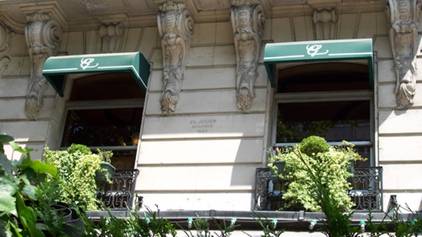
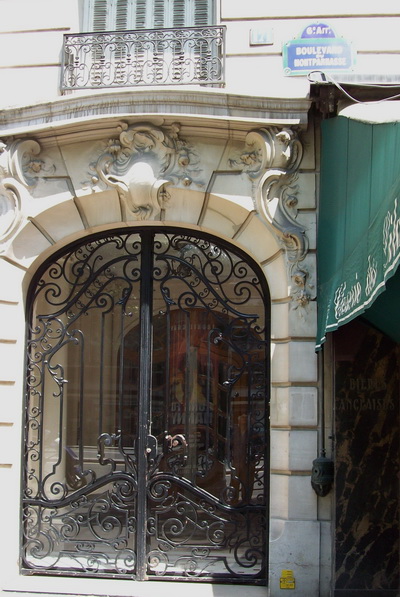
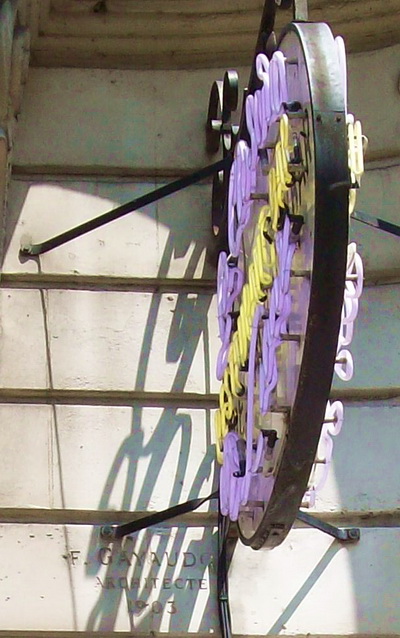
Images
of various parts of the building that houses the Clos des Lilas restaurant at
the corner of the boulevard Montparnasse and the avenue de l’Observatoire. |