Paris Journal 2011 – Barbara Joy Cooley Home: barbarajoycooley.com
Photos
and thoughts about Paris
Sign
my guestbook. View
my guestbook. 2010 Paris Journal ← Previous Next
→ ← Go
back to the beginning
|
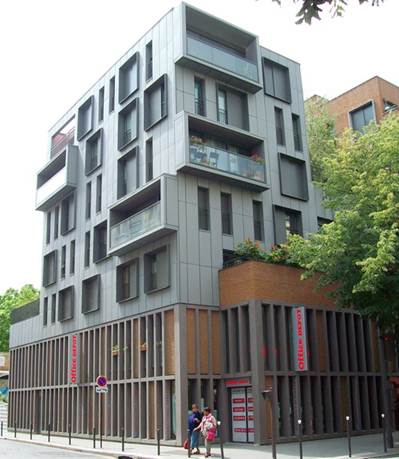
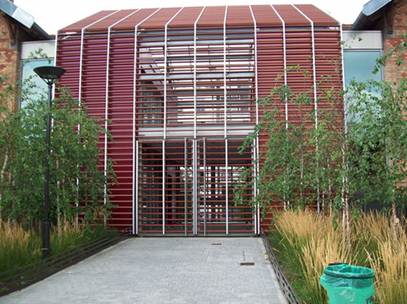
We shunned the crowds again yesterday by taking our walk in the lower part of the 15th. We went by Restaurant Le Cristal de Sel to see if we could get in there for a late lunch, but alas they close at 2PM and reopen at 8PM for dinner. Later, at home on Facebook, I noticed that they are closed for vacation for three weeks, starting today. We’ll have to try that place at the end of August. We weren’t all that hungry anyway, and the rain was supposed to come later in the afternoon, so we walked on. I got the sudden urge to explore rue de la Convention again, and we soon came upon the site of the former Boucicaut hospital, now called “Campus Boucicaut” on the Paris maps. A couple years ago, we noticed that the big old hospital had been closed and that all kinds of construction signs had been posted on it. I think I remember it as a hospital back in 1998-2000 or so, but it also may have been partially used by the university for research even then. Now, the main building is a pleasant looking government office building, complete with a sign that says “Republique Francaise” over the front door where it used to say “Hopital Boucicaut,” and of course the French flag proudly on display. Some of the ancillary buildings have been demolished and replaced by modern structures that fit in amazingly well with the streetscape of rue Convention. The Boucicaut hospital was associated with the famous Université Pierre et Marie Curie and Université Paris 7 (UPMC). The site is now the location of two institutes associated with this university: the INSP - Institut des NanoSciences de Paris (Paris Institute of Nanosciences) and the IMPMC - Institut de Minéralogie et de Physique des Milieux Condensés (Institute of mineralogy and physics of the condensed mediums) www.lmcp.jussieu.fr. The UPMC is a part of the University of Paris (often called “the Sorbonne”) that, according to en.wikipedia.org, is “the largest scientific and medical complex in France, active in many fields of research with scope and achievements at the highest level, as demonstrated by the many awards regularly won by UPMC researchers, and the many international partnerships it maintains across all five continents.” But the middle of the large former hospital site, behind the main building, is a big pit, with lots of demolition still underway. We were pleased to see that the charming little chapel in the middle is being preserved. Also, a nice allée of old trees from the garden remains. We walked all around the perimeter of the site, including a street we’d never explored, called rue Lacordaire. The big old hospitals of Paris fascinate me. Much that is important in the history of modern medicine has its roots in these big institutions. I would not want to be an inmate in one of these old behemoths, but thinking and learning about their history intrigues me. What the French do with old buildings and sites like this also intrigues me. They can be so good at combining new architecture and old in these redevelopments. So far, they’re doing a good job on the Campus Boucicaut. First, on the corners of the rue de la Convention and the rues Lourmel and Lacordaire, flanking the old main hospital building, modern buildings have been constructed which combine retail on the street level with residential units above. A sizeable (for Paris) Office Depot has been established in one of these buildings, and a mattress store in the other. There was an opening between the mattress store and the old hospital, leading to a narrow but pleasant little park. We went into it, and discovered, on the right, another fascinating modern structure built to connect two other old Boucicaut buildings. At least one of these buildings is now a nursery school. We walked on to see the Jardin Durantan on the street of the same name. It was okay, but not one of the more beautiful parks of Paris. It does provide a good place to play for all the little kids who live in the many surrounding apartment buildings. It started to rain very lightly, so we went back up the avenue Félix Faure and stopped at the Monop grocery on rue des Entrepreneurs for a few supplies. The name of that street always makes me smile, as I remember one of the goofier things that George W. Bush ever said: “The French don’t have a word for entrepreneur.” Yes, he really said that! A couple of young American tourists were in the Monop, and they’d cleverly figured out that this place is an opportunity to save money in Paris. The Monop has a snack bar just inside its front window, equipped with bar stools, a microwave, napkins, and plastic knives and forks. So rather than eating always in restaurants, kids travelling on tight budgets can get a sandwich and beverage, pay at the cashier, and plop right down at the snack bar to eat and watch people walk by. Tom stopped at the bakery on our way home, while I went up to put the groceries away. The rain had picked up, so we just decided to stay indoors. Later in the evening, Tom went around the corner for Chinese takeout food. Now that may not seem very French, and it isn’t, but this is also our “big city” time, when we can take advantage of having so many amenities of great variety just within a block of our home. There are no fewer than four Chinese takeouts within two blocks of this place. This year, the one that has looked the most promising to me (in terms of cleanliness, attractiveness of the food, and the look of the customers) is the one to the south, on the left side of the rue du Commerce as one approaches the St. John the Baptist church. That’s where Tom went. He brought home poulet croustillant (chicken in a crunchy batter) in a sweet and sour sauce with some veggies, and rice with a few peas scattered in it. It was surprisingly good! Tom thinks this place is really run by a Vietnamese family. Back on that subject of entrepreneurs, the Boucicaut hospital was named for Aristide Boucicaut, who founded the Bon Marché department store. Why would a hospital be named after a businessman? I think it is because Boucicaut’s second wife, who worked with Louis Pasteur, helped to establish it. In an attempt to modernize and eliminate some of the scary old public hospitals, Boucicaut was merged with two other old behomoths (Laënnec and Broussais) to form the Hopital Georges Pompideau, adjacent to the Parc André Citroën. The modern hospital opened in 2001. Even in its short history so far, however, the Georges Pompidou hospital has had many troubles. Among them was an outbreak of Legionnaires disease among its patients, very soon after it opened. I also remember not long ago there was an electrical problem that shut down the hospital’s operating rooms for some time. Newer may be better when it comes to hospitals, but it isn’t always perfect. Sign
my guestbook. View
my guestbook. Note: For addresses & phone numbers of
restaurants in this journal, click
here. |
Friday, July 29, 2011
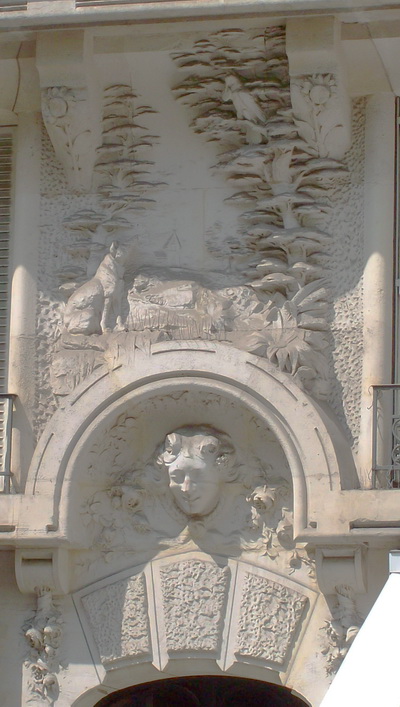
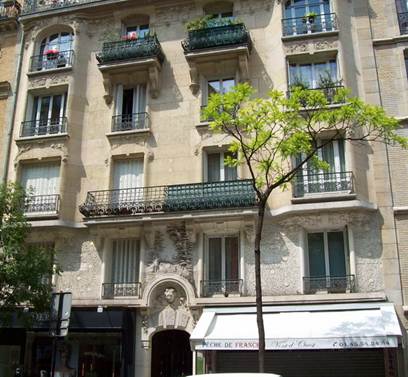
Haussmannian building on rue de la Convention with a bas relief
showing a scene from the fox and crow fable by La Fontaine. Below, the building façade in context.
New
commercial/residential building on the Campus Boucicaut
on the rue de la Convention.
Modern
structure connecting two older buildings on the rue Lacordaire
side of the Campus Boucicaut.
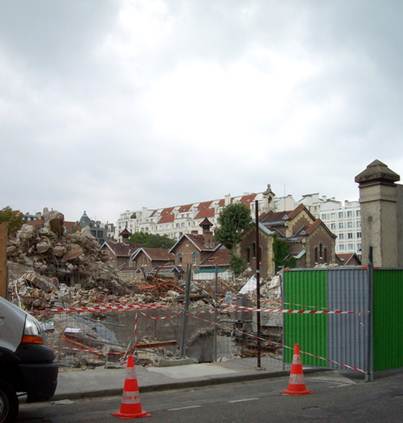
Major demolition
is still underway at the Campus Boucicaut, but
fortunately the charming old chapel (center right) is being preserved. |