Paris Journal 2011 – Barbara Joy Cooley Home: barbarajoycooley.com
Photos
and thoughts about Paris
Sign
my guestbook. View
my guestbook. 2010 Paris Journal ← Previous Next
→ ← Go
back to the beginning
|
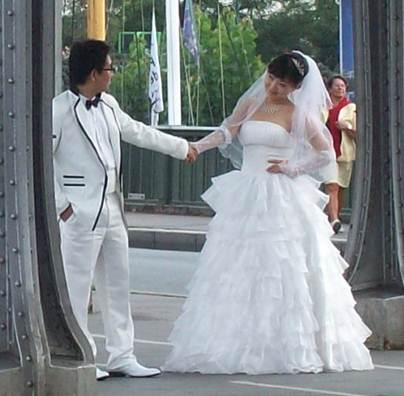
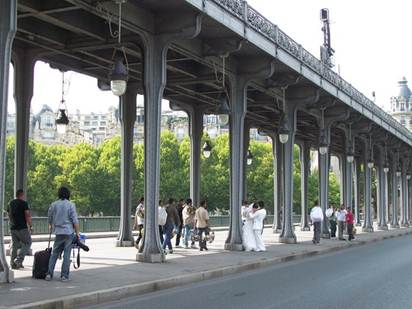
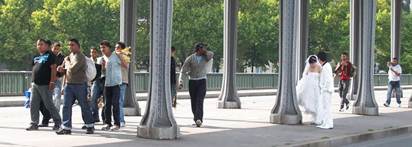
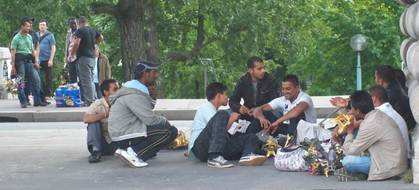
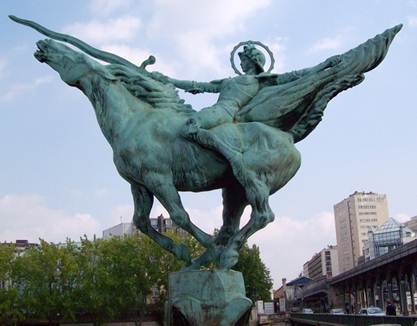
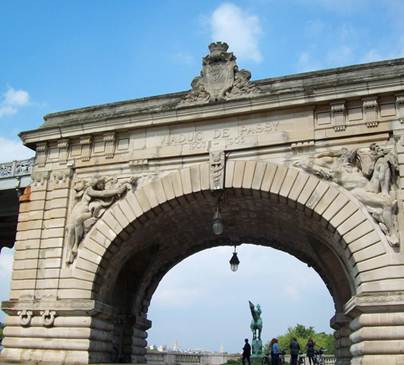
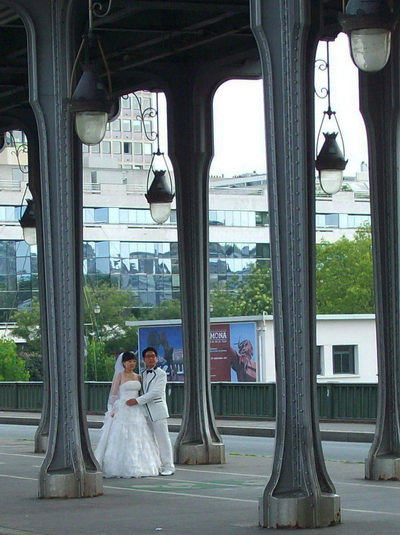
It was a busy Friday afternoon on the streets of Paris. Parisians are in a hurry to get out of town – this is the time for vacations to begin for vast numbers of French people. The newspaper contains reports of mammoth traffic jams on the highways around and outside the city. The photos of the traffic jams are enough to give you a headache. In the city, drivers are hurrying. They are impatient. Horns are heard blasting away. So, after consuming a magnificent omelette that I made, we chose to walk on the Allée des Cygnes, of course, away from the cars. This time, I wanted to go all the way up to the monument on the other side of the Bir Hakeim bridge at the far end. I’m so glad we did, because when we arrived there, we witnessed an amusing scene. First, we noticed a large bunch of the illegal vendors of Eiffel Tower trinkets moving along the bridge, away from the 15th arrondissement and toward the 16th. A policeman on a bicycle was riding along with them, encouraging them to leave his arrondissement. When the policeman reached the halfway mark on the bridge, which is where we climbed up to the bridge on the steps from the Allée, he turned his bike around and returned to his turf. The illegal vendors walked on for a short distance. Then they stopped, retraced their steps to the centerline, sat down to rest and socialize for a bit, and then eventually returned to the 15th side of the bridge, going back to the vicinity of the Eiffel Tower. The funny part was that they were oblivious to the fact that a young couple was trying to have their wedding photos taken there, by a professional photographer. The couple and photographer had to move farther down the bridge to make way for the illegal vendors! I was photographing the magnificent equestrian statue that is part of the Bir Hakeim monument. So of course I also photographed the vendors and the bride and groom. What a weird combination! The rider depicted on this statue is female. I never noticed that before. Sure enough, the statue is called “Le Monument La France Renaissante,” so the female is a Marianne, a symbol of France. It was made in 1930 by the Danish sculptor, Holger Wederkinch, and given as a gift to Paris by the Danish community. Originally, the rider on the horse was supposed to represent Joan of Arc. But the character of the figure was judged to be too emphatic and war-like, contrary to the iconography at that time of this heroine. It was not appreciated by the Paris city council, who issued an unfavorable opinion about it in 1956. To avoid a diplomatic incident, Denmark’s embassy decided to rename the statue “La France Renaissante,” making it simply a decorative statue. The erection of the statue in the Place was authorized later in 1956, and it was inaugurated on that spot in 1958, in the presence of the Danish ambassador. The bridge itself is interesting because it has two levels: the upper one for the elevated line 6 of the metro, and the lower one for pedestrians, cars, and bicycles. It is the second bridge erected on that site; completed in 1905. Originally named the Viaduc de Passy, it was renamed in 1948 to honor the troops called the Free French forces, who fought the Nazi Afrika Korps at Bir Hakeim in 1942. Bir Hakeim is an oasis in Libya. The Battle of Bir Hakeim ended in June of 1942, the month my husband was born. One month later, on July 16 and 17, 1942, was the horrible roundup of over 13,000 Jewish residents of Paris. They were taken to the Vélodrome d’Hiver, which stood very near the 15th arrondissement end of this bridge, called the Viaduc de Passy at that time. From the Vélodrome, these people – men, women, and children -- were sent by train to Nazi death camps. They were sent by the French. Now there is a park called the Parc des Martyrs Juifs de Vélodrome d’Hiver by the 15th arrondissement end of the bridge. So these monuments to the same few months of history in 1942, to the evil and the good, stand near each other. Who were the “Free French” forces who fought the Battle of Bir Hakeim? They were the French who kept on fighting against the Nazis, even after France capitulated in June 1940. The Free French forces of Africa, under General Henri Giraud, fought against the Nazis without any relationship to Charles de Gaulle’s organization. The Bir Hakeim bridge has been the site of many movie shoots, and even a Janet Jackson music video (Come Back to Me). Another delightful thing about it is that the handsome center of the lower level, between the stately columns and under the art-deco hanging lamps, is a bike path. The bridge was listed as a historic monument in July 1986. Rightfully so. In the evening, we went out again – this time to dinner at Le Commerce Café (not the Café du Commerce), where mercifully we were served by a nice young man instead of the older clown who often is there. One of the daily specials was a pork chop served in a mustard cream sauce, accompanied by Dauphinois potatoes. That’s what I ordered. It was delicious – the pork chop was tender, and the sauce was made with that old fashioned mustard with the seeds in it. I love that when it is used in a cream sauce. The potatoes were bland, but salt and lots of pepper fixed that. Tom ordered another daily special, brochettes that were available in beef or in lamb form. He selected the lamb, and these were accompanied by the Café’s homemade steak fries. Really good. Tom also ordered the fine apple tart for dessert, which arrived with a delicious scoop of old fashioned vanilla ice cream. Quite good. We came home and sat out on the balcony for a bit, as the weather was really nice for a change. As we sat high above the street, I read a story in the newspaper about a strange incident that happened this week below the streets of Paris. Some young people who’d had too much to drink found their way into the intricate system of tunnels beneath the city. These were made to mine the stone used to build Paris. It is forbidden to go into these tunnels, called “catacombs,” but these are much more than the Catacombs you may have visited on a guided tour, where bones from the Cemetery of the Innocents have been arranged. These catacombs are old mines, and it is dangerous to be in them. Collapses occur not infrequently. And it is easy to get lost in them. That’s what happened to the drunk young people – three of them. Their friends reported them missing almost right away, but it took the police two days to find them. As we suspected, cell phones and radios do not work in the catacombs. So, don’t go there. Sign
my guestbook. View
my guestbook. Note: For addresses & phone numbers of
restaurants in this journal, click
here. |
Saturday, July 30, 2011
Bride and
groom posing for photographs on the Bir Hakeim bridge, in the middle of the bike path. Aren’t they cute?
Illegal
Eiffel Tower vendors leaving the 15th arrondissement on the Bir Hakeim Bridge.
The vendors
turn around after the policeman leaves.
La France Renaissante, by Holder Wederkinch.
Central
arch of the bridge.
Bride and
groom under the art-deco lamps of the bridge.
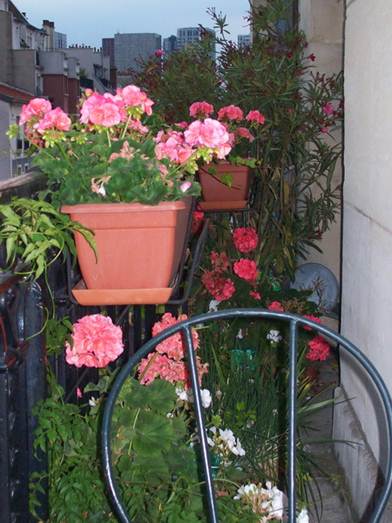
The flowers
that I care for in the summer, on the narrow balcony six floors above the street
level. |