Paris Journal 2009 – Barbara Joy Cooley Home: barbarajoycooley.com
Sign
my guestbook. View
my guestbook. ← Previous Next
→ Back to the beginning
|
Living in Europe for a quarter
of the year and having quite a few friends who are British has caused me to
pick up some “Britishisms” in my vocabulary. For example, I sign almost all
of my e-mails with “Cheers!” I also use the term “social
housing,” which is British, not American. Pointing this out to Tom the
other day, he asked, “Well, what do we call it?” I said, “We say ‘the projects,’
and it doesn’t sound very nice does it?” I suppose we also say
“subsidized housing” and “below-market-rate housing,” both of which sound
better than “the projects.” Call it what you will, there is
one thing that those of us who have lived in the inner city for decades know
for sure: it is a very bad idea to
concentrate that kind of housing in just one or a few areas. When social housing is too
concentrated in an area, nobody wants to live there. Parisians, sophisticated people
that they are, know this. The people
at the Paris city hall know this.
There is great pressure on each arrondissement to have and create more
social housing within their boundaries so it isn’t so concentrated in the
northern neighborhoods. Even so, too much of it is
concentrated in the upper parts of the city, particularly in the 19th
and 20th arrondissements, and it is the source of grief for many. Tuesday’s Le Parisien carried a sad tale about the rue Saint-Blaise in the
20th arrondissement. It is
a pretty street that begins at the Saint
Germain de Charonne church. About half of the housing in
the neighborhood is social housing, cheaply built in the 1980s. The buildings are scheduled for renovation
in 2014. There are two main
“projects,” if I may use that not-so-nice term. One is called “Saint-Blaise” and the other
is “Orteaux.” Each project has a gang
of youth. The two gangs fight with
each other constantly. Their fighting disturbs and
frightens the neighbors. It scares
customers away from businesses. The
gangsters overturn garbage bins in the square during their almost nightly fights. Nearly every morning, the neighborhood is a
mess. One businessman says that
really only about 15 or so youngsters are fighting. Whatever the number, it is enough to change
the character of the area so much that many young couples who have kids will
move away at the first opportunity. The origin of the big nasty
ongoing fight is said to be a long-ago disagreement over girls. The two gangs are territorial, and each
considers the girls in their project to be their cheptel, or “livestock.” The projects were poorly
planned. At the base of each building is
an open arcade, which merely serves as a gathering place for the gangs. In the planned renovation,
these arcades will be filled with businesses.
How they recruit businesses to a place like this is going to be
interesting to see. But the idea is,
when filled with businesses, the arcades won’t attract gangs. I’m dubious. Won’t the gangs just hang out in the
street? I think the answer lies in
diversity. When the projects are
renovated, instead of being all social housing, I think they need to be a 50/50
mix of middle-class market-rate housing and subsidized housing. That would bring the percentage of housing
in the neighborhood that is social housing down from 50 percent to 25
percent, a more manageable number for the neighbors and local police. In the next five years, I will
be watching to see what happens with the rue Saint-Blaise. Meanwhile, we went to dinner
last night at the local brasserie called Commerce, located down on the pretty
Place du Commerce park, right across from the Commerce metro station. Last year, I was disappointed
when both this brasserie and the one across from the Grenelle church closed
at the same time in August. In prior
years, it seemed that always either one or the other would be open. This year, we see why both were
closed. The Commerce brasserie has
been renovated, and the menu has been modernized. The sign on the corner now says “pizza” on
it, so we were initially turned off by the change. But now that we’ve walked past
it several times in the late evening, we realize that the place is very
successful. Many local people are
eating there. So last night we joined
them. The renovation changed what
needed to be changed. Many of the
surfaces, all of the colors, and the lighting are modernized. But the table bases are still the cast iron
classics. The old radiators are still
there, screened from view by good modern carpentry. While halogen lights dot the ceiling, the
old crystal ceiling fixture remains in the main dining area. The table tops are oval – the
best shape for brasseries, if you ask me.
This gives more space for place settings than the round little table
tops did, and they are easier to squeeze past than the square table tops
were. The color scheme is maroon and
light gray. Colors that will please
any Buckeye and many others. The menu has been modernized,
but still contains some classics like Andouillette A.A.A.A.A. I almost ordered the swordfish-and-shrimp
brochette on the specials of the day blackboard, but then I saw the pizza man
at work. Pizza man has a work station
right in the middle of the place, at the end of the bar. He has two pizza ovens, but seems to use
just one. He makes his own dough, and
he tosses it into round pizza shape right before your eyes. He looks Sicilian. Then I saw one of his pizzas
delivered to the young woman sitting nearest to us. It looked delicious. So I ordered pizza, and it was
really fine. Tom had the carpaccio of
beef, with a tasty green salad and some superior home-made fries. He also had a big part of my pizza. Prices were very
reasonable. The service was
friendly. Our main courses arrived
very quickly. Tom’s ice cream,
however, was quite delayed. But it was
good. The menu offers a veal
scaloppini, so I think this restaurant can now replace the other two neighborhood
Italian restaurants that have disappointed us lately. I think what happened here is
that a new owner purchased the existing brasserie, then kept most of the
employees. But it is a new restaurant
that has not yet qualified for a Visa/Mastercard account. You either pay with a European debit card
that has a chip in it, or you pay cash.
Our server was very apologetic about this, but we really didn’t mind. And besides, I think this will change in a
year or two. Our server was nice. He tried to speak a little English when
talking to us, but it wasn’t necessary at all, and his English really wasn’t
good. On the other hand, the young man
hired to run the Nicolas wine shop for the summer vacation time spoke English
with me yesterday; his English was of that very fine, American style. It was idiomatic, and his pronunciation was
excellent. I asked him if he learned
his English in school, and he said yes.
I said “very good!” and he was mightily complimented. Speaking of this language, I was pleased to
read the column
by Patricia O’Conner and Stewart Kellerman in the International Herald Tribune on Monday. From now on, I will use the pronoun “they”
as a non-sexist singular whenever I feel the need. Don’t even think about “correcting” me. Tom is now working on
copy-edited manuscript that cannot be sent back to New York
electronically. That means that we
will soon be making a pilgrimage to the FedEx office on the grand boulevard
Haussmann on the right bank. We have not yet been to the
right bank this summer, except for our arrival at the Gare de Nord! So the little article in
yesterday’s Le Parisien about a
bomb alert on the boulevard Haussmann caught my eye. The “forces of order” keep this area under
constant surveillance because it is considered to be a “strategic zone” that
is full of people. Someone left a suitcase
unattended on the sidewalk, so the bomb squad had to blow it up. First, they evacuated all the nearby
stores, including H&M, Mango, Zara, and Lafayette maison. The article also reported that
in December, five loaves of explosives were seized at the Printemps
department store and the malefactors have not yet been caught. |
Thursday, July 30, 2009
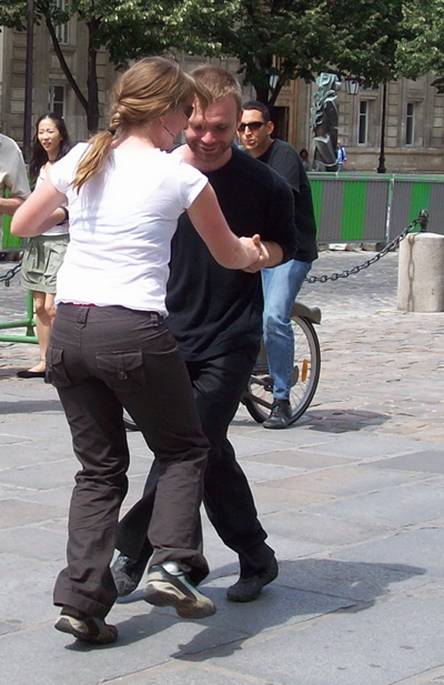
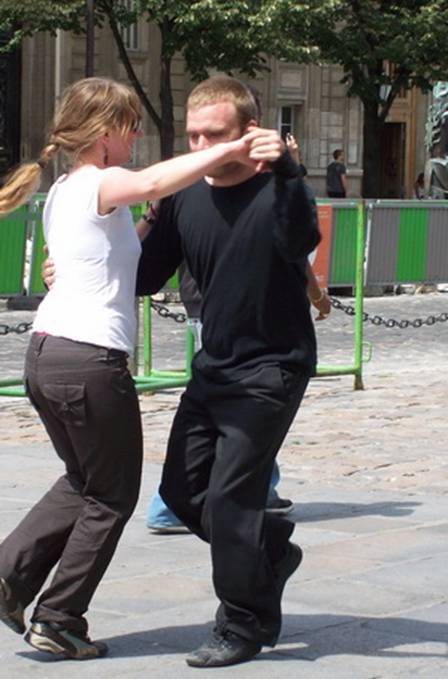
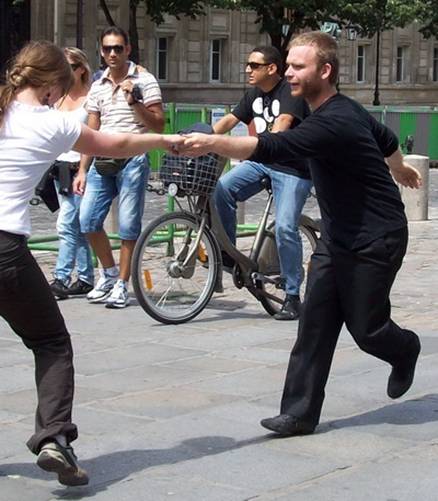
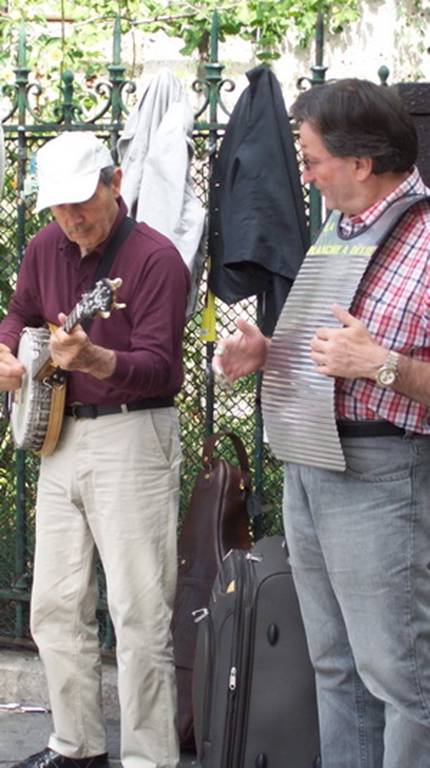
A couple of talented young people dancing to the music
of La Planche a Dixie.
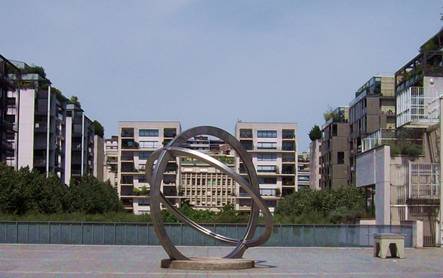
Public art in front of residential buildings
surrounding the Nicole de Hautecloque garden in the 15th
arrondissement. I think much of this
is social housing. It was constructed on
the former site of a gunpowder factory that blew up and burned to the ground. |