Paris Journal 2009 – Barbara Joy Cooley Home: barbarajoycooley.com
Sign
my guestbook. View
my guestbook. ← Previous Next
→ Back to the beginning
|
Whenever we come and go from the
apartment, I always try to make myself see the scene as if I am seeing it for
the first time. This way, I can be charmed
multiple times a day. If we decide to go in the
direction of the boulevard St. Germain, we exit our ancient courtyard doors
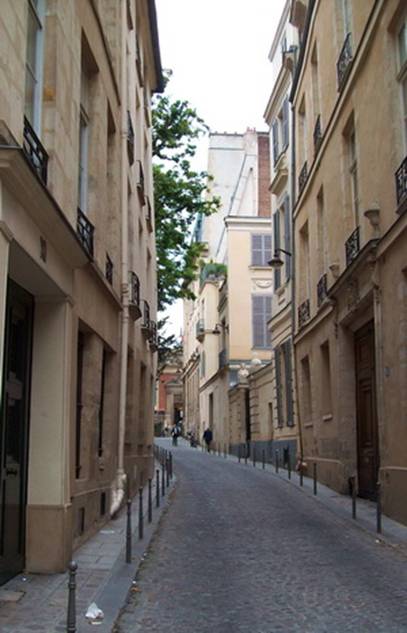
and go to the left, down one of the shortest streets in Paris. Then we turn on rue Servandoni, named for
the architect responsible for the façade of the St. Sulpice church. We see the side of the severe, imposing
church, at the end of the block. Everything is stone. The buildings on either side. The church at the end. The street beneath our feet. A canyon of stone. The only relief from stone is the sky
above. The stone has a warm hue. The stone is old, and we know the street is
old. This street has an older name, rue
des Fossoyeurs, or Gravediggers’ Street, for there was once upon a time a
graveyard a bit to the south, in the direction of the Luxembourg Gardens. Looking up to the left as we
turn on the rue Servandoni, we can see an old stone on the corner building
that has the older street name chiseled into it. We can be confident that this stone will be
preserved with all the might of the French government’s rules and
regulations. Once upon a time there were
monks and other people who made a living doing one thing or another related
to the church. There were little shops
selling decorative religious items.
One theory about the mysterious name for our street, rue du Canivet,
is that a canivet was a knife used for lacemaking. Nobody knows for sure. We walk the very short
half-block up to the rue Palatine that borders the southern side of the
church. Here we’re faced with the
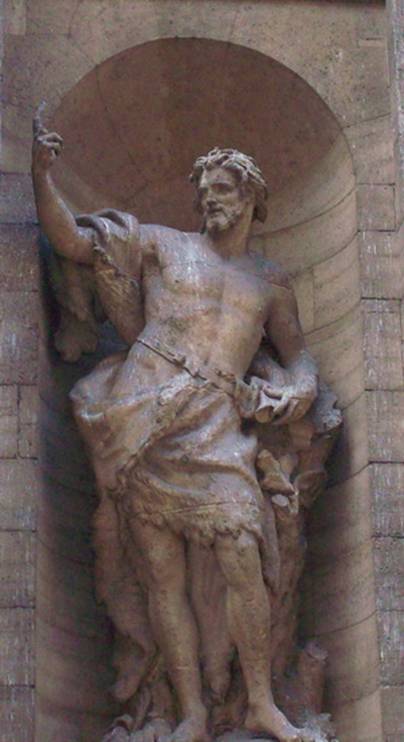
massive old door at the side entrance, to the transept of the church. Standing in slightly elevated, arched nooks
on either side of this entrance are statues of powerful-looking men in
robes. One of them has had two fingers
chopped off of his outstretched hand, leaving one upraised finger, which
looks vaguely obscene until you decipher that it isn’t that finger. At this point, we often hear
organ music or voices singing inside the church. There is usually a funny little half crazy
man standing near the side door of the church. The little man thinks it is his
job to look after this entrance. If he
decides it is not appropriate for people to enter here, he sends them around
to the front entrance, on the Place Saint Sulpice. He wears heavy work gloves. Some of his clothing resembles that worn by
the “little green men,” the workers who wear green and who pick up the trash
and clean the streets of Paris. The little green men have a work
outpost beneath part of the church.
The entrance is a trap door in the sidewalk. This isn’t as unusual as you might think,
because all Paris churches built before 1920-something are owned by the
government. The churches are simply
allowed to use the real estate and must pay for the routine upkeep and
maintenance. So the huge renovation of the
St. Sulpice structure is being paid for by the taxpayers. It has been underway for years, and there
appears to be years’ worth of work yet to be done. But there’s hope. The scaffolding is slowly being removed
from the top of the north tower, which is the more beautiful one, and the one
that was more difficult to restore.
The very top is looking elegant.
We await the unveiling of the rest with great anticipation. The funny little man who
“guards” the entrance at the south transept is, I suspect, someone who would
otherwise be homeless. And, I suspect,
the church is providing him with a place to sleep. Because of his unpleasant
tendency to lecture people who approach his doorway, we generally avoid
him. At the same time, we are always
amused to see him at a little distance, and to see what he might do next. If we decide to go in the other
direction, toward the Luxembourg Gardens, we exit the big courtyard door and
turn to the right. Very soon, we are
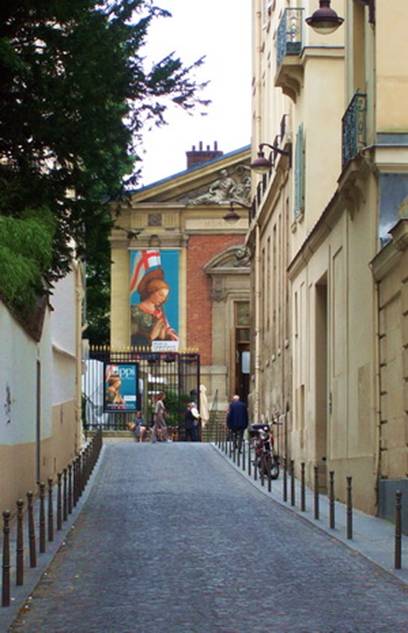
turning left onto the rue de Férou. It
is a narrow street, and it ascends slightly as it curves ever so slightly in
the block-and-a-half of its full length.
It, too, is made of stone
buildings on each side, and a stone surface beneath our feet. But at the end of it, we see some leafy
trees and the entrance to the brick-and-stone Luxembourg Museum, instead of
more solid stone. On the right, we pass a lean-to
structure with some translucent glass.
This was once Man Ray’s
studio. There is no plaque marking its
location. A little farther down, there is an
impressive old apartment building with a courtyard gate guarded by two
sphinxes. In this building, on the
first floor (which is the best, one level above street level), was the best
place Hemingway ever lived in Paris.
This was when he was married to a woman named Pauline – a woman who
had money. There is no plaque marking
this location, either. The end of the rue de Férou is
the busy rue Vaugirard, forming the northern edge of the Luxembourg
Gardens. The museum by the entrance to
the park faces down the rue de Férou.
Sidled up to the side and the front corner of the museum is a charming
outdoor café. We’ll have to try it
sometime. It seems to be mostly just
for drinks. A handsome, tall, decorative
cast iron fence encloses the park, which is owned by the Senate. The Senate generously allows the public to
use the park, and the Senate makes the rules for the use of the park and
determines opening and closing hours.
The Senate also pays for the upkeep of the park. That is to say, the French taxpayers pay
for it (but not just Parisians). With a slight jog to the right
after leaving the end of the rue de Férou, we see a crosswalk. There is no traffic light. The cars zipping up and down the street are
supposed to yield to pedestrians. I’m
sure there are many close calls here. After braving the crosswalk, we
are at one of the main entrances to the park.
The cast iron gates are tall, and they welcome us to a world of mature
trees and meticulous gardens. People use the park
heavily. All kinds of people. There are plenty of places for children to
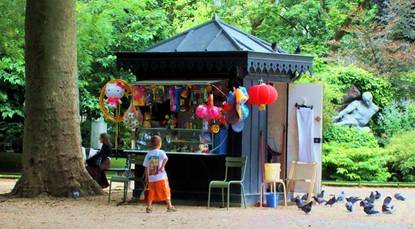
play, and there is a world-famous marionette theatre in the park. An old woman staffs a kiosque where
children’s toys can be purchased. A
young woman gives children rides on ponies. There is an area where people
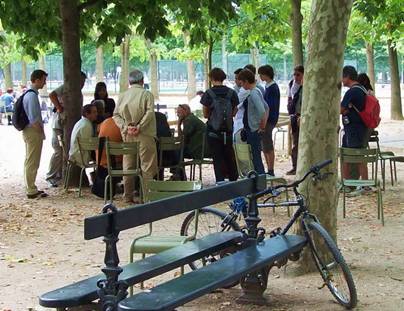
play chess players. Sometimes, when a
particularly interesting chess game is being played, a small crowd gathers
around to watch. There are tennis courts. A basketball court. Men (mostly) playing boules. Two charming indoor and outdoor
cafés serve the park, one on each side. The Orangerie for the Luxembourg
usually hosts temporary art exhibitions.
A photography show will start today.
It is called “Le Pont Brid6e, the photos of Galata.” The middle of the park is a
long, formal garden with improbably perfect flowers and a formal round pool
with a fountain at the northern end of it.
The ducks who live in the pool have a little shelter house. A nearby vendor rents toy sailboats for
children to put into the pool. The sides of the park are wooded
with old trees. They are also graced
by statues of all the old queens of France.
No, I’m not talking about transvestites. Real queens, from the past. The wooded areas open up, here
and there, into sunny grassy spots where lovely old stone and bronze
sculptures are on display in the midst of well-kept flowerbeds. At the southwestern end of the
park is a little brick building and fenced-in area where beehives are
kept. The bees service an orchard,
just to the south, in the end of the park.
The public is not allowed to go into the fenced area where the fruit
trees are; the individual fruits on the trees are protected by little bags,
so bugs and birds cannot eat them.
These fruits are to be eaten instead by the Senators, in their dining
rooms in the Luxembourg Palace, which looks over all of this. South of the park is a massive
high school, called the Lycée Montaigne.
When school is in session, the kids pour into the southeastern
entrance to the park at every opportunity – lunchtime, after school, while
skipping school, you name it. There is
usually one section of grassy lawn marked with signs saying it is okay to be
on the grass. Otherwise, the lawns are
forbidden in this park. The high
school kids love to lounge on the permitted grass. Off the southeast corner of the
park is an area with greenhouses.
These are not open to the public, except for special times, like
Patrimony Days in September. The exit from the east side of
the park leads directly to the Panthéon, a few blocks uphill, where great
people have been interred. The northeast corner of the park
holds the Medici fountain, a peaceful place to sit and watch ducks being fed
or to watch water fall into the pool. Leaving the park at the big
gates in the northeast corner puts you right in front of the Théâtre National
de l’Odéon (1787), the oldest Paris theatre auditorium still standing. It has been beautifully restored. On its other end, the Odéon faces a
handsome square, which is really round, called the Place Odéon. Some nights, a caterer transforms the part
of the Place directly in front of the theatre, and the portico down the side
of the theatre, into a pleasant café. Just a little to the west, on
rue Vaugirard (the longest street in Paris) is the entrance to the
magnificent Luxembourg Palace, home of the Senate. Across the street from it is La Poste, the
post office, which is also a bank. It
has probably the safest ATM in the city, because the entrance to the Senate
is always guarded. At the Square
Poulenc, across from the Senate, too, is a pleasant, friendly place to buy
newspapers. Farther on, across from the
older, Petit Luxembourg, is a marble arcade with entrances to offices that
serve the Senate. The arcade has
interesting window displays about the Senate, or about things the Senate
wants you to know about. At one end of the arcade,
embedded in the marble wall, is a bronze strip representing the precise
length of a meter. When the meter was
introduced, several of these were placed around the city so that merchants
could be sure their meter sticks were accurate. At
the end of the rue Servandoni, across from the Petit Luxembourg where the
president of the French Senate lives, is the small,luxurious, four-star Hotel
Luxembourg Parc. This is where Faulkner once stayed when it was called the
Grand Hotel des Principautés-Unis and had its main entrance on the rue
Servandoni instead of the rue de Vaugirard as it is now. It was a
short but influential stay for Faulkner.
And so ends our short but influential tour. Last night, our landlords and
friends, Elisabeth and Ron, took us out to eat at L’Epi Dupin. This is one of those places where you must
order a three-course, fixed price dinner, but don’t worry. The portions are small, and you won’t be
overwhelmed. Our food was modern, inventive,
delicious, and expertly presented. We
also consumed a beautiful white wine, a Touraine Sauvignon, which was a
little costly. Our server was a handsome young
man, who, upon learning that Ron could not speak French at all, insisted on
going over the entire menu (presented on a blackboard) in English. He did better than I could have because he
was very familiar with the preparation of these particular dishes. I admired his skill both at English and at
describing food, and also thought he looked very stylish in a pink shirt with
thin blue stripes and pink tie with tiny blue dots. In France, real men can wear pink. He was just as nice as can be. In the past couple years, you’d
have to make a reservation day or two ahead if you wanted to dine at L’Epi
Dupin. But even here, where everything
is just about perfect, now there are empty tables. I still advise making a reservation anyway,
just in case the economy suddenly picks up. On the way home, Ron and Tom
somehow got separated from Elisabeth and me.
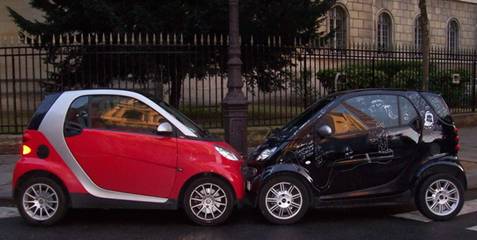
They found their way, somehow, without us. When we were almost home, Elisabeth noticed
two Smart cars parked so that it seemed they were kissing. I got my camera, and voila!
|
Wednesday, July 8, 2009
The
rue Servandoni with the St. Sulpice church at the end.
Statue
in a nook by the south transcept entrance to St. Sulpice.
The
rue de Férou, looking toward the Luxembourg Gardens (above and below).
People
watching a chess game in the Luxembourg Gardens.
Toys
are sold at a kiosque in the park.
It
was about to rain when I entered the park.
I was immediately greeted by this sign of warning about violent winds
and falling branches. I came to Paris
to escape hurricane season! Anyway,
nothing much happened -- just a few
drops. Sign
my guestbook. View
my guestbook. |