Paris Journal 2009 – Barbara Joy Cooley Home: barbarajoycooley.com
Sign
my guestbook. View
my guestbook. ← Previous Next
→ Back to the beginning
|
My friends seem to be confused
about the gender of a kir royal. This
is understandable, because it is one of the exceptions to the rule that good
things are feminine and bad things are masculine. A kir royal is, inexplicably, masculine, in
French. C’est la vie. “Vie,” you notice, is feminine. So is “joie,” as in Barbara Joy Cooley. I tried to inject some joie into the annoying housework that
we both had to continue yesterday evening at the apartment in the 6th. The laundry is endless. So while the machines were going, I set Tom
to work with the vacuum cleaner because he is very thorough with that
instrument. When he finished each
room, I went in on my hands and knees with a damp rag and lovingly polished
each tile. The tiles in the apartment are
special. The apartment is special;
after all, its owner is the fascinating Elisabeth. As I cleaned and polished, I thought about
the apartment’s history. Elisabeth’s
father and mother had the tiles put in.
Her father was a famous architect in Brazil. Earlier, he’d had a practice in Paris with
another architect named Jean Ginsburg.
During the Occupation, Elisabeth’s father hid Mr. Ginsburg in their
office (Mr. Ginsburg was Jewish). So Mr. Ginsburg survived the
war and went on to become famous as an architect in Paris. Elisabeth’s international family
and roots include some Spanish connection, I think, and the dark red tiles
seem to be Spanish in color and style.
They have a wonderful surface which, when properly cleaned and
lovingly polished with a damp cloth, glows softly. The dark red color has a hint of caramel in
it. Very warm and soothing. The floors looked so good when
we left. We’d walked over to the
apartment and then did all that physical labor, so we decided to take the
metro back to the 15th. We
cleaned ourselves up and went to dinner at Le Tipaza, where Mohammed greeted
us like the old friends that we are.
We thanked him for recommending the photocopier at Telephone pas cher to us. Resources like this are important in the
month of August when so many Parisians close up shop. Le Tipaza is open every day,
even on the big holidays and throughout the entire month of August. Tom had a hankering for their steak, and I
ordered the veal scaloppini with mushrooms and delicious, rich sauce. We discovered that it is better to order
sautéed potatoes there, rather than fries. We sat amidst the elaborate
tile and molded plaster in the open front of the restaurant, admiring the
elegant avenue Emile Zola and the new home goods store across the
street. An attractive, young,
perfectly bilingual couple sat near us with their adorable tiny little
baby. They alternated between English
and French in their conversation. One
might wonder how the baby will be able to distinguish between the two
languages as she learns to speak, but somehow small children can do this
naturally. At first, only one other table
in the restaurant was occupied. At it,
four people were speaking at least three different languages. English is what they had to use when
speaking to the entire table. I admire multi-lingual
people. Elisabeth, for example, is
fluent in at least five languages.
When you have multi-national roots as a child, the opportunities for
being truly multi-lingual are there. Mr. Ginsburg, by the way, was
French but he was born in Poland. Who
knows how many languages he spoke.
Here is what the web site Answers.com has to say about him: Jean Ginsberg
(b Czestochowa, Poland, 20 April 1905; d Paris, 14 May 1983).
French architect of Polish birth. He was educated in Warsaw and Berlin and
went to Paris in 1924 to study at the Ecole Speciale d'Architecture,
graduating in 1929. While there, he worked for short periods in the offices
of Le Corbusier and Andre Lureat. In 1930 he opened his own office in Paris.
After a two-year association (1930-31) with Berthold Lubetkin, he formed a
partnership with Franz Heep, who had also worked for Le Corbusier,
which lasted until 1945. Ginsberg's family sponsored his first residential
design (1930-31) at 25 Avenue de Versailles, Paris, a block of flats with
ribbon windows and communal roof garden that was the first successful attempt
to adapt the design principles of Le Corbusier's villas to the typology of
the infill building in Paris. Across the street, at 42 Avenue de Versailles,
he built another block (1933-4) that was remarkable for the design of its
streamlined penthouse and bold corner treatment. Both were widely published
in architectural journals and were followed by similar projects in the 16e
arrondissement of Paris featuring compact plans well suited to the
requirements of the Machine Age in place of the bourgeois room arrangements
traditional in this area. With these
buildings Ginsberg played an important role in popularizing the ideas of the
Modern Movement in the field of housing. After World War II his
residential practice expanded considerably, ranging from small suburban
developments influenced by Scandinavian models, to tower blocks such as the
Tour Mille Fiori (1960-63), Monte Carlo, to large low-cost grands
ensembles or housing estates in the Corbusian tradition, including some
in Meaux and Argenteuil; he also continued to work on infill buildings in the
16e arrondissement of Paris, such as 37-9 Boulevard Murat (1967). His work
was characterized by careful planning, attention to detail and a search for
impeccable workmanship using industrialized components. In 1965 he won the
competition to plan the Israeli city of Asdod (with Pierre Vago and Martin
van Treeck; unexecuted). Other work included government offices in Paris, the
Embassy of Finland (1962), Paris, a technical university (completed c.
1979; with others), Libreville, Gabon, and the Les Speluges complex (1971-8)
below the casino at Monte Carlo. |
Tuesday, August 11, 2009
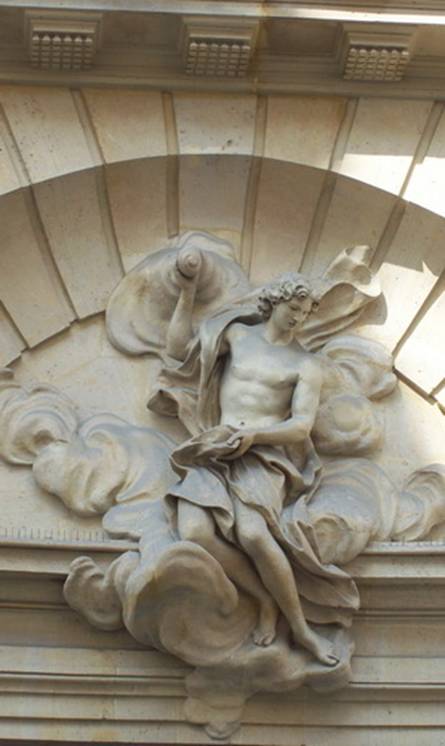
Detail on a building near the Baptist Church on the rue
de Lille.
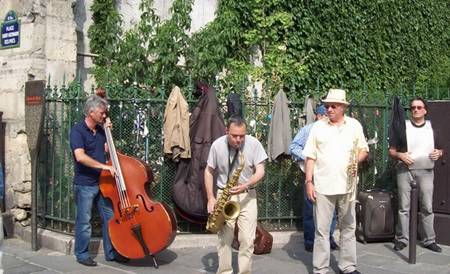
La Planche a Dixie playing by the St. Germain-des-Pres
church on Sunday.
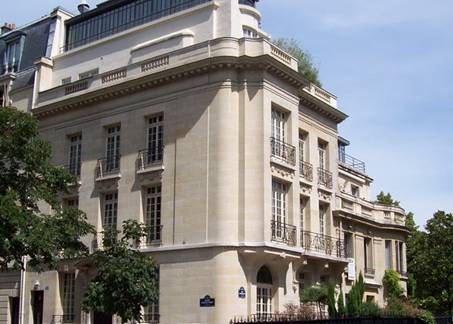
A building (actually, two buildings) that we’ve admired
near the Champ de Mars for years. When
we first saw it, it was a disaster, marred by graffiti and trash, with broken
windows and plywood. It underwent an
extensive renovation that took years, but now it is two gorgeous
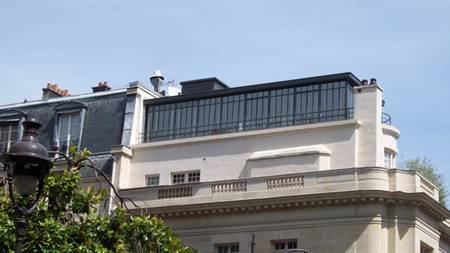
residences. I especially like the
solarium that was added on the top.
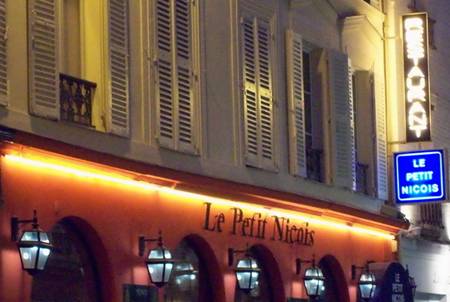
Le Petit Nicois on the rue Amelie at night. |