Paris Journal 2013 – Barbara Joy Cooley Home: barbarajoycooley.com
Find me on Facebook 2012
Paris Journal ← Previous Next
→ Back to the Beginning
|
The Parc Monceau strikes me
as one of those real estate boondoggles -- a lovely one. I’ve seen it so many times: somebody owns or buys real estate in an
area, and then gives some of it away in the form of a public park. This makes the surrounding real estate more
valuable. Lincoln Goodale did this in
Columbus. Ben Hill Griffin did it in
south Florida (not with a park, but with a university). It has been done many times. In 1769, Philippe
d’Orleans, who was the Duke of Chartres, bought land in what is now the
northern part of the 8th arrondissement. In 1778, he made a park in the middle of
it. He did a nice job. He hired a professional, the artist Louis
Carrogis Carmontelle, to design it. It
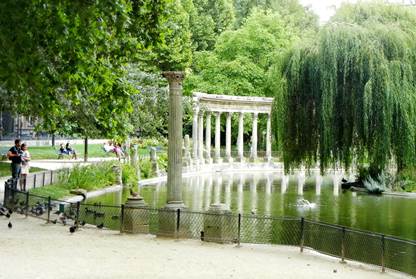
is a whimsical park, complete with architectural follies. The glorious, expensive
homes constructed around the park include what is now the Cernuschi museum of
Asian art – one of those City of Paris museums that has free admission. Also in this category is the Musée Nissim
de Camondo, which I wrote about on July 31, 2006, and
on August 25, 2000. Lovely museum, sad story. The park has the
distinction of being the first park that Baron Haussmann transformed. That’s when a main east-west allée was created in the park. We followed this (with a couple of minor
detours); that way was different for us because in the past we’d always
entered the park in the middle, at its southern entrance. Yesterday, we entered
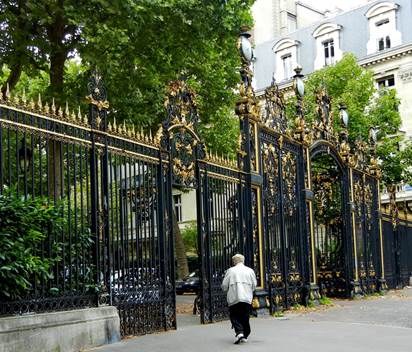
through the elaborate gates of the eastern entrance, via avenue Velasquez
from the boulevard Malesherbes, along which we’d walked all the way from the
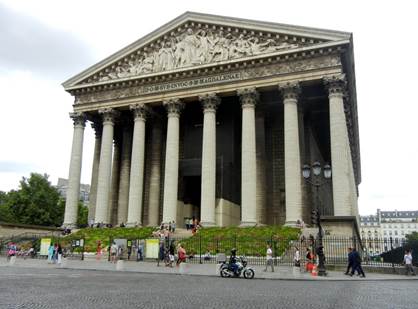
Place de Sainte Marie Madeleine. Between those gates and the
actual beginning of the park the avenue is lined with exquisite stately
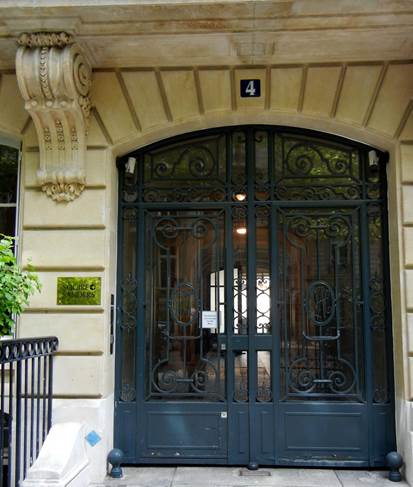
homes. We noticed that one of them is
the Paris headquarters of the international law firm, Squires Sanders, which
was founded in Cleveland, Ohio, in 1890.
Now Wikipedia states that it is the 24th largest law firm
in the world! We strolled slowly through
the park, taking in the sights of follies, flowerbeds, and folks sitting on
green park benches, enjoying the refreshing weather. At the other end of the
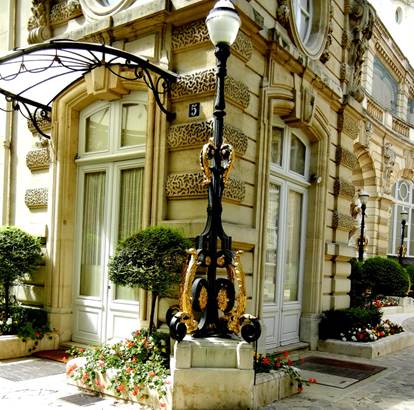
park, we paused to look through a fence at a particularly attractive stately
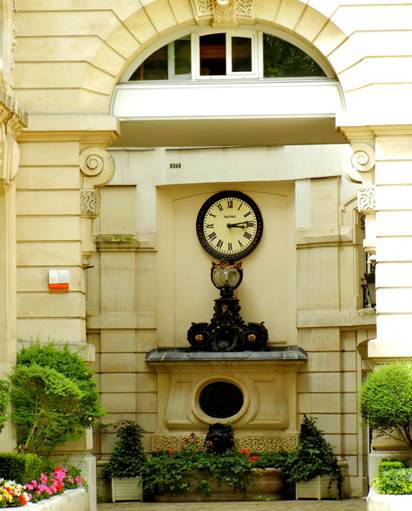
home. As I was photographing a couple
of its features, a young man on a bicycle stopped and began speaking with us,
in rapidfire, friendly French. He spoke about how
extraordinaily expensive houses like this are, but yet they are not very
old. He prefers old homes that are
truly old, like the Hotel Lambert, on the Île de Saint Louis (which I wrote
about last year on September
3 and on September
18, 2009). Yes, indeed,
expensive. I think that Prince Abdullah Bin Abdullah Al-Thani, the brother of the emir of Qatar, invested over
100 million euros in the Hotel Lambert. Upon realizing
that we were from the U.S., and Florida in
particular, he told us he has a cousin named Robe in Miami, and an uncle
named Kott (or perhaps Cote?) who is a journalist
in Chicago. Then he started
a long conversation about American movie stars who had some sort of
connection with France, or with Paris in particular. Sometimes it was hard to understand a name
because of the way he pronounced it in his French. For example, “Grace Kelly” came out like a
rapidly run-together “Grawzkuli.” He wanted to
talk, and he wanted to demonstrate that he had American connections, and knew
about American culture (movie stars).
The conversation lasted for about a half hour, then
we all said our cheerful farewells and good-days. Tom and I then
began walking toward the Seine via the rues de Courcelles,
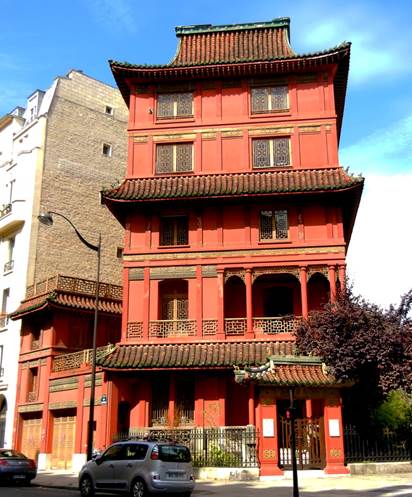
Monceau, and Washington. We passed the unique, Chinese pagoda-style
building that was once home to an antique dealer. It was known as “Loo’s House,” at 48 rue de
Courcelles. Two years ago,
Baroness Jacqueline Von Hamerstein-Loxten renovated
it and opened it for an exhibition called “Pagoda Paris: Asia in Vogue” last
October. Also on display was Mr. C. T.
Loo’s art library. Baroness Von
Hamerstein-Loxten recently received the medal of honor from the Fondation
Prince Louis de Polignac for her preservation of this pagoda house. The award was presented by Prince Albert of
Monaco, and on the occasion there was a dinner in the fabulous dining room of
the pagoda house. You can see a photo
of the table and the room at the end of this
issue of the Eventail newsletter. Beyond that first
exhibition, there don’t seem to be any more public events planned for Pagoda
Paris, as the building is now known.
The web site (www.pagodaparis.com)
does indicate that the place can be rented out and caterers are available for
private special events. I’m pleased that the
buiding has been preserved. Thank you,
Baroness V. As we approached the Champs
Élysées, Tom said he needed a break involving refreshments. I joked that Fouquet’s
was straight ahead (very expensive tourist trap on the Champs Élysées). But we walked on by Fouquet’s and down the
avenue George V, leaving the tacky part of the Champs Élysées behind. Just before the Place de
l’Alma is the Café George V.
Perfect. We sat at a table on
the uncrowded terrasse and ordered
a café gourmand for Tom, a bottle of sparkling water for us, and a glass of
white Cote de Rhone wine for me. It was that time of the
afternoon that was too late for lunch, and too early for the drinks crowd, so
the place was relatively calm. After that interval, we
crossed the Place de l’Alma, right by the flame statue where people still
leave occasional bouquets in remembrance of Princess Diana, who was fatally
injured in a tunnel just below that spot. I can never walk by that
place and not think of her. On the other side of the
Seine, we followed the avenue Rapp once more to the Champ de Mars, and went
onward toward home. There we rested
and I made a reservation for dinner at Le Café du Commerce, the beautiful
restaurant right around the corner, right behind our building. Vegetables ruled the
dinner. We shared an eggplant-and-goat
cheese crumble with green salad for an appetizer, then we each had the daily
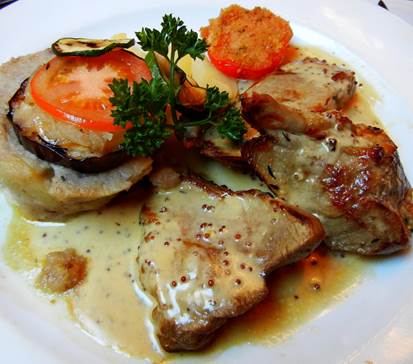
special, filet mignon of pork in an old-fashioned mustard sauce with a potato
and onion concoction topped by eggplant, tomato, and zucchini, with a few
poached pear slivers thrown in to enhance the pork. All very good! For dessert, we simply had
to share a classic baba au rhum. Le Café du Commerce does that dessert so
very well. Soon after dinner, we were
home again. Once again, I’m reading
about Paris history around the time of World War I, but my friend Jim H. has
recommended a mystery series that takes place in the Dordogne region of
France. It was too tempting to resist,
so I will probably start that tonight. But first, I have to
participate in a foundation board meeting by phone, at 10PM! Of all the board members, I guess that I’m
the farthest east. Paris is a wonderful world
away from home. |
Wednesday, August 14, 2013
The
Madeleine church in the 8th arrondissement.
Parc Monceau gates
on the avenue Velasquez entrance.
Entrance
to the Paris office of Squire Sanders, an international law firm that was
founded in Cleveland, Ohio.
A
colonnade folly on a pond in Parc Monceau.
I
was taking this photo of a stately home on the avenue Van Dyk
side of the Parc Monceau when a friendly young
French man stopped his bicycle to chat with us for a half hour or so. Below, another feature of that home.
The Paris Pagoda.
Tender
filet mignon of pork in mustard sauce with lots of veggies. |