Paris Journal 2013 – Barbara Joy Cooley Home: barbarajoycooley.com
Find me on Facebook 2012
Paris Journal ← Previous Next → Back to the Beginning
|
The story goes that one day
in September of 1846, the Virgin Mary appeared before two kids named Melanie and
Maximin on Mount Sous les Baisses, near La Salette, in France. The Virgin Mary was
weeping. Then she spoke to the kids
and told them that if people did not respect the Sabbath, there would be a
potato famine. Sure enough, there was
a potato famine in Ireland and France in the following months. We saw hungry people,
across the wide avenue de Cronstadt, just before we found the church of Notre
Dame de la Salette. We knew they were
hungry, because they were agressively diving into green trash containers
which were overflowing with packages of food discarded from a supermarket
around the corner. The young women with long,
glossy, black ponytails were yelling.
The young men with thick, wavy black hair were not yelling, but they
were doing their best to keep up with the yelling women in their efforts to
retrieve as much of the packaged food as possible. A small, frail, elderly
woman with thinning dyed red hair was right in there with the aggressive
people. I didn’t see how she stood a
chance of getting any of the food, unless one of the younger ones took pity
on her. These people were fighting
over discarded food. Tom wanted to
stop and watch. I urged him on,
because, I explained, these people might become angry if they see him gawking
at them. So we moved on. Next to the park benches on the sidewalk
near us were a few shopping trolleys whose owners had abandoned them,
temporarily. I surmised that these
belonged to the people fighting for food across the street. They must have been waiting for the bus
when they saw the trash bins being placed out on the sidewalk. They must have run across the street to
grab the food. Anyone could have walked
off with one of those shopping trolleys.
But nobody did. We were stunned by the
scene. We walked quietly on down the
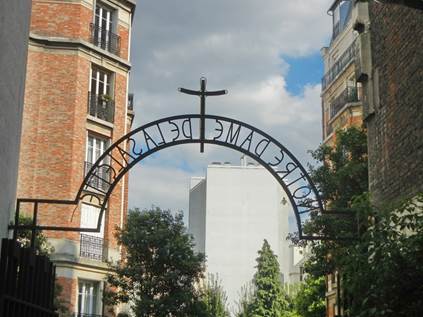
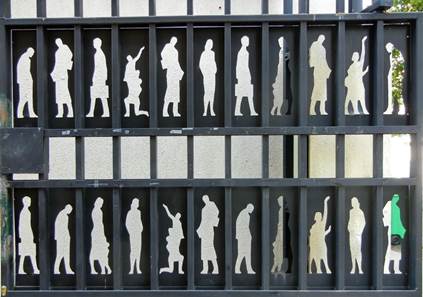
avenue. Suddenly, on our right, was a gate to a short lane. The gate was interesting: a modern metal
design with cut-outs of various human forms.
Ahead, at the end of a short lane, was an ultra-modern church: Notre Dame de la Salette, 38 avenue de
Cronstadt. (This parish has another
church nearby at 27 rue Dantzig, too.) The parish’s web site
includes a brief history of the neighborhood.
It tells us that for 600 years, sand, stone, and clay were mined from
surface and underground mines in this area.
Stone from the neighborhood was used in construction of Pont Neuf, the
Saint Sulpice church, the Tuileries (there was once a palace there), and the
École Militaire. Louis XV had purchased the
plains of Grenelle and Vaugirard at the urging of the Marquise de Pompadour,
for the purpose of creating these quarries where the streets of Cronstadt,
Morillons, Olivier de Serres, and Convention now exist. The clay mined here is
still known for its so-called “Vaugirard,” the hardness of the tiles made
with it. At the end of the 19th
century, there were 12 brickworks in the area. The “upper Vaugirard”
(meaning the part that was not swamp, but instead, a hill) included a large
vineyard call The Perichot.
“Morillons” are small black grapes that were grown there. In 1853, the religious
order of St. Vincent de Paul was given the responsibility of what became this
parish. At the time, it was a
territory occupied by mostly by rag pickers (chiffoniers). Their plight
motivated a man named Le Prevost (1803-1874) to build an orphanage for 90
kids and a chapel that was demolished in 1969. Today, the Foyer Le
Prevost, a home for kids, is located at 27 rue de Dantzig. The founding of this
congregation of the religious order of Saint Vincent de Paul coincides with
the apparition of the Virgin Mary on that mountain near La Salette. This, along with a healing of three
orphans, was the occasion for the first small chapel or shrine to be built
here in 1858. It was then expanded
into a church in 1886. The modern church was
constructed in 1960, to accommodate a growing population in the lower part of
the 15th arrondissement. To
direct the project, a committee of church members was formed, and they worked
hard. They decided on a round
sanctuary, in part because of the terrain that was available to them. They hired two architects,
Henri Colboc and Jean Dionis de Séjour.
They created a sanctuary that is more than 32 meters in diameter and
17 meters high, in the middle. The effect of this magnificent,
modern, and austere room is calming. I
didn’t photograph it because there were two people praying or meditating
there. We just stood quietly in the
outer perimeter, hands folded, and looked.
Here’s a panoramic
view of this sanctuary. And here
is a 360-degree
animated view. The bigger church in the
area is Saint-Lambert de Vaugirard.
The land upon which it was built was given by Nicolas Groult d’Arcy
(1760-1843). He also gave the land
that is the rue de l’Abbé Groult, which was our route from our neighborhood
to our destination, the Parc Georges Brassens. Nicolas became a
Benedictine monk at age 21. He was a
Latin scholar, and a professor of literature in Auxerre. But he left the Benedictine order during
the Revolution, when he joined the military and got married. I don’t know what happened
with the wife, but Nicolas returned to the Church during the Empire
(convenient?) and became a professor of moral theology at the Sorbonne, as
well as the director of a school for the Association of the Knights of St.
Louis. For his students, he acquired
a large parcel of land between the rue Blomet and rue de Vaugirard. It is from this land which he subdivided
that he donated the church site and the street that now carries his name. As we walked the full
length of the rue de l’Abbé Groult, we saw the church of Saint-Lambert de
Vaugirard off to our left, on the rue Bausset. But we continued on to the end of the
street, where we turned right onto the rue de Cronstadt. (Cronstadt, or Kronstadt in English, is the
name of a Russian military port in the Gulf of Finland where the French
northern fleet was “triumphantly received” in 1891. This was the beginning of an alliance
between the French and the Russians.) At the end of the rue de
Cronstadt, we entered the main gate of the Parc Georges Brassens. This relatively new park,
established in 1991, is named for the singer/poet because he lived nearby in
1968, on the rue Santos-Dumont. Up
until the 18th century, grapes and vegetables were grown until an
abattoir (slaughterhouse) was constructed in 1884. The slaughterhouse was
demolished in 1975, except that the belfry and the former hall of horses
remain. I suspect that the covered
market stalls used for a bookmarket now were once used by butchers to sell
meat. An educational vineyard, kitchen
garden, and apiary are part of the park now, a tribute to its agricultural
past pre-slaughterhouse. As we sat on a bench and
admired the surroundings, we realized that there was a back part of the park
that we’d never explored. Onward, we went, into the
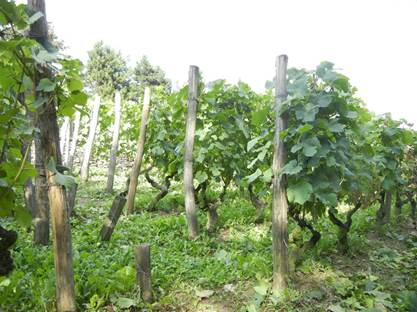
unexplored territory. Along the way,
we found the vineyard in the park, and we saw signs pointing toward the
apiary. The area we explored abuts
a section of the “petit ceinture,”
a railroad that once encircled the city, but was abandoned in 1969. Bit by bit, the old “petit ceinture” is being turned into greenbelt, or so it is
hoped. In the 15th
arrondissement, however, this seems to be a controversial proposal. It has not progressed because some
neighbors object. So when we walked along
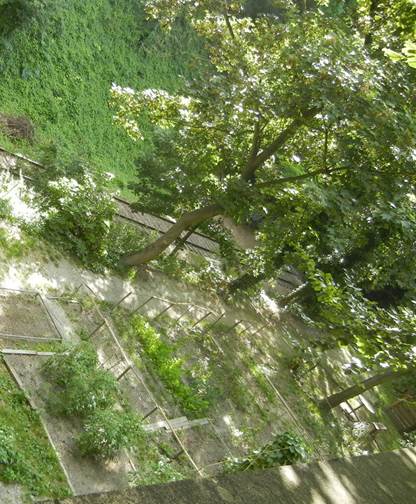
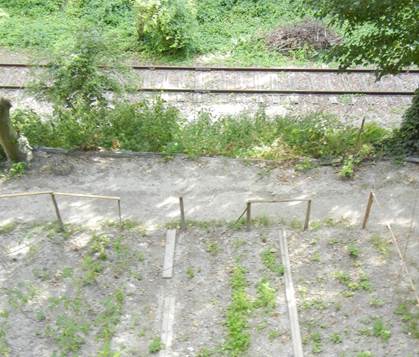
this wooded upper rim along the south side of the park, we looked down over a
wall that encloses the area of the train tracks. Nature has taken over. It would not take much to turn this into a
lovely walk through the woods. People
are trying to grow vegetables in neatly laid-out plots by the old tracks, but
I think it is probably not sunny enough down there. We speculated that the vegetable gardens
were created by people living in a huge apartment project overlooking the
tracks from the other side, opposite the park. We walked along as far as
we could, looking down at the verdant old railway, and when we reached the
end of the park, there stood a modern building that must be on the site of
the tracks. That building might be a
problem for creating a greenbelt, but it looks to me like it would be no
great loss if it were demolished. It
is a 1970s monstrosity. Tom wanted to see some of
the streets around there, so we left the park and wandered, managing to avoid
the big social welfare institutional buildings to the west of there. When we found ourselves
back at the lower reaches of the familiar rue de la Croix Nivert, we were
stopped by a young couple with a baby stroller. They were looking for the nearest metro. We figured out that the closest one was
Boucicaut, at the corner of the rue de la Convention and the avenue Félix
Faure. We showed them how to get
there. Then we went on up the rue
de la Croix Nivert, intending to turn onto the rue de la Convention and go
toward that same intersetion with avenue Félix Faure, but we saw another
park. This one was new to us: the
Square du Clos-Feuquières. We entered it. What a nice surprise! It was created in 1972 on the property of
the Marquis de Feuquières, the entrance for which was at 10 rue Desnouettes. Some of its nice features
include a pergola covered with wisteria and roses, and two remarkable trees:
an Atlas cedar, and a giant sequoia. A
40-square-meter pond and an educational vegetable garden are also popular
features, as well as a fresco of colored glass representing a dragon, by
Hugues Veil. Ball games are encouraged,
not discouraged, in this park, and there are ping pong tables, too! It is truly an enclosed
garden, and even today, it is set back from the street, behind buildings, and
each entrance is a short lane leading into the lovely greenspace within. By the time we left the
Clos-Feuquières, it was about 6:30. We
walked back up to the rue de la Convention.
We were across the street from Bistro 121 when I happened to glance over
at it. Inside, I saw a young man in a
dark ball cap and tee-shirt, boogying away, dancing to some music we could
not hear. Then he grabbed a large,
square bottle of clear liquid off the bar (gin? vodka?) and began swigging right
out of the bottle. I’m glad I don’t
drink gin or vodka. I’m sure his boss,
Chef Eric, would not be pleased. We turned at the avenue
Félix Faure, and by the time we were walking up the rue du Commerce, it was
7PM, so we decided to dine casually at Le Commerce Café on the Place du Commerce,
before going home. Shortly after our food
arrived at the table, a group of 32 well-dressed Japanese tourists came in
and filled up the main back dining room.
It was a treat to hear their leader explain the drinks menu to them
all. I guess the rest of the dinner
had been decided for them, because as soon as their drinks were served, the
staff began bringing out lots of dishes of escargots for them. We were entertained by all
this, but the couple next to us was not.
They were fuming over the fact that the blackboard menu on wheels had
not been rolled over to their table for them to examine. When a server came to our table to check on
us, I asked him if he could please move the blackboard over to this couple. They didn’t say thanks; to them, I guess we
were just more foreigners who must somehow be intruding. Nevermind that we live on an island that
fills up with tourists in the winter . . . and in summer, plenty of European
tourists are on our island while we’re in Europe. It seems only fair . . . . Back at the apartment after
dinner, I didn’t have much time to read before I had to participate via Skype
in a foundation board meeting that was taking place at 4PM in Florida. This was 10PM Paris time, and the relatively
efficient meeting lasted for an hour.
I was so tired after a day of working, then urban exploring, that I
couldn’t read after that meeting. I
just fell into bed and drifted quickly into a deep sleep as I listened to
jazz played softly. As sleep came, visions of
rag pickers, feisty dumpster divers, verdant forests, abandoned tracks,
pergolas with roses, vegetable plots, and a calm round sanctuary beyond
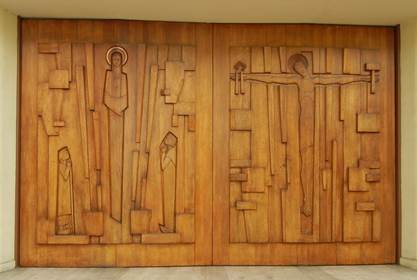
carved wooden doors danced through my head. |
Thursday, August 15, 2013
Looking
back through the archway over the gate to the church of Notre Dame de la Salette on the avenue de Cronstadt. Below, a close-up of the gate.
Carved
walnut doors of the Notre Dame de la Salette
church.
A
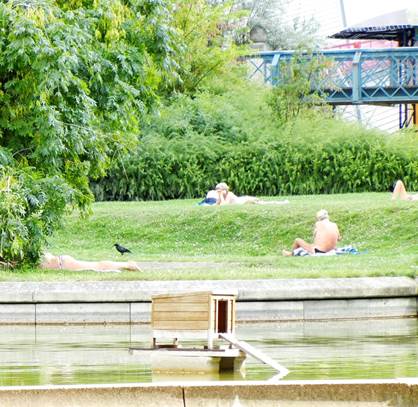
pinot noir vineyard that we found in the Parc Georges Brassens. Below, people sunning themselves near part
of the lake in the park. The little
box is a shelter for ducks who live on the lake.
Looking
down over a wall from the Parc Georges Brassens to the abandoned tracks of
the “petit ceinture” and vegetable gardens.
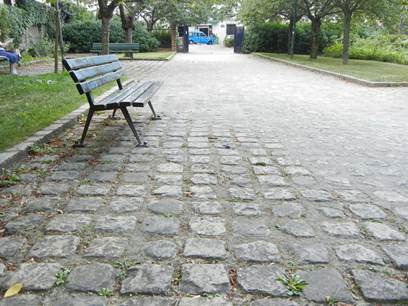
A
back entrance to the Parc George Brassens, which was once the site of a
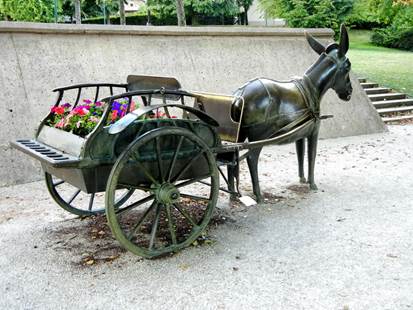
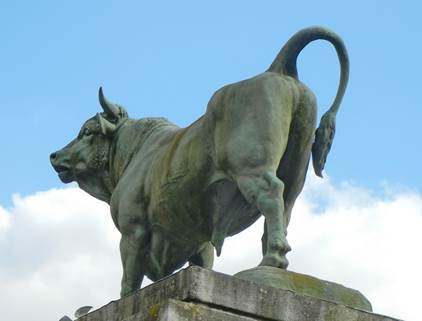
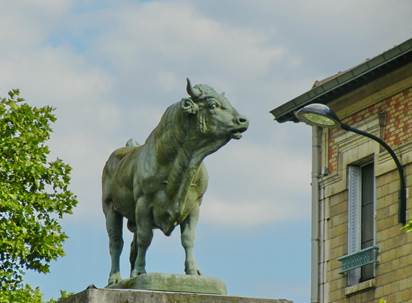
slaughterhouse. Below, statues that
testify to the original use of the site.
Bull
sculptures were created by Auguste Caïn (1821-94).
|