Paris Journal 2013 – Barbara Joy Cooley Home: barbarajoycooley.com
Find me on Facebook 2012
Paris Journal ← Previous Next
→ Back to the Beginning
|
Why create a pond in an
urban park? The Paris parks people
tell us why, on a plaque in the Square du Clos-Feuquières. There, they’ve created a pond
with wetland plants around it. It is
fenced off, not directly accessible by people. But you can look at it. The plaque tells us (in
French only) that the creation of a pond, even a small one, is an important
act favoring environmental protection.
Ponds are a habitat for a number of plants and animals, and they are
the place for reproduction for numerous species including some whose numbers
are dwindling (dragonflies, frogs).
Ponds in an urban milieu are ecosystems in danger of
disappearing. In Paris, they
contribute to maintaining biodiversity and they enhance biological continuity
between the city and the neighboring communities. The words on the plaque
urge us to respect this pond, and not to put animals in it that could disturb
or destroy its ecosystem (Florida turtles, fish). It is important, furthermore, not to throw
food or trash in the water in order to conserve the natural equilibrium. We are reminded that “the animals present
have need of tranquility.” Me, too. Examples of animals and plants
that one can see in a pond: 1. Damselfly (similar to a dragonfly) 2. The great ramshorn (freshwater snail) 3. Cattails 4. Gerrus lacustris (water spider or water strider) 5. Fringed water lilies or yellow water lilies 6. Marsh marigolds. The plaque goes on to tell us
that this is how the food chain works in a pond: ·
The aquatic
plants and phytoplankton feed on mineral material, furnish oxygen to other
living beings, and are consumed by herbivores. They constitute the base of the food chain
and so are called “producers.” ·
The herbivores
(in this pond, these are essentially insects and mollusks) feed on the
aquatic plants and so are called “herbivorous consumers.” ·
The carnivores
or “carnivorous consumers” (in a pond, these are mostly amphibians and birds)
feed on the herbivores. ·
The plant
debris and dead animals are then consumed by the “decomposers” (bacteria,
fungi) that transform the organic material into mineral material, which is
eaten by the “producers” described in the first bullet point. I’m fascinated by all this
effort to educate about the environment not just because I am an
environmentalist who lives in the swamp, but also because Tom and I now own
some land that has, among other interesting features, a 20-foot by 20-foot
square concrete cistern that dates back to the 1920s or earlier. Because of the high water
level that I saw in it during the dry spell, I think the “cistern” (as the
surveyor called it) may be somewhat spring fed. It did not stink during
that dry spell, so there is some kind of aquaculture going on in that
cistern. The water was covered in
duckweed, so I couldn’t see into it. I’m afraid it was breeding
mosquitos when I saw it, so I want to find out how to balance out its
system. What kind of fish should we
introduce? What aquatic plants would
be better? Do we start by pumping out
and cleaning out the whole thing, and starting over? Demolishing it would be
wrong, I think, because the thing is historic, by Sanibel standards. Maybe I could take one of
these Paris parks pond specialists back with me to help plan this
project. Do you think any of them
would like to come to south Florida?
Say, maybe in the winter? Seriously, I’m sure that
the Florida wetlands specialists are what I really need. But it is so nice to see that there are Parisians
who care about swamps the same way that I do. The pond in the Clos
Feuquières didn’t photograph well because of the fine mesh of surrounding
plants. But I did photograph the
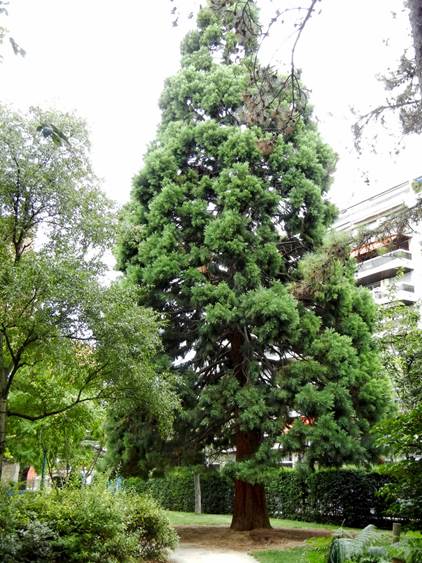
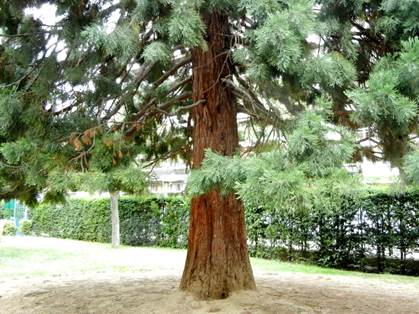
“giant” sequoia, which may be a giant by Parisian standards, but not by
California standards. It is a
fantastically beautiful tree in the Clos Feuquières, however. What possessed the Paris
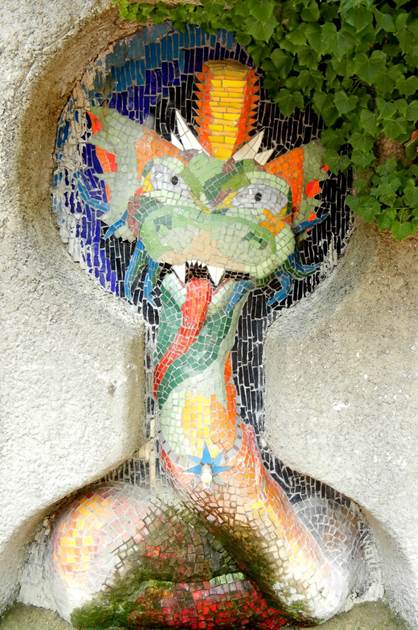
parks personnel to make the public water spigot a dragon in the Clos
Feuquières? There is no explanation,
but I like it. I bet the kids do, too. I found that the third
volume of the Marquis de Feuquières’ memoires was available via archive.org,
so I downloaded it to my Kindle. I
wonder how easy it will be to read his French? I wonder how the Marquis
would feel about the fact that his estate is now swallowed up by Paris, but
that his garden lives on in the form of a beautiful neighborhood park? I wonder if vegetables were
grown on the Marquis’ estate, since the area was known for vegetable farming
back then. I wonder how he would have
felt about all the sand, clay, and limestone mines that replaced the
vegetable plots? I wonder what he
would have thought of all the brickworks and tuileries (tile factories) that were constructed in the area? Are descendents of the
Marquis de Feuquières still around here somewhere, and what do they think
about all this? I wonder, I wonder.
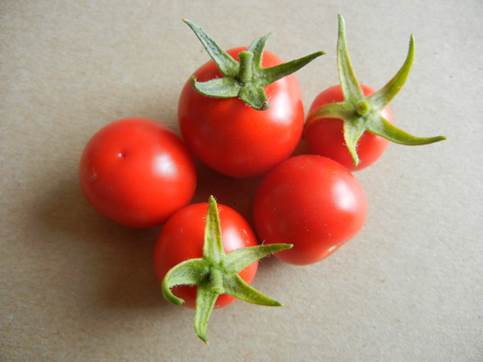
We grow vegetables in Paris.
These are cherry tomatoes harvested from plants grown amidst the
flowers on “our” balcony. This summer
I’ve been repeatedly reminded by the weather about how very much water tomato
plants require. |
Saturday, August 17, 2013
Dragon
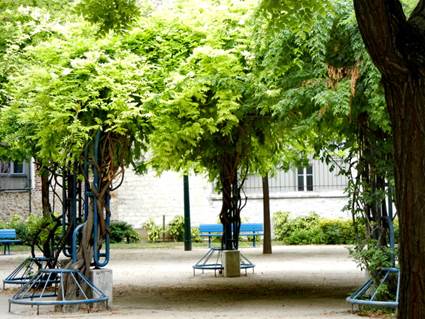
as public water spigot in the Square du Clos Feuquières. Below, the park’s wisteria arbor.
Crème brûlée with praline and raspberries atop a pool of red liquor, our
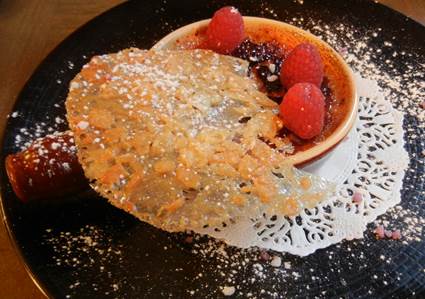
shared dessert at Bistro 121 last night. |