Paris Journal 2013 – Barbara Joy Cooley Home: barbarajoycooley.com
Find me on Facebook 2012
Paris Journal ← Previous Next
→ Back to the Beginning
|
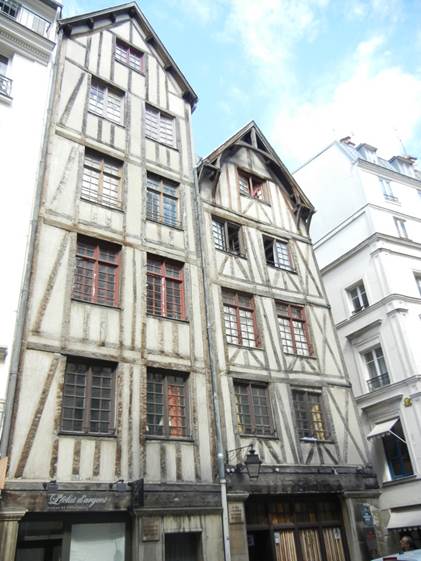
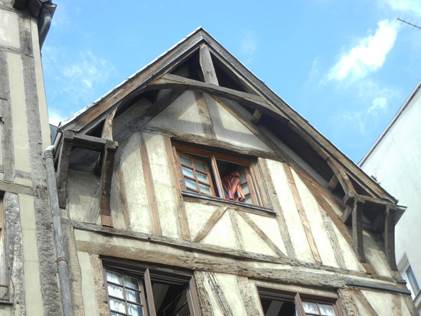
Two medeival houses grabbed
our attention when we turned onto the rue François Miron in the 4th
arrondissement. I’ve seen a few other half-timbered
houses without their facades covered over in Paris, but none as tall as
these. They are rare, in
Paris. The house at number 11 used to
have a sign depicting a sheep, and its neighbor at 13 bore a sign showing a
reaper. They date to the beginning of
the 16th century in the form they’re in now, but in a more
primitive state, they could date back to the 14th century. Beginning in 1508, royal
ordinances repeatedly forbade the construction of projections – parts of the
building that stuck out from the rest – because there was a risk of them
falling into the street. That’s why
the overhanging gable of the house at number 13 was cut back in the 17th
century. It was reconstructed in 1967,
when the two houses were restored. In 1607, a decree ordered
the plastering-over of half-timbered buildings like these to limit the risk
of fires. In the restoration, the
architect was able to release these buildings from that requirement in order
to return them to their original design. When I walked around the side
of number 13, on the narrow rue Cloche Perce (photo below), I could see how
the city of Paris must have looked when all the streets were narrow and the
buildings were several stories high, like numbers 11 and 13 rue François
Miron. It would have been a bad scene
for claustrophobics, but charming. But
then again, it would have been smelly, and stuffy. Also, notice how the buildings were built
to bow out in the middle, for strength.
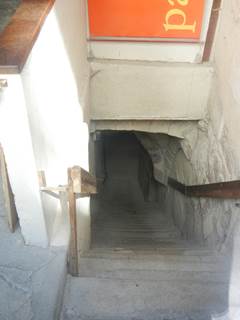
Across the street, we found
the headquarters of Paris Historique at 44 rue François Miron. Of course, it was closed for the holiday
(Feast of the Assumption), but we could look in the windows to see some
interesting publications as well as a mysterious and ancient stairway leading
down into the cellar, or, more appropriately, the cave.
We made a mental note to go
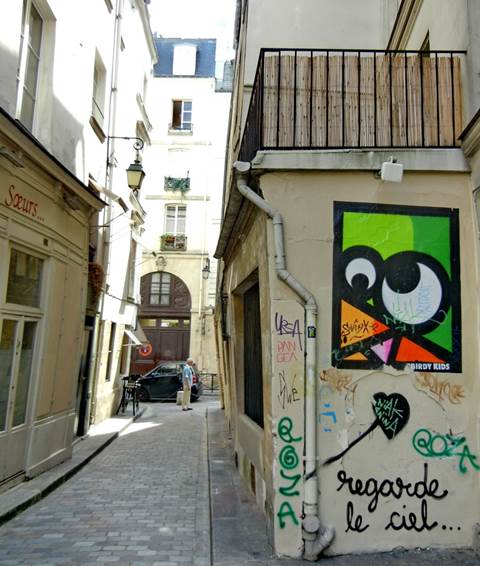
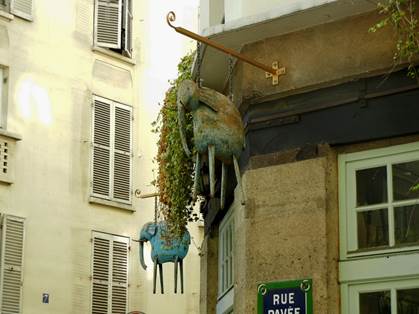
back there when the place re-opens, after the 19th. We turned up the rue Pavée
and saw a couple of elephant enseignes,
so I photographed them for my Republican friends. I looked down the street at a couple
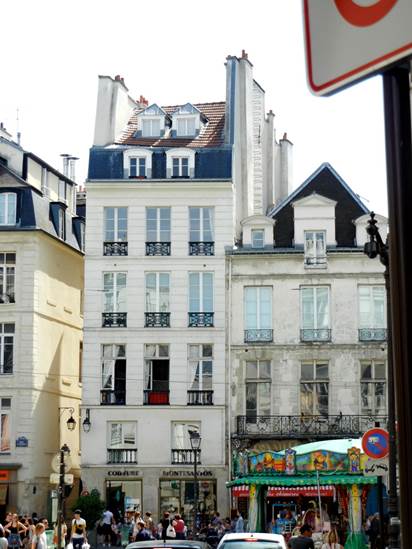
buildings back on the rue de Rivoli, and realized that they were probably
half-timbered, tall medieval houses, too, but that they still had the
fire-inhibiting stucco/plaster covering them up. The building where we stay in September is
also like that, we think. There are probably a large
number of half-timbered buildings still in Paris, all covered up with
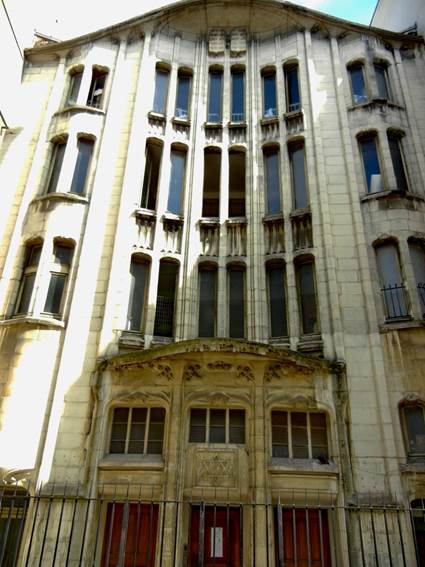
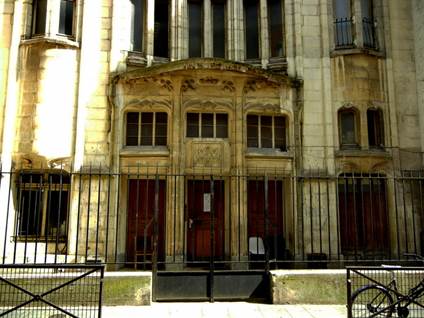
stucco/plaster. An Art Nouveau synagogue
was next to grab our attention. As I
was photographing it, I realized that the block that names the architect says
“Hector Guimard, Architecte, 1913”! I
had no idea that Guimard had designed a synagogue! A number of architects had
been suggested for this project, evidently, but it was Adeline Oppenheim, the
neice of the synagogue’s main funder, Joseph Landau, who suggested
Guimard. She and Guimard had married
in 1909. As great as Guimard was,
his creations were somewhat unaffordable.
He somehow slipped into obilivion after his career had peaked. He emigrated to the U.S. in 1938 because
of Nazi anti-semitism. When he died at
age 75 in the Adams Hotel in New York City in May 1942, his importance as an
architect was almost forgotten. It wasn’t until the 1960s
that the architectural world began to rediscover him. When we reached the corner
of the rue Pavée and the rue des Rosiers, we paused to admire the
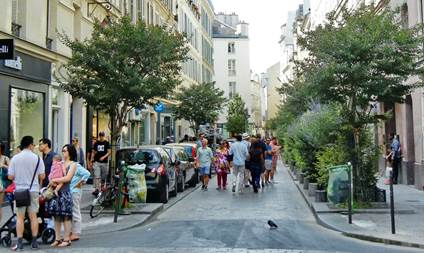
pedestrianization of that shopping street.
Much of the 4th arrondissement has been pedestrianized to
some degree or another; some during certain days, other parts, almost always. We weren’t too surprised to
see that the cleverly named bookstore, Mona Lisait, was open on this
Assumption holiday. If they’re clever
enough to come up with a name like that, they’re clever enough to know they
should be open on a day like this when the area was buzzing with human
activity. I came upon the History of
Paris plaque that tells the sad tale of the Prisons de la Force. There once was a stately home at 12 to 22
rue Pavée which was owned by the Duke de la Force. Louis XV’s financiers took it and it became
the headquarters for the Ministry of War.
Then in 1780, it was transformed into a prison, or rather, two
prisons. La Petite Force was for
women, including the Princess of Lamballe, one of Marie Antoinette’s good
friends. A mob massacred the
princess after her “trial” in 1792, and her head was paraded about on a post,
supposedly for Marie to see, outside her prison cell. The guards closed the shutters,
however. Marie was told what was
happening, whereupon she fainted. The next amazing sight was
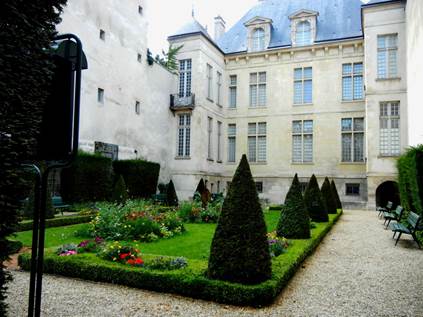
the stately home that is now the Paris Historical Library, and then the
garden of the Hotel Donon/Musée Cognac Jay, a City of Paris museum of 18th
Century Paris. When we needed to rest for
a bit, there was the peaceful Square Georges Caïn. One reason that the park is
so peaceful is that there is another park (Square Louis Achille) just one
building away that has a play lot for little kids. The noisy tykes were over there, not in the
Square Georges-Caïn. Another reason is that the Square
Georges-Caïn is one of the many Paris parks that has free wifi. So adults can sit quietly and look up
information on their smartphones, rather than use the phone for noisy
conversations. Here are a few words about
free wifi in Paris. When you go out
and about and see “Free WiFi” appear periodically on the list of available,
open networks on your device, ignore it.
“Free WiFi” refers to wifi offered by Free.fr. You must have a Free.fr account to use
it. While it appears open, when you go
to use your browser, a login page appears.
If you don’t have a Free.fr account, you can’t log in, and the
connection will be useless to you. Same is true for SFR,
Orange, and other internet service provider networks that appear to be
available and open; they’re not. They
will all require you to log in with an account on their web page in order for
the connection to work. Truly free wifi in the
Paris parks is always listed as “Paris ____.”
It, too, requires that you go to a login page on your browser to log
in. But you don’t need an
account. You simply fill in the blanks
for your last name, your first name, and then your email address. When you see “authentication reussie” on the screen, you know you’re
connected. Then you can go check in on
Facebook, access the city map at plan.paris.fr, check your email, or
whatever. After we checked on our
orientation on the “Visit Paris by Metro” app (which also includes a good,
downloadable street map of Paris) in relation to the Place des Vosges, we
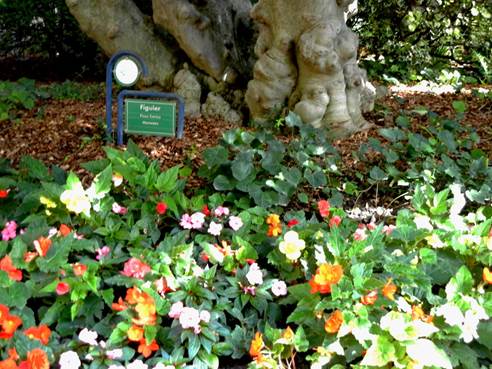
exited the park. But we paused outside
the fence to admire a beautiful old fig tree (base of tree, below) that was
bearing fruit abundantly.
We passed the elegant
doorway through a wall, with a sign announcing the Hotel Chatillon, and then
a picturesque antique shop at the end of the rue Payenne. We skirted around the Square Louis Achille
on the rue du Parc Royal, avoiding the squealing tykes, and then strolled
down the rue Sevigne to the rue des Francs Bourgeois, which took us to the
northern side of the Place des Vosges. By the way, the
pre-Revolution name of the Place des Vosges was the Parc Royal. We stopped briefly in the
park in the middle of the Place, then decided to go for refreshments at the
Café Hugo – a very busy place, even in the middle of the afternoon! We like Café Hugo for its lunch salads,
too. Given its location, the prices
are reasonable and quality is good. To avoid smokers, we sat
just inside the open French doors, which gave me a chance to photograph the
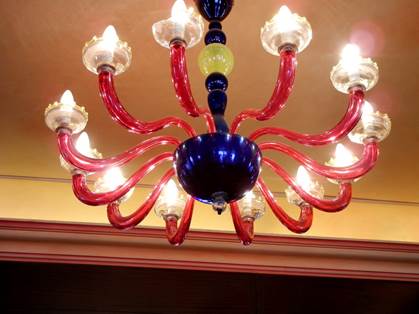
dining room’s cool chandelier. I do
love chandeliers! To exit the Place des
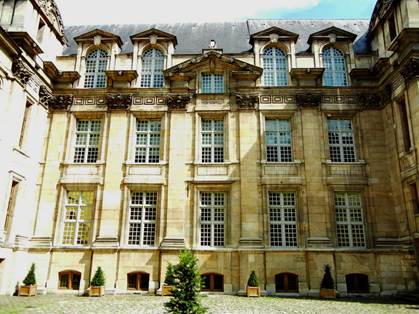
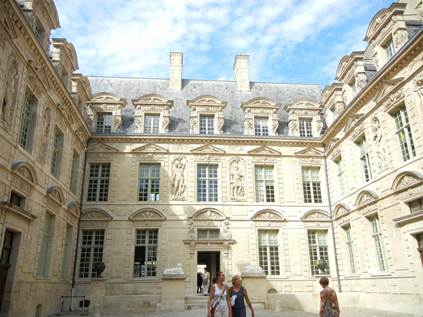
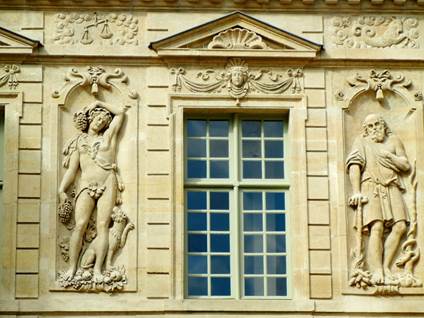
Vosges, we walked through the magnificent courtyards of the Hôtel de Sully. Once we were back out on
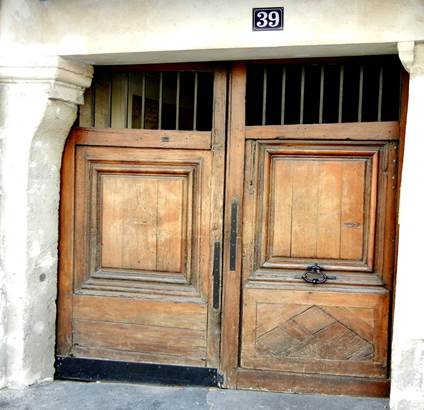
the busy rue Saint Antoine, I saw one of the most charming, really old doors
on a porte cochere that I’ve ever
seen. Shortly after, we went by
the “Temple Sainte-Marie.” In French,
the word “temple” is used to refer
to a Protestant church (as opposed to “eglise,”
which is used only for a Catholic church).
This church has a beautiful dome, which is even sometimes compared to
that of Les Invalides. The church was built in
1632-34 for the convent of the Visitation on the site of the former Hôtel de
Cosse. The convent was destroyed during
the Revolution, and the church was used as a Protestant church starting in
1802. When we turned on the rue
Castex, we were surprised to see a large, Art Deco post office. Then we just followed the boulevard Henri
IV to the Pont de Sully, where we crossed back over the Seine to the left
bank. As we were strolling down the
Quai de la Tournelle, we saw that traffic had been stopped by the police and
that the Quai was quiet! Something was
about to happen. We kept walking alongside
the bouquiniste (bookseller)
stalls, and still there were no cars on the street. When we reached the Quai de Montebello, we
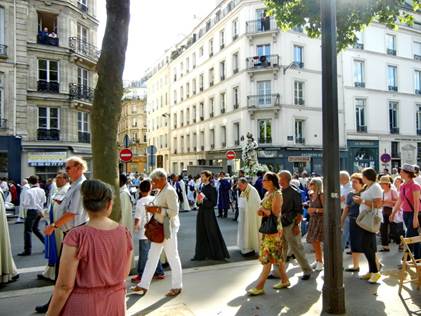
saw what was happening: the procession of the faithful on the occasion of the
Feast of the Assumption. Thousands of people walked
in the street, going in the opposite direction of the way we’d been
headed. We stopped in front of one of
the bouquiniste stalls on the
sidewalk, and watched. It was a beautiful thing to
see, and hear. People walked slowly,
prayer books in hand, as they sang along with the music provided by
loudspeakers mounted on a few vans that were interspersed along the
procession. Every once in a while, the
music would end, and instead we heard a priest’s reassuring voice over the
speakers. They were all headed to the
Île Saint Louis and the Île de la Cite, where at 6:30, Cardinal André
Vingt-Trois would say mass at Notre Dame. About 150,000 people were
expected to participate in the two days of activities at Notre Dame on the
occasion of this holiday. Needless to
say, the procession we watched was long, and I treasured every minute of it. When it was over, we walked
on to the Square Viviani (free wifi), the park by the ancient Saint Julien le
Pauvre church. There, we sat in the
deep shade of an arbor, and looked across the river at Notre Dame. Bleechers had been set up on the parvis in front of the church. We went on past the church
of Saint Severin and into the tight maze of busy little streets at la
Huchette. An aging saxophone player
was playing “Caravan.” He was playing
sweetly, beautifully, and he was sadly a little short on breath. I loved his music. So of course, I gave him a euro. Earlier, on the
l’Archeveche bridge, we’d heard a couple of young musicians (saxophone,
guitar/vocal) playing Antonio Carlos Jobim music really well. Then they started trying to play Stevie
Wonder’s “Isn’t She Lovely,” and they just couldn’t get the beat at all. I gave them a euro and said to Tom, “Let’s
go,” because I couldn’t stand to hear that song massacred. But then as we walked away, an old, black
harmonica player joined the two Argentinians, and he took over the lead on
that song, thank heavens. He must be
an American; he understands that beat, we thought. Even earlier, we’d heard a colorful
guy playing a very small piano on wheels on the Pont Saint Louis. He played a mean ragtime, just excellent,
but that darned piano was grossly out of tune. It hurt to listen. So I also had given him a euro and we left. Maybe the quality of the
street musicians isn’t as good on a national holiday? I don’t know. We worked our way down
through medieval streets to the broad, Haussmannian boulevard Saint
Germain. I thought we might walk all
the way home, but at the Mabillon metro entrance, Tom suggested that we ride
home because of the time. Restaurant choices are
better in the 15th.
Besides, we wanted to rest a little and change/freshen up before
dinner. I was very surprised to see
that our favorite bakery was open when we exited at Émile Zola. We bought a baguette, just to reward them
for being open. Walking past Le Café
Du Commerce just before we turned onto our street, we saw that the dinner
specials were appealing. We called for a reservation
there once we were home. There was no
problem getting one, but the restaurant was very busy. We were assigned a table upstairs, where we
like to be. When I climbed the stairs,
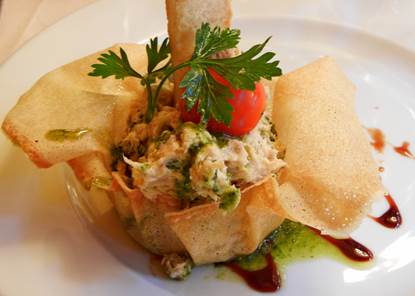
I saw a tray of appetizers with one especially appealing item on it: it looked like a thin, crispy, tulip-shaped
pastry cup filled with a seafood spread. Tom found it on the menu: moelleux de saumon dans sa tulipe
croustillante. We shared one.
Delicious! And pretty. Tom had the onglet de boeuf (steak) special, and I
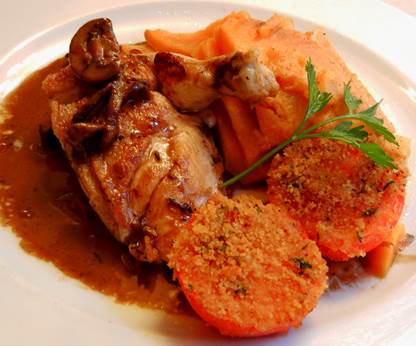
ordered the chicken suprême with
mushroom sauce. Both main courses came
with scalloped sweet potatoes which were somehow light, and very tasty. The resto calls these “opéra de patates douces.”
I guess those sweet potatoes did sing to us because we finished every
morsel of them, with enthusiasm. We passed on dessert and
coffee. Back at the apartment, we
opened the French doors to take in the evening air and sunset colors. I started reading Bruno, Chief of Police: A Novel of the French Countryside, by
Martin Walker. It’s a well-written
crime novel that contains detailed descriptions of provincial life in the Dordogne
region. |
Friday, August 16, 2013
Numbers
11 and 13, rue François Miron. Below, the reconstructed “pignon” projection on number 13.
These
may be covered-over half-timbered houses.
Synagogue
on rue Pavée, designed by Hector Guimard (above and below).
The
rue des Rosiers.
Garden
of the Hotel Donon/Musée
Cognac-Jay.
History
of Paris library.
Chandelier
in Café Hugo, in the Place des Vosges.
Hôtel de Sully, above, and below.
Handsome
old door on the rue Saint-Antoine.
Procession
of the faithful, to celebrate the Assumption.
If you look closely, you’ll see the effigy of the Virgin Mary being
carried along (center right of photo).
Moelleux
de saumon dans sa tulipe croustillante, a delicious salmon
appetizer at Le Café du
Commerce.
Suprême
de volaille fermière rôtie, crème forestière, opéra de patates douces, at Le Café du Commerce. |