Paris Journal 2009 – Barbara Joy Cooley Home: barbarajoycooley.com
Sign
my guestbook. View
my guestbook. ← Previous Next
→ Back to the beginning
|
Yesterday at a little before
2PM we started out on foot for the FedEx office. We had three chapters of copyedited
manuscript to send back to the publisher in New York. FedEx is, naturally, located in
the right bank neighborhood of the grand boulevards, at the eastern end of
the 8th arrondissement, on the boulevard Haussmann. The right bank is much more
business-oriented than the left bank, and this location is in the heart of
commercial Paris. It is a long walk, but we knew
that today would be very hot and it would be better to walk a lot while it
was merely very warm. I planned a
pleasant route along the broad avenues La Motte-Picquet and La Tour Maubourg
on the left bank, then crossing on my favorite bridge, the Pont Alexandre
III. We made it across the Champs
Elysées and took the avenue Marigny past the president’s Elysées Palace. Then we chose a series of narrower streets
to bring us up to the haunting little park called Square Louis XVI, where
masses of guillotine victims are interred, on the boulevard Haussmann. There the expiatory chapel of
Louis XVI is now surrounded with corrugated metal construction fencing. It must be undergoing a much needed
restoration. I found this Michelin
newsletter article about this site by using Google’s cached web site feature;
i.e., Michelin no longer offers this article on its web site, so I’m going to
take the liberty of reprinting it here so that it may live on: His destiny A sciences and geography buff, Louis XVI was also passionate about
history. A book filled him with enthusiasm as a small child and he kept it by
his side till death: The History of
England by David Hume. His admiration was such that he told the English
philosopher so in a little compliment of his devising when he happened to be
at Versailles - the young prince was nine years old. One chapter in particular stayed in his mind all his life: that on
Charles Ist's beheading. His lifetime obsession was to reign without
succumbing to the leniency and weaknesses to which he was inclined and which
had led Charles to the scaffold. But that awareness didn't prevent Louis from
being guillotined on Monday 21 January 1793, on Place de la Concorde. A site of memories The monarch's corpse was transported in the hangman Sanson's cart to the
Madelaine cemetery. The corpse was placed in a coffin hands still tied, head
between legs and eyes still open. The coffin was then lowered into a communal
grave into which a full barrel of quick lime was thrown. Marie-Antoinette's
remains were buried with her husband on 16 October of the same year. It was in 1815 that Louis XVIII had the king and queen's bones exhumed
and decided to build at his expense a chapel in remembrance of the royal
couple on the very site of their burial. Chateaubriand, who claims he
attended the setting of the bodies, relates this episode with tongue in cheek
in Les Mémoires d'Outre-Tombe: 'In the midst of the bones, I recognised the
queen's head by the smile which this head had given me at Versailles.' The
sovereigns' remains were then transferred to the Saint-Denis basilica,
necropolis of the kings of France. A little neoclassical
masterpiece The chapel was built from 1816 to 1826 by Pierre-François-Léonard
Fontaine, Napoleon's architect to whom we own the Arc de Triomphe du
Carrousel. It is a little Greco-Roman style temple, perfectly harmonious with
its Doric portico and its dome. Chateaubriand saw it as 'perhaps the most
remarkable monument in Paris', which is of course an exaggeration. The interior, lit naturally by the oculi of the coffered vault, bathes in
a sepulchral atmosphere perfectly fitting for the building's memorial
function. On each side, under the lateral half-domes, there are two
remarkable statues: Louis XVI to whom an angel shows the sky, by François
Joseph Bosio and Marie-Antoinette supported by Religion, by Jean-Pierre
Cortot. At the back, the altar marks the exact site where the bodies were
buried. Located on the present-day Boulevard Haussmann, between Place de la
Madeleine and Gare Saint-Lazare, the place is also worth a visit for its
peace which is rather uncommon in this part of the 8th district. The building
is situated in a charming little square (Square Louis XVI) isolated from the
surrounding noise by trees and bushes. The elegance of the place and the way
it fits in pefectly with its Haussmannian environment come as a real delight. That’s a great little
article. My compliments to the
Michelin newsletter staffer who wrote it.
I wouldn’t change a thing, except that I corrected one typo. Aha! The
link just reappeared on Michelin’s web site. The article is by Éric Boucher, and it has
several photos with it. Unfortunately,
the wrong map appears on the web page with the article. Can’t trust Michelin for maps???!! I wish I had seen the article
before we saw Wendy (friend from Sanibel staying in the apartment in the 6th
now). Being a journalist by traininig,
Wendy likes to “interview” or quiz or question or interrogate people on
subjects about which she thinks they should be knowledgeable. She started asking about Louis XVI, and I
answered rather sloppily but accurately that I thought his body had been moved
a few times and I wasn’t exactly clear on where it might be now, but that I
thought it probably was no longer at the Square Louis XVI. Later, she wanted to
interrogate us about exactly who each king of France was and what he did, and
we protested that French history was far, far too complicated and that we
weren’t going to participate in this exercise. Fortunately, Cassie (Wendy’s 22-year-old
daughter) supported us entirely, so we were let off the hook. As consolation, Tom showed
Wendy the chart in that apartment which delineates the family trees of all
French kings. That helped her
somewhat. At any rate, when we finished
our business at FedEx near the guillotine victims of the Square Louis XVI, we
went across the street to the brasserie Triadou Haussmann, as is our habit
after FedEx-ing, and had a late, light, cool lunch as the afternoon air
warmed up. The Triadou Haussmann is an
excellent brasserie. I dined on a cool
cucumber soup that had a layer of tomato gazpacho on the bottom, and we
shared a country terrine. Tom ordered
another piece of mirabelle (golden plum) tarte. Fortified, we went on. I wanted to show Tom something I’d just
read about in Air France’s Madame
magazine. I wouldn’t tell him what it
was going to be. This was to be a
surprise. We went along the narrow rue de
Provence, which begins just across from the Triadou brasserie, and which
skirts along the backside of the grand department stores Printemps and
Galeries Lafayette. The back entrances of
Printemps, especially, retain their old fashioned elegance. One even sports a gorgeous winding marble
staircase. At the Place Jacob Kaplan, we
turned a sharp right onto the rue Lafayette.
Across the street, and number 20, was our goal, the Hôtel Banke. The magazine had informed me
that this 4-star hotel is, indeed, in a former bank. It is owned by a Spanish family named Clos
who have a chain of hotels, but this is their first one in France. The restaurant in the gorgeous
lobby features Spanish cuisine, including tapas, according to the
article. We approached the front
entrance and were greeted by the doorman, an elegant young man with exotic
looks. He was friendly. I asked about the restaurant, and he said
unfortunately that it is closed for the month of August. I asked if we could go in and look
anyway. He said that certainly we
could. We went in, admired the sumptious
and warm décor in which the owners kept as much as possible of the original
grand bank lobby features. We fell in
love with the leather sofas in the lobby. I want to a bellman (the two
people at the small registration desk were busy) and asked if there was a
card for the restaurant, even though it is closed, so that we could have the
phone number. He graciously reached
behind the registration counter and presented a card to me. After leaving the gracious
Hôtel Banke, we took a little street with big, handsome Haussmannian
buildings called rue Pillet-Will. Now
that name deserves to be looked up. It is named for Michel
Frédéric, comte Pillet-Will (1781-1860), financier, one of the founders of
the savings bank Caisse d'Epargne in Paris. We continued down the rue
Lafitte to the boulevard des Italiens, where the street changes names to the
rue Gramont. There, at Lafitte and Italiens, is the site of the Maison Dorée. I say the “site,” because when the bank BNP
Parisbas decided to move its headquarters there, the neighbors launched a
campaign to try to convince the bank to keep the historic structure (once an
elegant and expensive restaurant during Napoleon’s empire). The bank’s architect, “in a fit
of rage,” designed a project that completely replaced the building’s
interior, keeping only the façade, and launching the continuing controversy
over the historic presevation nemisis called ‘facadism.’ Taking the rue Gramont on to
the rue Saint Augustin, we jogged to the right so we could walk through the
arcade called Passage
Choiseul. This arcade, unlike some in
Paris, has not been “modernized.” It
still retains all of its original 1825 charm, and is not the least bit
pretentious in its collection of shops.
There is even a quaint little theatre in it, which boasts that it is
NOT air conditioned. We went on down the rue
Richilieu, past the Comedie Française and through the Louvre grounds to the
Passerelle des Arts, where we crossed the Seine and ducked through the little
arched opening in the French Academy.
Continuing on down the artsy rue de Seine, we crossed the boulevard
Saint Germain and skirted around Saint Sulpice so we could pick up our mail
at the apartment in the 6th and water the courtyard plants. The plants desperately needed us, and with
today’s heat, I think they probably would have croaked if we’d not been there
to water them yesterday. After reading the mail and
resting in the shade of the Luxembourg Gardens, we connected by phone with
Wendy and went back to the apartment for a drink with her and Cassie. We decided then to walk through the
Luxembourg Gardens to go to dinner, because somehow, even though this is the
third time Wendy has stayed in that apartment, she still had yet to see the
Gardens!!! The southern extension of the
gardens is really two separate little parks called the Jardin
Cavelier-de-la-Salle, and the Jardin Marco Polo. The latter has a fabulous
fountain at the end, called the Fountain of the Four
Parts of the World, featuring wild horses with crocodile tails, turtles
spewing water, menacing fish, four beautiful women, and so on. A placid square pool of water sits adjacent
to the north edge of the fountain.
(Here’s a photo of
the wild horses from my Keep and Share site.) Cassie and I looked back to see
what had become of Tom and Wendy. They’d
stopped by the placid square pool and were staring at something. So were a few other people. Cassie and I backtracked. At the pool, we saw a pigeon ramier (also called a palombe or wood pigeon) in the water,
struggling and not able to climb out.
Evidently a little girl had chased the stately, plump bird into the
pool. It is most definitely not a
water bird. While everyone else stood
around gaping at this poor creature which, unaided, would surely succumb to
exhaustion and drown, Cassie and I went into action. I unsuccessfully tried to talk Tom into
giving me his shirt, under which he had a t-shirt, so that I could throw it
over the bird and then lift it out of the water. But Tom would not give up his
shirt. I only had a t-shirt and bra,
and I was not going to go to dinner in my bra. So I went to the side where the
bird now was struggling, and began to pull things out of my tote bag (the
mail, my camera, and our mobile phone) so that I could use it to get the
bird, or give the bag to Cassie, who was now barefoot, in her knee-length
skirt, wading up behind the bird slowly.
Clearly she was planning to use her bare hands to lift the bird out. I was afraid she’d be scratched
or pecked by the palombe, but gently she tried once, and then again a
successful second time, lifting the bird to safety. I said, “Well done, Cassie! Well done!” The little girl’s mother, who
was Asian, smiled and said “thank you” to me in perfect English. I was very proud of
Cassie: Young American woman bravely
springs to action, saving helpless palombe while French people watch. Of course the palombe was too
wet to fly away. The four of us
started to go on our way, but looking back across the pool we saw the little
girl running toward the poor palombe again. I called out “no, no, let the
bird rest; the bird must rest; leave it alone” while shaking my head and
gesturing “no” with my hand. The
little girl’s mother could only control her sister, and evidently not her. Two older ladies on the park
bench near us finally joined in by calling out in French for the little girl
to leave the bird alone. I don’t think
the little girl understood them, but she understood me. She stopped, realized the error of her
ways, and went back to her mother. At the restaurant, Le Select on
the boulevard Montparnasse, Tom and I decided to buy dinner for Cassie to
thank her for her good deed. She had
a fine veal chop with a rich reduction sauce.
I had a very nice, light seafood plate, Tom had a light charcuterie
plate, and Wendy had a dinner-size salad. For dessert, Cassie was
rewarded with a fancy layered ice-cream and whipped cream parfait, a café liegois. Cassie charmed the older server
who was just as nice as could be to all of us. He even brought ice for our water, because,
he said, “In all the American restaurants you get ice.” Cassie said she wants to learn
to make a rich brown sauce like the one that covered her veal chop. We explained that it is a type of reduction
sauce, and that Julia Child’s book starts out with the basics of how to make
this general kind of sauce as well as three others. She announced to Wendy that she
wants this cookbook, Mastering the Art
of French Cooking, for her birthday.
|
Wednesday, August 19, 2009
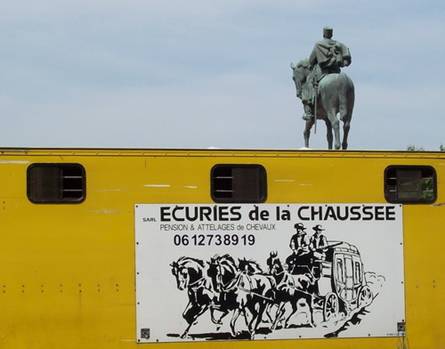
The horses who pull the carriage shown on my August 13 journal entry arrive in this truck, which
pulls behind it an open trailer with the carriage on it. The statue shown is not on the truck, but
at the end of the Champ de Mars. It
just looks like it is on the truck.
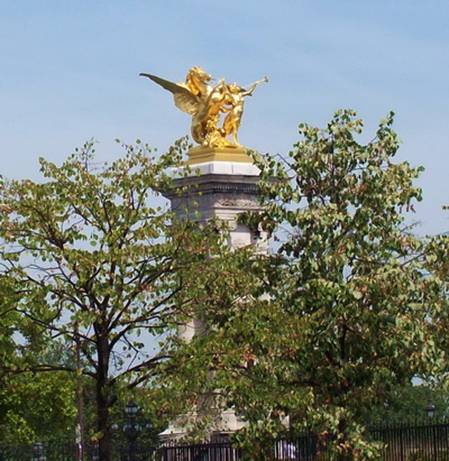
More lovely decoration on the Pont Alexandre III.
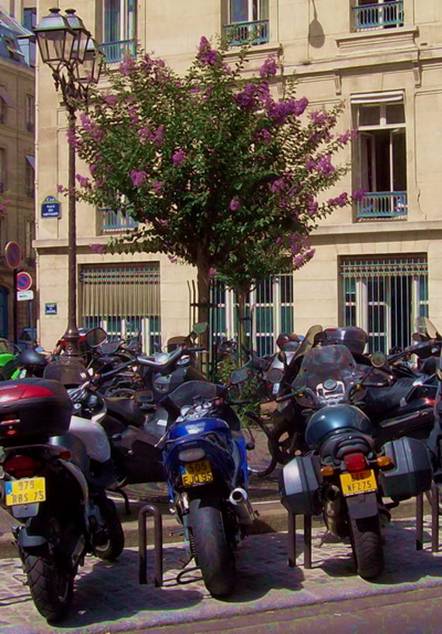
The Place des Saussaies in the 8th
arrondissement. It is chock full of
motorcycles, and it is very close to the Elysées Palace.
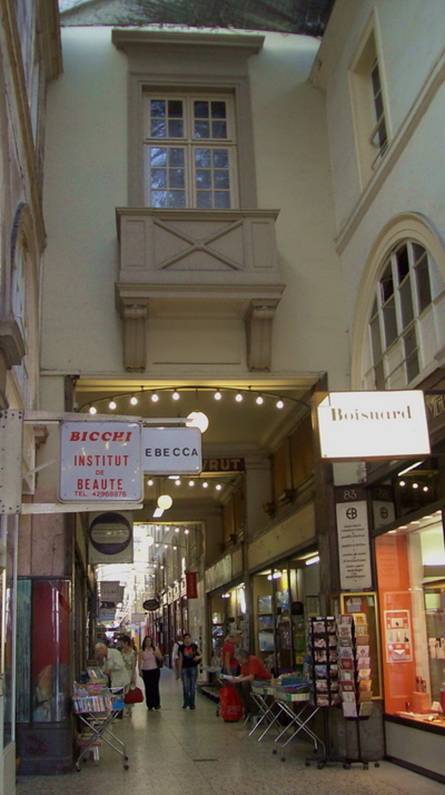
The Passage Choiseul, with its old charm intact.
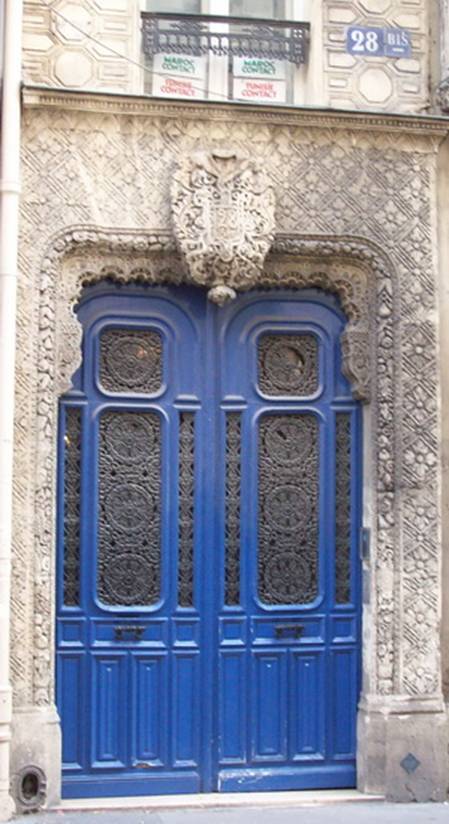
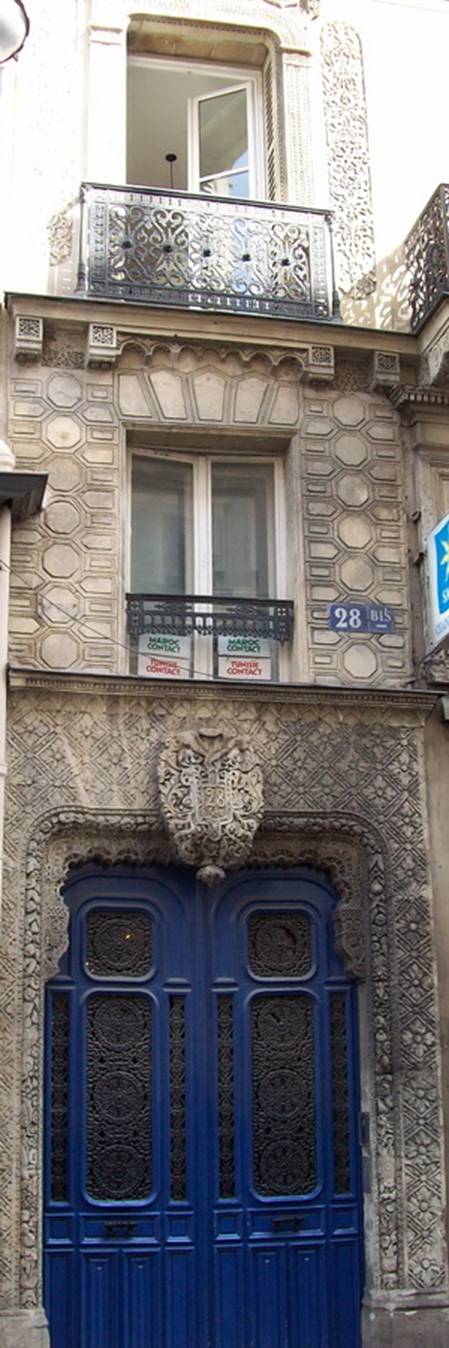
Above and below, an interesting doorway on the rue
Richilieu.
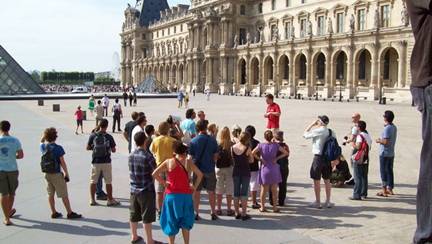
Funny looking group of tourists at the Louvre,
listening to a red-t-shirt guide who speaks English with an alarmingly strong
cockney accent. |