Paris Journal 2009 – Barbara Joy Cooley Home: barbarajoycooley.com
Sign
my guestbook. View
my guestbook. ← Previous Next
→ Back to the beginning
|
The weather is really hot now,
and air conditioning exists only in rare places in Paris. One hot day we can manage; we can keep the
apartment cool by making certain arrangements with the awnings, windows,
curtains, etc. But if that hot day is followed
by a hot night in which the air never really cools much, the next day can be
pretty uncomfortable. That’s where we
are now. Fortunately, the weather is
supposed to be somewhat cooler tomorrow and much cooler by Saturday. Yesterday evening, we did not
go out until 7PM to buy newspapers, so we had to walk all the way to the
other side of the École Militaire. I’d made a reservation online
at La Villa Corse, a rather elegant and well-capitalized Corsican restaurant
on the boulevard de Grenelle. I
remembered that it is, indeed, really air conditioned. The walk to buy papers and then
to go to the restaurant felt like walking through an enormous oven. The pavement and the buildings were still
radiating large amounts of heat. The
humidity yesterday, according to the Weather Channel’s web data, was only 28
percent. So this is not at all like
southwest Florida heat; this is desert heat. If we had southwest Florida
heat and humidity, I’d be finding us a room in a four-star hotel with air
conditioning and wifi access. An above-the-knee
sleeveless Chico’s Traveler’s Collection dress is the best thing to wear
on a hot evening when one must walk to an elegant restaurant. Thank you, Chico’s. You always know what we need. As Wendy pointed out the other
day, this August is much warmer in Paris than last year’s August. The canicule alert has been sounded for a
large part of the south of France.
Even in Brittany, in the Côtes d'Armor, the heat is one of the
compounding factors in a large bloom of green algae that is so bad it is
emitting poisonous gas – enough to kill a horse, literally. The algae bloom (a macro-algae)
is caused by agriculture in the region.
This is a problem that we’ve had in south Florida, too, but I have not
heard of horses or other land-based creatures yet being killed by poisonous
gas emitted by the algae on Florida beaches. I have heard of dogs and people
who became ill after swimming in water with blue-green algae (a micro-algae)
in Florida, however. And our
occasional algae-related fish kills are legendary. I don’t think anyone would even
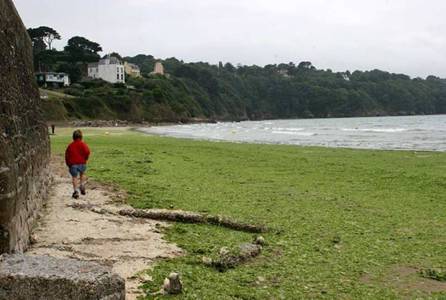
begin to want to swim in this bright green water shown in the photos of this
French algae bloom. In the bay of
Saint-Michel-en-Grève, samples have been taken which reveal a concentration
of hydrogen sulfide of about 1,000 parts per million (ppm). According to the newspaper Ouest-France, “one knows that above
500 ppm, the dose can be lethal.” The algae blooms are fed by
nitrates from agriculture and have been getting progressively worse for the
past thirty years in Brittany. The personnel charged with
cleaning up the algae on the beaches and treating it may be given portable
devices for measuring the risk of poisonous gas emissions, if the experts’
recommendations are followed. Those who raise pigs are
pointing the finger at those who use fertilizer, and vice versa. But Prime Minister Fillon will have none of
this blame game; he says the cause is a “conjugation of several factors.” Although “actions for modifying
agricultural practices accompanied by the enforcement inspections have permitted
some advances in certain areas, the results are not in rapport with the level
of efforts made,” according to Fillon. Time for improvement. After the horse died on the
beach of Saint-Michel-en-Grève, hundreds of people in the town demonstrated
in support of their mayor, René Ropartz,
A local emergency room doctor confirmed that in certain cases where
the algae is in a state of putrification, it can be deadly. The person riding the horse
lost consciousness but was saved by witnesses who responded rapidly. Other mayors in neighboring
towns came out to support Mayor Ropartz, too.
It seems that everyone, including the environmental organizations, is
blaming the prefect of the Côtes d’Armor, accusing the prefect of not having
taken steps to stop this pollution.
October 2007, the state of France was judged by the administrative
tribunal in Rennes as responsible for the green algae. According to Mayor Ropartz,
whose town has only 480 residents, his community must spend 150,000 euros
this year for cleaning up the algae.
“This issue has not even been approached by the Ministry of the
Environment, and the various French authorities have not listened to us,” the
mayor complains. Time for improvement. Pollution problems have also
stopped the collection of oysters in many areas, so at the Corsican
restaurant, I didn’t even think of shellfish.
Instead, I ordered the special of the day, a rose dorade filet served
with ratatouille. It was
delicious. Tom ordered a homemade
tagliatelle pasta dish with cêpes,
delicate little mushrooms. It, too,
was delicious. I had plenty of fish,
and so Tom shared that with me. We
also shared a fraisier for dessert
(strawberries layered with creamy pudding and spongecake). After dining in the air conditioned
comfort, we walked to the last half hour of air conditioned shopping at
Monoprix to pick up just a few grocery items.
As we walked home at 10PM, the air still felt like a hot, dry oven. This morning we were pleased
that a new packet arrived from New York with yet another copyedited chapter
of the next Norton Sampler. We were pleased this time because it was
sent overnight, not on three-day delivery.
Thank goodness people are starting to understand how important three
days can be when they give Tom deadlines to meet. It is also no fun to sit around for four
days, waiting, thinking that each day the next packet will arrive. Communication is almost always a good
thing. Work, work, work. But Paris is a great place to
do it. |
Thursday, August 20, 2009
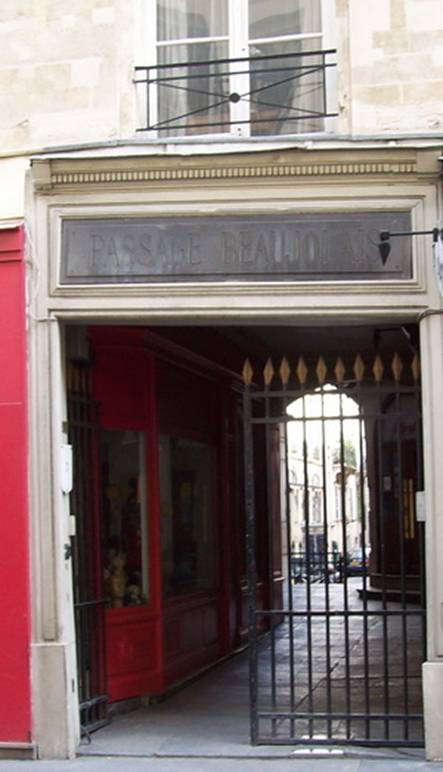
The Passage de Beaujolais near the Palais Royal is so
old (1812) that it leans to one side.
The beach at Ris covered by green algae. From what I read in the papers here, I
understand that the algae is removed from the beach when this happens, and
then it is treated. Photo by Olivier
Boitet.
Logo on the door of the institution on the avenue de la
Motte-Picquet for “The Most Grand Invalids of War.”
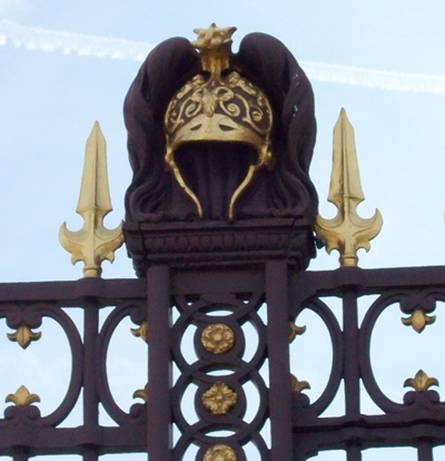
Decoration on the fence at the École Militaire. |