Paris Journal 2011 – Barbara Joy Cooley Home: barbarajoycooley.com
Photos
and thoughts about Paris
Sign
my guestbook. View
my guestbook. 2010 Paris Journal ← Previous Next
→ ← Go
back to the beginning
|
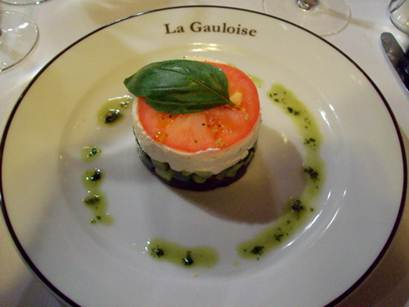
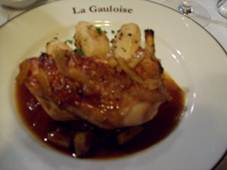
I caught up on my reading of the French newspaper, Le Parisien, so now I can share some interesting tidbits with you. Most interesting and useful is the article about all that is now forbidden in Paris this summer. The rules have changed, and you don’t want to be fined for misbehavior, so here’s my best attempt at translating and summarizing the confusing list of do’s and don’ts. Some of this involves things you can do in some places, but not in others. So you have to be aware of where you are. It is forbidden now to be on the Champs Élysées in any kind of state of undress. So, in the park-like part of the Champs, guys can no longer stretch out in the sun without a shirt. All sexual exhibition is punishable by a year in prison. However, it is not forbidden to wear a bathing suit there. Go figure. Generally, tanning or jogging bare-chested is not forbidden in the parks. No distinction is made between males and females in the article. “Racolage passif,” or solicitation by dressing provocatively and standing around, is punishable by a fine of 38 to 3,750 euros and two months of prison. Swimming or bathing in the Seine, lakes in the woods of Boulogne or Vincennes, the basin at la Villette, or the basin of the Arsenal (near Bastille) is forbidden. The fine is 38 euros. Alcohol is now banned in more places. Drinking in public is now forbidden between 9PM and 7AM in the Place Stalingrad, the Quai de la Loire, and even on the Champ de Mars. Now THAT will be difficult to enforce. The sale or take-out of alcohol is also forbidden in several neighborhoods between 10:30PM and 7AM. This has been the case in the Marais since 1983, and now it is true around La Villette (the northeast part of Paris), since July 4 of this year. Giant picnics and improvised parties are generally tolerated; however, with more than 30 people present, you must have special authorization. The tango sessions down on the Quai Saint-Bernard have been authorized now, but the number of participants must be limited. The outdoor parties that young people have in the grand park at Buttes-Chaumont and elsewhere now must end early. At 8:30 or 9:30PM, the parks close. Furthermore, the prefecture of police states that “it is forbidden to use the existing equipment in the green spaces in a way that they were not intended to be used.” In other words, you cannot sleep overnight on the park benches. It is forbidden to use barbeque grills that burn wood or charcoal on terraces or balconies. It is okay to use little electric barbeque grills, however. But if you have an outdoor barbeque party, you better not be too noisy. If you do have noisy parties repeatedly, you can be fined 450 euros. The journalist asked Guy Konopnicki, author of Silence de la Ville (Silence of the City), “In your book, you evoke with nostalgia the smoking, the racket, and the mixing of workshops and residential buildings. Is Paris dying?” Guy responded, “A certain Paris is moribund because of the disappearance of these industries and workshops. The petitions against the noise at Les Halles amused me. In this neighborhood, there are printers, prostitutes, all-night brasseries. Everyone leaves, but the inhabitants of the rue Montorgueil protest against what little noise remains. Parisians are becoming intolerant. They don’t put up with people smoking or talking loudly beneath the windows which they bought at high prices.” The journalist then asked, “Must Parisians renounce the right to sleep in peace?” Guy answered, “Why does silence become the right of the Capital and of the privileged people who live there? Paris is becoming a strange city where the residential erodes the active neighborhoods, anesthetizing them, imposing the laws and regulations of silence. But Paris remains the Capital and can never become a quiet little village.” Finally, the journalist asks, “Can one imagine a more festive Paris that is respectful of the hopes of its residents?” Guy responds, “One cannot conciliate the two. The celebrations strongly provoke the noise. It is the vice of the city government: City hall governs for the voters. Because those who have the right to vote are those who reside there. But there are twice as many people who work there and even more who go there for leisure. In wanting to suppress too many things, one risks eradicating liveliness. It is necessary to re-learn how to live together.” For balance, the journalist also interviewed Elisabeth Bourguinat, the spokesperson for the network called Vivre Paris (To Live Paris). Elisabeth supports the new prohibitions against the sale of take-out drinks at night. She says, “With the increase in the prices for consuming drinks in the clubs and bars at night, more and more of the young people are finding themselves in the streets with their pack of beers that they drink on the spot, next to the lively terraces.” Elisabeth is one of those people that Guy mentions – she lives near the former site of Les Halles. She questions whether the prefecture of police has the means to enforce the new rules. “Because,” she says, “I have never seen the police warn the noisy nighttime partiers.” In her eyes, “it is a public health problem because not only do the young people not know how to party without abusing alcohol, but, in addition, they ruin their ears in the night clubs. All with no regard for the residents who cannot sleep anymore. Sleep is a fundamental right.” Tom and I agree with Elisabeth, and we don’t even vote here. Other subjects in the news: Fifteen homeless families had taken up residence in the park called Square Boucicaut, in the chic 7th arrondissement next to Bon Marché. They were encouraged to do so by an organization called Droit du logement (Right to Housing). After they’d been there for 15 days, the police expelled them at 6AM last Friday morning. Square Boucicaut is where Tom and I stopped to use the sanisette on Tuesday afternoon. By the way, Cynthia mentions that she remembers using 1-franc sanisettes in 1988. I do think there were some earlier renditions of the pay sanisettes – my research turned up conflicting information about this matter. Accor is selling some of its big hotels in Paris, including the Sofitel Arc de Triomphe, to a group of French investors. Earlier this year, Accor also announced that it is giving up the Pullman Hotel at Bercy, and is going to do the same thing for the Pullman Hotel at Balard, in the lower 15th arrondissement. The hot spring weather was bad news for the chestnut trees of Paris. Plagued by a small caterpillar that lays its eggs in the leaves, these trees are turning brown prematurely again, as we’ve seen them do certain years in the past. The Keller public swimming pool has opened its retractable glass ceiling, and the adult swimmers are pleased because the noise made by the kids swimming there no longer amplifies and ricochets off the ceiling. Being open to the sky makes the pool quieter, and also releases a lot of that obnoxious chlorine smell. This pool is notable for being cleaner than most of the public pools. It is also in the 15th arrondissement. It is named for an engineer named Robert Keller, who was known for his work in telegraphs and telephones. He was part of the Resistance during the Occupation in the early 1940s. He tapped into the phone line that went from Paris to Strasbourg to Berlin, enabling the Resistance to listen to the Nazi communications. In 1942, he was denounced in an anonymous letter to the Gestapo, and then was deported to the Bergen-Belsen concentration camp in Germany where he died of typhus in April 1945. The Keller swimming pool is near the site of the tragic Vélodrome D’Hiver, about which I’ve written several times in this journal. Typhus, by the way, is a completely different disease from typhoid fever. Typhus at the Bergen-Belsen concentration camp was particularly bad. According to Wikipedia, “During World War II typhus epidemics killed inmates in the Nazi Germany concentration camps who were held in purposefully unsuitable hygiene conditions. Pictures of typhus victims' mass graves can be seen in footage shot at Bergen-Belsen concentration camp. Among thousands of prisoners in concentration camps such as Theresienstadt and Bergen-Belsen who died of typhus were Anne Frank at the age of 15 and her sister Margot. Many German POWs after the loss at Stalingrad also died of typhus. Even larger epidemics in the post-war chaos of Europe were only averted by the widespread use of the newly discovered DDT to kill the lice on millions of refugees and displaced persons.” Typhus is caused by lice; salmonella is the cause of typhoid fever. Speaking of fever, the annual country music festival is happened again last weekend in the French village of Craponne-sur-Arzon, in the Haute-Loire region south of here. This unlikely festival got started in 1988, with about 250 attendees. These days, it draws 20,000 to 25,000 people, many of whom dress up like American cowboys. The Country Music Association based in Nashville, Tennessee, considers this even to be “the best country music festival outside of the United States.” Did you know the French term for cowboy boots is “les santiags”? That’s it for the news for today. In the evening yesterday we decided to walk up to the Champ de Mars, buy the French newspaper, and walk all around the Champ, finally returning to dine at La Gauloise on the avenue de la Motte Picquet. We both were in the mood for supreme de vollaile, the best part of the chicken. I started with the petit gateau de legumes, which was not a cake at all. It was made from layers of cold, fresh marinated vegetables, beginning with a slice of eggplant on the bottom, topped with layers of diced vegetables of various kinds, topped with a delicious, smooth goat cheese, and finally capped with a perfect slice of marinated tomato. It was all nicely seasoned, and even had a bit of spiciness to it. Cold and fresh, it was a delightful summertime appetizer. The supreme de vollaile, likewise, was very well seasoned. This French food is not bland at all! The rich sauce was as salty as anything I’ve consumed in this country, and the mélange of pepper used in it was not the least bit bashful. Wow. Hats off to Chef Sebastien Carabeux. He’s hot. At least, his cuisine is. Tom finished with a couple scoops of excellent ice cream, one vanilla and one chocolate. When we entered the restaurant, the server who seated us asked if we wanted French or English menus. He seemed to remember that we prefer the French menu, even though we’re native speakers of English. The server assigned to our table, however, brought English menus when it was time to order dessert. She’s lived in Tuscon, where she did a pretty good job of perfecting her English and she wanted to use it with us. We ended up speaking a combination of the two languages. Fact is, we are accustomed to using French in restaurants, and the menus translated into English just confuse us. Her English, while good, is a little rough because she uses “false friends.” For example, she said “you have chance to be in Paris in the summer,” when she meant “you’re fortunate to be able to be in Paris for the summer,” or “you’re lucky to be able to be in Paris for the summer.” Chance, which means luck in French, does not mean luck or good fortune in English, even if it is a word in English as well as French. That, my friend, is known as a “false friend.” And if I were to use “fortune” instead of “chance” in making the statement that we are fortunate to be able to be in Paris in the summer, while speaking French, I’d be wrong, and I’d sound like I was saying we are wealthy and therefore able to be in Paris in the summer. Now that, my friend, is a VERY false friend. Sign
my guestbook. View
my guestbook. Note: For addresses & phone numbers of
restaurants in this journal, click
here. |
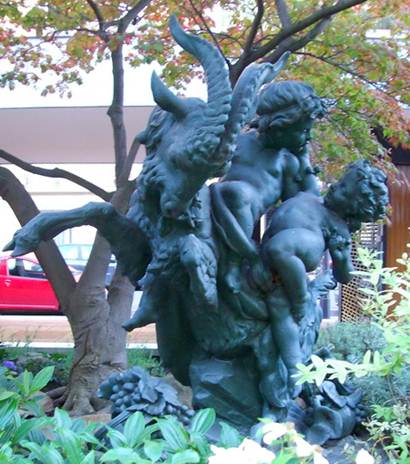
Sculpture in one
of the courtyard gardens of the Village Suisse, a commercial/residential
development that has plenty of pricey antique shops. It is a nice place to stroll through,
across from the fine restaurants La Gitane and La Gaulouise on the avenue de la Motte
Picquet.
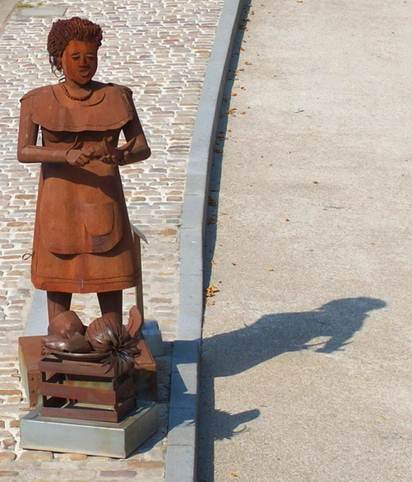
We found yet
another of the Carmona statues, near the Pont Mirabeau.
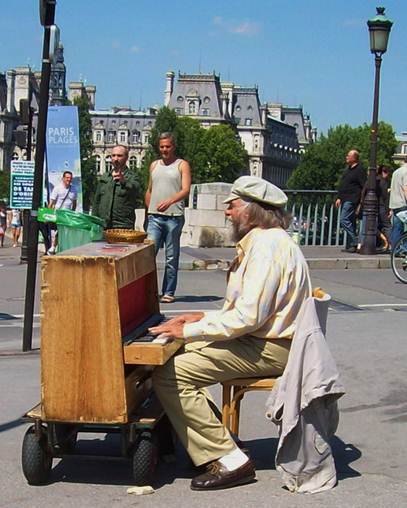
Keyboard player by
the Pont Saint Louis.
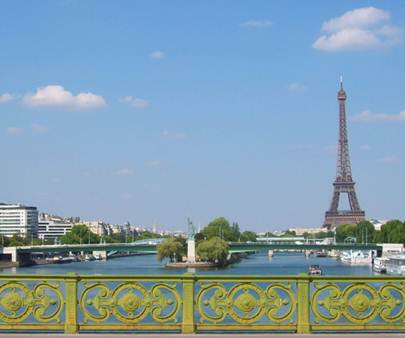
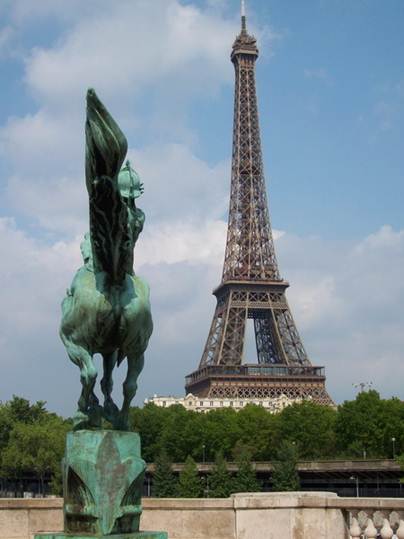
Rear view of La France Renaissante,
and the Eiffel Tower.
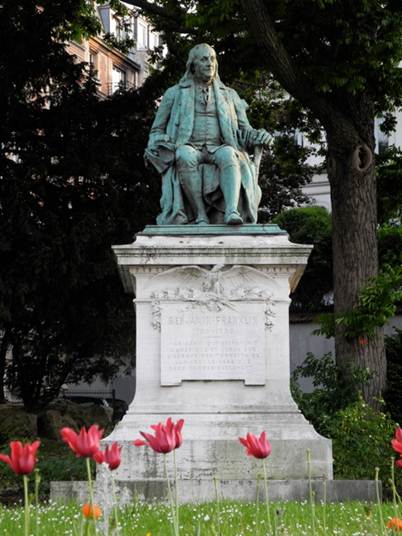
Ben Franklin
statue in the Square Yorktown.
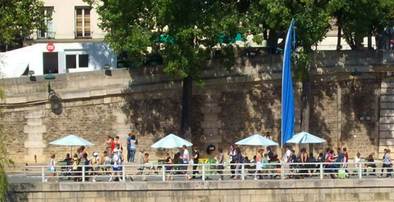
A small part of
the Paris Beach summertime attraction.
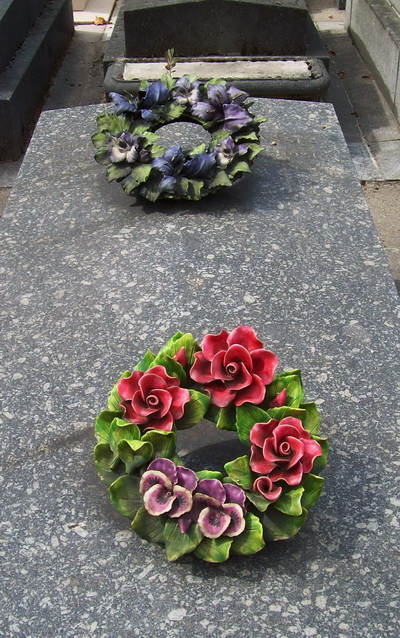
Ceramic flowers
decorate a tomb in the Grenelle cemetery.
The gateau de petits legumes at La
Gauloise. Below,
the supreme de volaille.
|